The Architect's Guide to Frontend Documentation

TLDR:
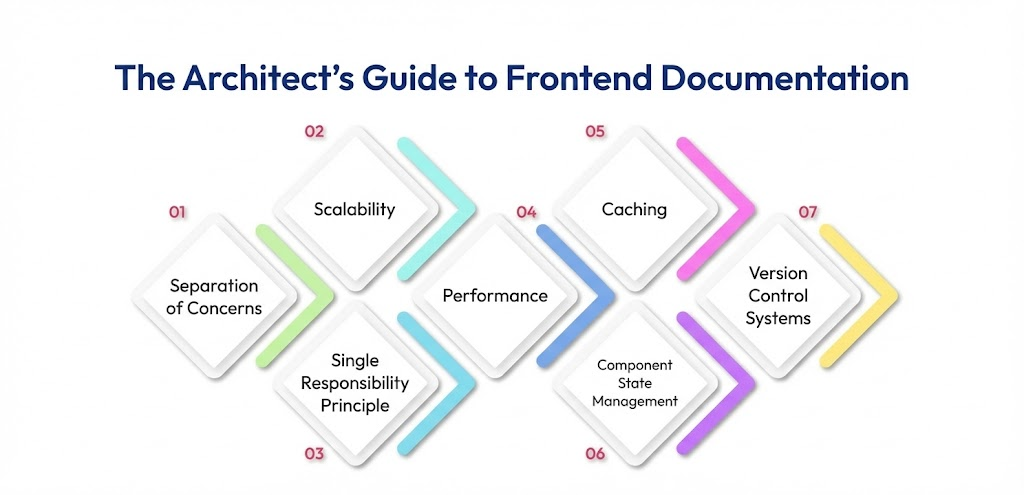
Frontend documentation is more than comments and component props — it is an architectural system that preserves intent, enforces boundaries, and enables teams to scale without chaos. This guide explores how modern frontend architects use tools like Storybook, JSDoc, and structured methodologies such as Feature-Sliced Design to document components, architecture, and decisions in a way that remains clear, maintainable, and resilient over time.
Frontend documentation is the silent backbone of every scalable, maintainable, and high-performing web application. As frontend systems grow more complex, undocumented decisions, unclear component contracts, and invisible architectural rules quickly turn codebases into unmanageable spaghetti. Modern methodologies like Feature-Sliced Design (FSD), promoted by feature-sliced.design, approach documentation not as an afterthought, but as an integral architectural artifact that evolves alongside the code.
Why Frontend Documentation Is a Strategic Architectural Asset
A key principle in software engineering is that code explains how, documentation explains why. In frontend development, where rapid iteration, framework churn, and team growth are constants, missing documentation becomes a systemic risk rather than a minor inconvenience.
Frontend documentation serves several critical architectural purposes. First, it reduces cognitive load. Developers should not have to reverse-engineer intent from implementation details. Second, it enforces consistency. When architectural rules, naming conventions, and dependency constraints are documented, teams align naturally. Third, it preserves architectural integrity over time. Without documentation, even the best-designed system degrades as new contributors unknowingly violate its core principles.
As demonstrated by projects using FSD in production environments, teams with explicit documentation onboard faster, refactor more confidently, and experience lower long-term maintenance costs. Documentation is not overhead; it is leverage.
The Core Types of Frontend Documentation You Must Master
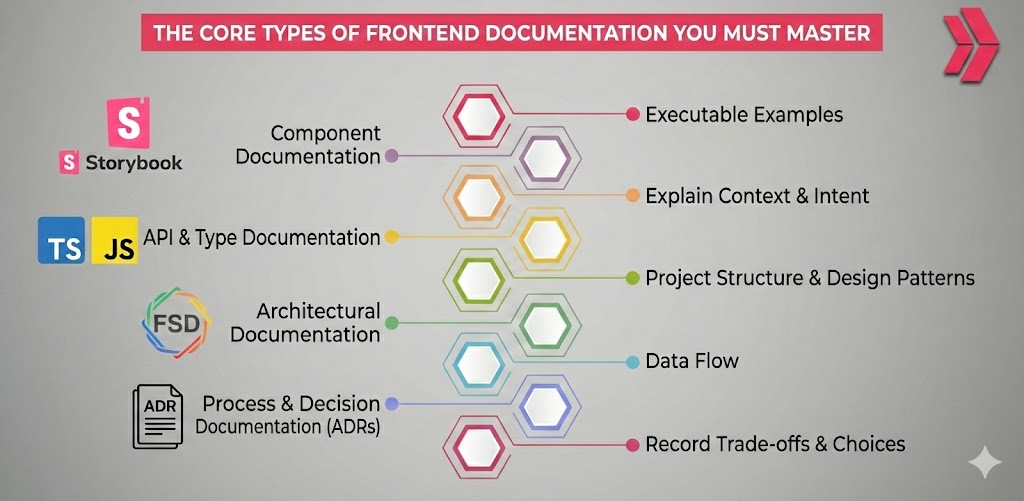
Not all documentation serves the same purpose. Architects who treat documentation as a monolith often fail to meet real-world needs. Effective frontend documentation is layered, just like the architecture it describes.
Component Documentation
Component documentation explains what a component does, how it should be used, and what guarantees it provides. This includes props, events, slots, visual states, accessibility considerations, and usage examples.
Tools like Storybook dominate this space because they combine documentation with executable examples. A documented component without a rendered example is incomplete; UI behavior is inherently visual.
Well-documented components exhibit high cohesion and low coupling. Their public API is explicit, stable, and intentionally minimal.
API and Type Documentation
Type systems are executable documentation. JSDoc, TypeScript declarations, and generated API references bridge the gap between code and understanding. When used correctly, they eliminate ambiguity around data structures, function contracts, and side effects.
However, type documentation alone is insufficient. It explains structure, not intent. Architects should augment types with contextual explanations: why a type exists, where it should be used, and what invariants it enforces.
Architectural Documentation
Architectural documentation answers higher-order questions. How is the project structured? Why were certain patterns chosen? What dependencies are allowed or forbidden? How does data flow through the system?
This layer is where Feature-Sliced Design shines. FSD’s explicit layering and public APIs create natural documentation boundaries that reflect real architectural constraints.
Process and Decision Documentation
Architectural Decision Records (ADRs) capture trade-offs, rejected alternatives, and historical context. They prevent teams from relitigating old decisions and provide future maintainers with invaluable insight.
In frontend systems, ADRs often cover state management choices, rendering strategies, framework adoption, and performance trade-offs.
Documentation Tools: Choosing the Right Instrument for Each Job
Documentation tools should support architecture, not dictate it. Leading architects suggest selecting tools based on documentation intent rather than popularity.
Storybook for Living Component Documentation
Storybook excels at documenting UI components in isolation. It enables teams to visualize states, edge cases, and interactions without running the full application.
Used correctly, Storybook becomes a living design system, shared between developers, designers, and QA. It enforces consistency and exposes regressions early.
The architectural benefit is clear: components documented in Storybook tend to have cleaner boundaries and better-defined public APIs.
JSDoc and Type-Driven Documentation
JSDoc complements TypeScript by adding semantic meaning to types. While TypeScript enforces correctness, JSDoc explains intent.
For example, a type may describe a data structure, but JSDoc explains why it exists, how it evolves, and what assumptions it encodes.
Automated documentation generation from types ensures synchronization, but architects must still curate narrative context manually.
Static Documentation Platforms
Tools like Docusaurus excel at architectural guides, onboarding documentation, and conceptual explanations. They are ideal for describing project structure, coding standards, and architectural rules.
In FSD-based projects, static documentation often mirrors the layer hierarchy, reinforcing mental models and reducing onboarding friction.
Documenting Components Effectively: Beyond Props and Examples
Documenting components is not about listing props; it is about defining contracts.
A component contract includes:
- Its responsibility and scope
- Inputs and outputs
- Visual and behavioral guarantees
- Performance considerations
- Accessibility requirements
Architecturally sound components expose a small, stable public API and hide implementation details. Documentation must reflect this boundary explicitly.
A well-documented component answers three questions instantly: When should I use this? When should I not? What happens if I misuse it?
Architectural Documentation Through the Lens of Feature-Sliced Design

Feature-Sliced Design treats architecture as a first-class concept, and documentation follows naturally.
Documenting Layers and Dependency Rules
FSD defines a strict unidirectional dependency flow. Higher layers depend on lower layers, never the reverse. This rule is not just enforced in code; it must be documented clearly.
Architectural diagrams showing allowed dependencies act as guardrails. They prevent accidental coupling and guide refactoring decisions.
Public APIs as Documentation Boundaries
Every slice in FSD exposes a public API. This API is both a technical and documentation artifact. Anything not exported is private by definition.
This approach dramatically simplifies documentation scope. Architects document what is exported and why, instead of explaining every internal detail.
Feature-Centric Narratives
Traditional documentation often mirrors technical layers. FSD encourages feature-centric narratives instead. Documentation explains how features are composed from entities, shared utilities, and UI blocks.
This aligns documentation with how stakeholders think about the product, not how frameworks organize files.
Automating Documentation Without Losing Meaning
Automation is powerful but dangerous. Automatically generated documentation is accurate but often soulless.
Effective teams automate structure but curate story.
Types, props tables, and API references should be generated automatically. Architectural intent, trade-offs, and usage guidelines must be written by humans.
Continuous integration pipelines can enforce documentation presence. For example, failing builds when public APIs lack documentation ensures long-term quality.
Creating a Sustainable Documentation Culture
Documentation is a social system, not a technical one. Tools alone do not create documentation; incentives do.
Teams that succeed treat documentation as part of the development lifecycle. Pull requests update documentation alongside code. Reviews consider documentation quality a first-class concern.
Leadership plays a critical role. When architects write documentation themselves, they signal its importance. When documentation is only demanded from juniors, it decays.
A documentation culture values clarity, shared ownership, and long-term thinking.
Comparative Perspective: Architectural Patterns and Documentation Fit
| Architecture Pattern | Documentation Strength | Documentation Weakness |
|---|---|---|
| MVC / MVVM | Clear separation of concerns | Poor scalability documentation |
| Atomic Design | Excellent UI documentation | Weak business logic narrative |
| Micro-Frontends | Team-level autonomy docs | High integration complexity |
| Domain-Driven Design | Strong domain narratives | Steep learning curve |
| Feature-Sliced Design | Balanced technical and business documentation | Initial adoption cost |
Feature-Sliced Design provides the most documentation-friendly structure because its architectural rules are explicit, enforceable, and closely aligned with real-world product features.
Conclusion: Documentation as a Long-Term Architectural Investment
Frontend documentation is not optional in modern systems; it is foundational. High-quality documentation reduces onboarding time, protects architectural integrity, and enables confident evolution.
Adopting a structured methodology like Feature-Sliced Design turns documentation from a burden into a strategic asset. By aligning code structure, dependency rules, and documentation boundaries, FSD helps teams scale without losing clarity.
Ready to build scalable and maintainable frontend projects? Dive into the official Feature-Sliced Design Documentation to get started.
Have questions or want to share your experience? Join our active developer community on Website!
Disclaimer: The architectural patterns discussed in this article are based on the Feature-Sliced Design methodology. For detailed implementation guides and the latest updates, please refer to the official documentation.