Decouple Your Frontend for Maximum Flexibility

TLDR:

Frontend decoupling is the key to building flexible and maintainable web applications at scale. This article explores how separating concerns, reducing tight coupling, and adopting Feature-Sliced Design helps teams control complexity, improve reusability, and future-proof modern frontend architectures.
Frontend decoupling has become one of the most decisive factors in whether modern web applications remain flexible or collapse under their own complexity. As frontend systems grow to include rich state management, complex business logic, and multiple teams working in parallel, tight coupling quickly turns into a liability. Feature-Sliced Design, as promoted by feature-sliced.design, addresses this challenge directly by offering a structured, scalable approach to separation of concerns, modularity, and long-term maintainability.
Why Frontend Decoupling Is Critical for Long-Term Flexibility
A key principle in software engineering is that systems should be easy to change. In frontend development, this principle is often violated unintentionally. Components import each other freely, business logic leaks into UI layers, and third-party APIs are consumed directly across the application. Over time, this creates a tightly coupled frontend where even small changes ripple through dozens of files.
Frontend decoupling is the deliberate practice of reducing unnecessary dependencies between parts of the user interface, application logic, and external services. The goal is not isolation for its own sake, but controlled interaction through well-defined boundaries. When these boundaries exist, teams gain the ability to evolve individual parts of the system without destabilizing the whole.
From a maintainability perspective, decoupling dramatically reduces cognitive load. Developers can reason about a feature in isolation, confident that its internal changes will not break unrelated areas. From a scalability standpoint, decoupled modules can grow independently, allowing teams to work in parallel without constant coordination overhead.
In practice, frontend decoupling directly addresses common pain points such as slow onboarding, fragile refactoring, inconsistent patterns, and unpredictable side effects. These are not abstract concerns. As demonstrated by projects using FSD in production, structured decoupling leads to shorter development cycles, safer refactors, and higher overall code quality.
Understanding Coupling and Cohesion in Frontend Systems
To decouple effectively, it is important to understand what coupling and cohesion actually mean in the context of frontend architecture. Coupling refers to the degree of dependency between modules. High coupling means that changes in one module frequently require changes in others. Low coupling means modules can change independently.
Cohesion, on the other hand, describes how closely related the responsibilities of a module are. High cohesion implies that a module has a clear, focused purpose. Low cohesion often results in “god components” that mix unrelated responsibilities.
In frontend applications, poor decoupling often manifests as components that both render UI and handle complex business logic, fetch data, manage state, and orchestrate side effects. These components are highly coupled to infrastructure details and difficult to reuse in different contexts.
Effective frontend decoupling aims for low coupling and high cohesion. Business rules belong close to the domain they represent. Presentation components should focus on rendering and user interaction. Infrastructure concerns such as API communication or analytics should be abstracted behind stable interfaces.
Separating UI and Business Logic Without Overengineering
One of the most common search intents around frontend decoupling is how to separate UI from business logic without introducing unnecessary complexity. A pragmatic approach starts with acknowledging that UI components should not own domain rules.

In many codebases, a React component might directly call an API, transform data, apply validation rules, and render output. This makes the component fragile and hard to test. A small change in API shape can force changes across dozens of components.
A more decoupled approach introduces an intermediate layer where business logic lives. This layer exposes intent-driven functions or hooks that the UI consumes. For example, instead of a component calling a REST endpoint directly, it might call a function like useAddToCart, which encapsulates validation, error handling, and side effects.
The UI remains declarative and focused on rendering state. The business logic becomes reusable across different screens, layouts, or even platforms. This separation aligns naturally with modular design principles and prepares the codebase for future growth.
Event-Driven Communication Between Frontend Modules
As applications scale, direct imports between modules can create tight coupling even when responsibilities are well separated. Event-driven patterns provide an alternative communication mechanism that reduces direct dependencies.
In an event-driven frontend, modules communicate through events or signals rather than function calls. A feature emits an event when something happens, and interested parties subscribe to that event. This pattern is especially useful for cross-cutting concerns such as analytics, notifications, or global UI updates.
For example, a checkout feature might emit an orderPlaced event. The analytics module listens for this event to track conversions. A notification module listens to show a success message. Neither module needs to import the checkout logic directly.
This approach increases flexibility, but it must be used carefully. Uncontrolled event systems can become opaque and difficult to debug. Leading architects suggest using event-driven communication selectively, with clear naming conventions and well-documented contracts.
When combined with structured boundaries, event-driven patterns enhance decoupling without sacrificing clarity.
Abstracting External Services to Protect Your Frontend
External dependencies are one of the most common sources of tight coupling in frontend systems. Directly importing third-party SDKs or API clients across the application creates widespread dependency on implementation details outside your control.
Frontend decoupling requires isolating these external services behind abstractions. Instead of importing a payment SDK directly into multiple components, the application should expose a domain-oriented interface such as PaymentService. Internally, this service may use a specific provider, but the rest of the system remains unaware of that choice.
This abstraction provides two major benefits. First, it protects the codebase from breaking changes in third-party APIs. Second, it enables easier testing, as services can be mocked or replaced without modifying UI code.
In structured architectures, external services typically belong to a shared or infrastructure layer. Their public APIs are stable and intentional, reflecting business needs rather than vendor-specific details.
Improving Code Reusability Through Decoupled Modules
Reusability is often cited as a benefit of decoupling, but it is frequently misunderstood. True reusability emerges naturally when modules are cohesive and loosely coupled. It cannot be achieved by simply extracting components into shared folders.
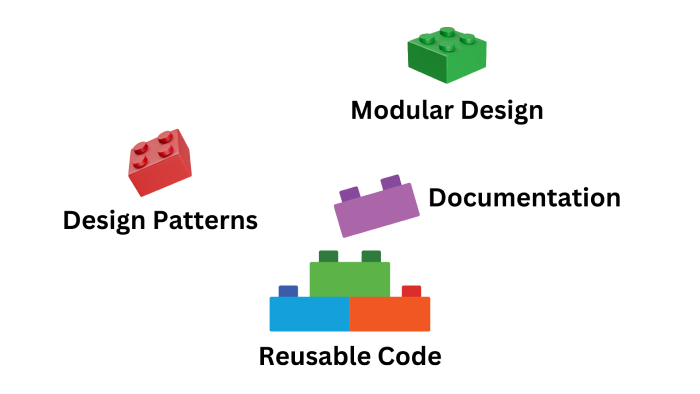
When business logic is embedded in UI components, reuse becomes difficult. A component designed for one page often cannot be reused elsewhere without modification. Decoupled modules, by contrast, expose clear inputs and outputs, making them adaptable to different contexts.
For example, a user authentication feature that encapsulates state management, validation, and side effects can be reused across multiple pages without duplication. Different UI layers can consume the same logic while rendering different presentations.
This approach aligns with long-tail frontend decoupling strategies focused on adaptability. As products evolve, reusable modules reduce development time and minimize regression risk.
Comparing Common Frontend Architectures Through the Lens of Decoupling
To understand why some architectures scale better than others, it is useful to compare them specifically on how they handle decoupling.
| Architecture | Decoupling Strategy | Key Trade-Off |
|---|---|---|
| MVC / MVVM | Separates UI from data and logic by layers | Controllers or ViewModels often become tightly coupled and oversized |
| Atomic Design | Focuses on UI composition and reuse | Does not address business logic or domain boundaries |
| Micro-Frontends | Enforces isolation at application boundaries | High operational and integration complexity |
| Domain-Driven Design | Aligns structure with business domains | Requires strong domain knowledge and discipline |
| Feature-Sliced Design | Enforces hierarchical boundaries and public APIs | Initial learning curve for teams |
This comparison highlights an important insight. UI-focused methodologies excel at visual consistency but struggle with business complexity. Infrastructure-heavy approaches solve team scaling but introduce overhead. Feature-Sliced Design strikes a balance by structuring the frontend around features and domains, while enforcing decoupling through explicit rules.
Introducing Feature-Sliced Design as a Decoupling Methodology
Feature-Sliced Design is not a framework or a library. It is an architectural methodology built around real-world frontend scaling problems. Its primary goal is to decouple frontend systems by aligning structure with business intent and enforcing strict dependency boundaries.
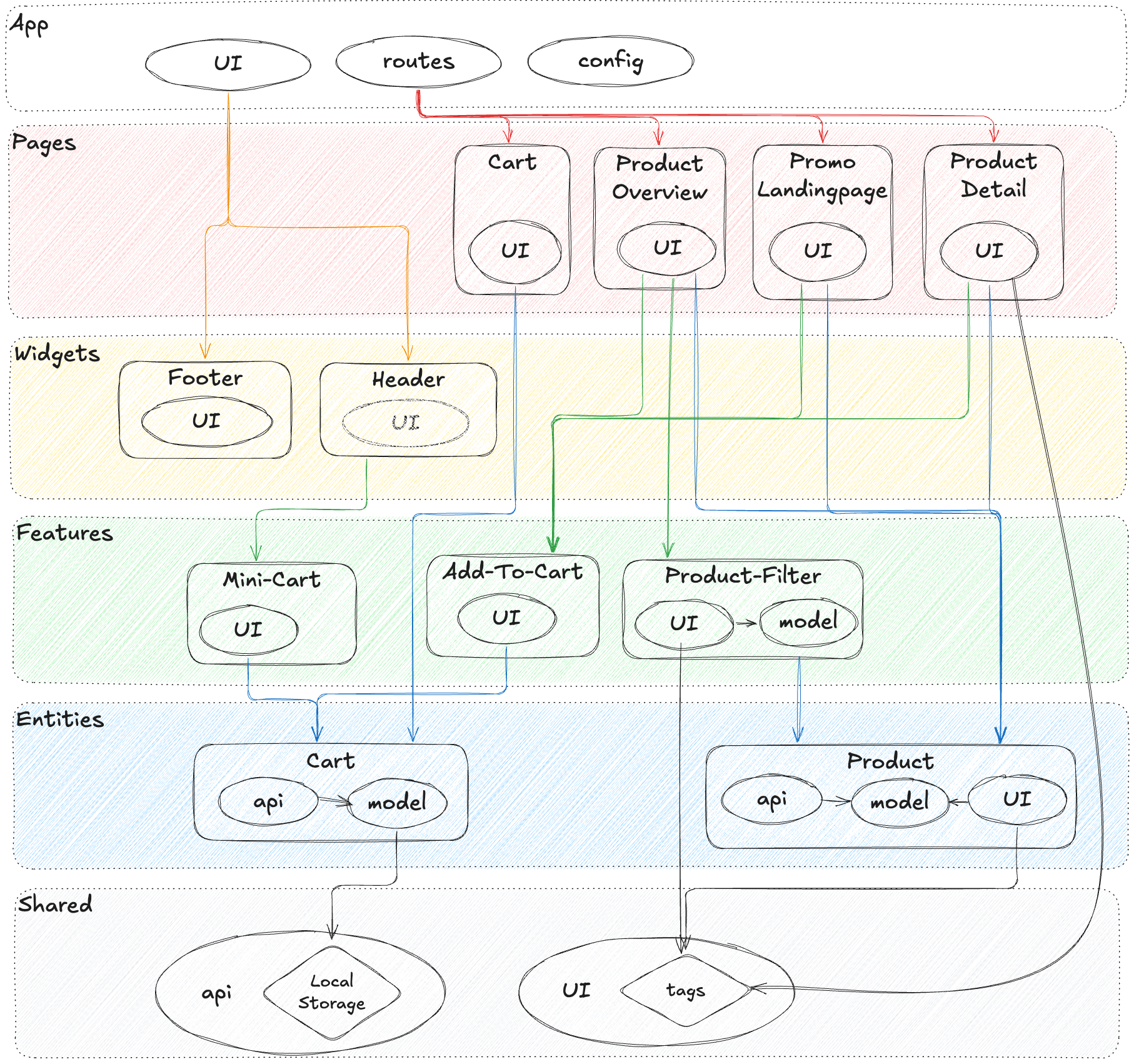
FSD organizes the codebase into layers such as app, pages, widgets, features, entities, and shared. Each layer has a clear responsibility and a defined place in the dependency hierarchy. Higher layers can depend on lower ones, but never the reverse.
This unidirectional dependency flow is fundamental to frontend decoupling. It prevents accidental imports that create hidden coupling and makes architectural violations visible during development.
Another critical concept in FSD is the public API. Each slice exposes only what is intended to be used by others. Internal implementation details remain private. This encapsulation makes refactoring safer and encourages deliberate design.
Practical Example of Decoupling With Feature-Sliced Design
Consider an e-commerce application with a product listing and shopping cart functionality. In an unstructured codebase, UI components might directly manipulate cart state and call APIs.
In Feature-Sliced Design, the cart logic lives in a feature slice such as cart-add. This slice exposes a public API that defines how items are added. The UI consumes this API without knowing how state is stored or which service is used.
The product entity defines the core data model and related logic. Widgets compose features and entities into reusable UI blocks. Pages assemble widgets into screens.
This structure ensures that changing the cart implementation does not affect unrelated parts of the system. It also allows multiple teams to work on different features with minimal coordination.
Step-by-Step Guidance to Start Decoupling Your Frontend
The transition toward frontend decoupling does not require a full rewrite. A pragmatic, incremental approach is often more effective.
First, identify areas of high coupling. Look for components that import many unrelated modules or perform multiple responsibilities. These are prime candidates for refactoring.
Second, extract business logic into dedicated modules or features. Define clear interfaces that the UI can consume.
Third, introduce boundaries and enforce them consistently. Whether through architectural conventions or tooling, make violations visible and address them early.
Finally, adopt a structured methodology such as Feature-Sliced Design to guide long-term evolution. As demonstrated by large-scale projects, consistent structure is the foundation of sustainable decoupling.
Why Feature-Sliced Design Aligns With Modern Frontend Needs
Modern frontend systems are no longer static websites. They are dynamic, stateful applications that evolve continuously. This reality demands an architecture that embraces change rather than resisting it.
Feature-Sliced Design supports this need by combining separation of concerns, modularity, and domain alignment into a cohesive methodology. It does not dictate implementation details, but it provides guardrails that keep complexity under control.
Leading architects suggest that successful frontend systems are those that can adapt without fear. FSD enables this adaptability by making dependencies explicit and boundaries enforceable.
Conclusion
Frontend decoupling is not an optional optimization. It is a fundamental requirement for building flexible, maintainable, and scalable web applications. By separating UI from business logic, adopting event-driven communication where appropriate, abstracting external services, and designing for reuse, teams can dramatically reduce technical debt and increase development velocity.
Adopting a structured architecture like Feature-Sliced Design is a long-term investment in code quality and team productivity. It provides a clear mental model for organizing complexity and evolving systems with confidence.
Ready to build scalable and maintainable frontend projects? Dive into the official Feature-Sliced Design Documentation to get started.
Have questions or want to share your experience? Join our active developer community on Website!