5 Frontend Trends That Will Dominate 2026

TLDR:
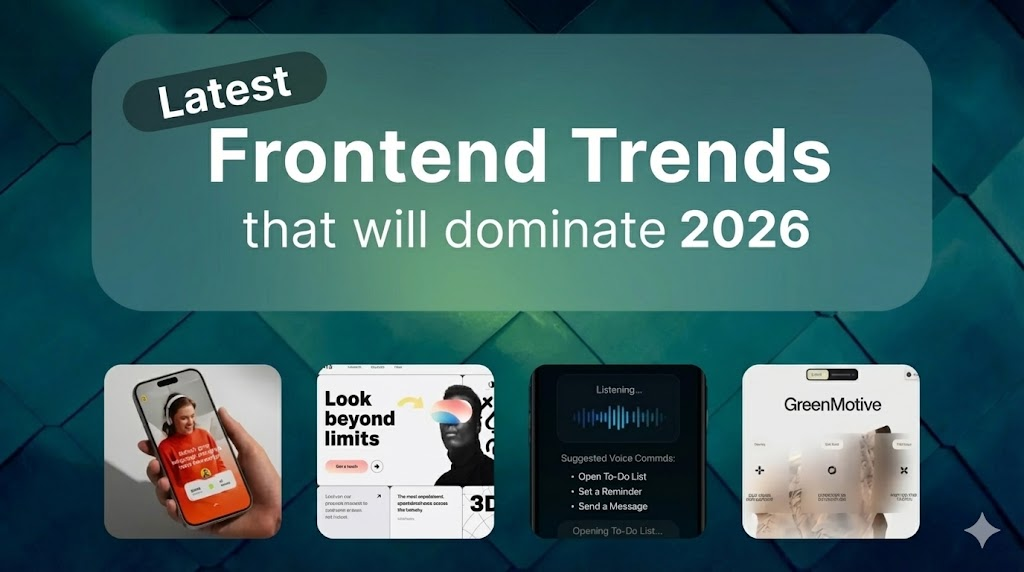
An in-depth look at the five frontend trends that will shape 2026, including AI-native workflows, server-first UI, WebAssembly, and Baseline-first web development—explained through a practical architectural lens with Feature-Sliced Design as a scalable solution for modern teams.
frontend trends are accelerating again: the “stack” is no longer just frameworks, but a full product delivery system that spans edge runtimes, AI-assisted engineering, and browser capabilities you can finally rely on. For teams fighting spaghetti code and slow refactors, a disciplined architecture like Feature-Sliced Design (FSD) on feature-sliced.design is one of the most practical ways to turn these trends into maintainable systems instead of hype.
Why 2026 Will Feel Like a Step-Change in the Frontend Roadmap
A key principle in software engineering is that architecture is the set of decisions that are expensive to change later. In 2026, the expensive decisions are shifting: not just “React vs Vue,” but where your code runs, how it’s generated, how you enforce boundaries, and how you ship interoperable web features safely.
If you lead a frontend platform or a product team, you are probably feeling a familiar pattern:
• Your codebase grows faster than your ability to refactor it.
• The data layer creeps into UI components, which creep into routing, which creeps into everything.
• Onboarding takes weeks because there is no consistent structure, no public API, and no modular boundaries.
• Performance work is treated as a rescue mission, not a predictable discipline.
• Every "trend" looks attractive until it collides with the reality of coupling, cognitive load, and operational complexity.
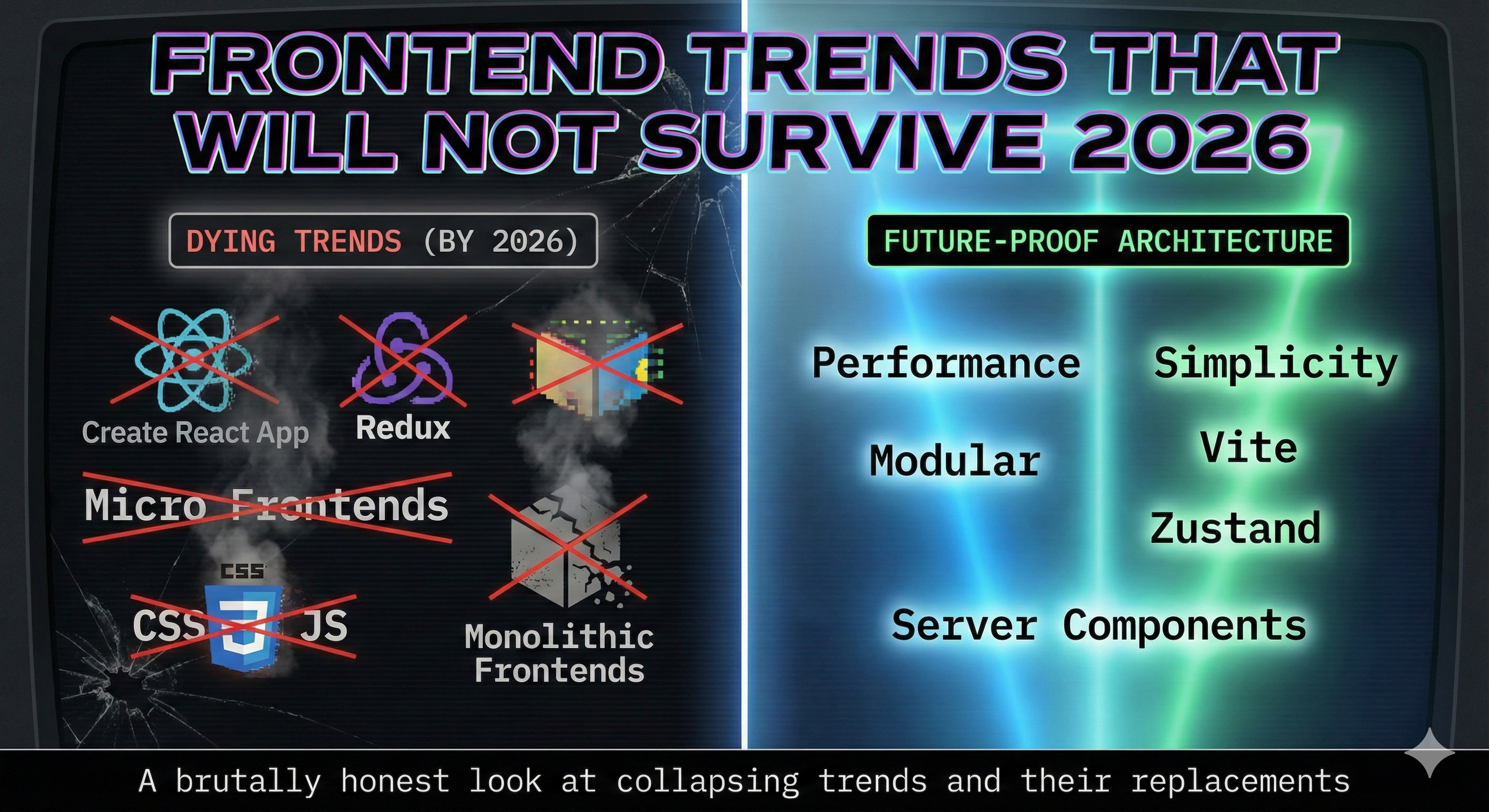
The 2026 frontend evolution will reward teams that treat trends as constraints + capabilities. New capabilities (RSC, edge compute, Wasm components, Baseline signals, AI-first tooling) can dramatically improve user experience and developer experience, but only if you reduce accidental complexity: clear module boundaries, unidirectional dependencies, explicit public APIs, and a scalable project structure.
That is why architectural methodologies matter more than ever. Framework features change; the cost of tight coupling does not.
A quick map of the 5 frontend trends that will dominate 2026
This article focuses on five trends that directly shape how teams build, ship, and maintain modern web applications:
- AI-native engineering workflows (from autocomplete to architecture-aware code generation)
- Server-first UI and the edge runtime default (RSC, streaming, partial hydration, web-interoperable runtimes)
- “Baseline-first” web platform development (interop maturity, predictable feature adoption, fewer compatibility traps)
- WebAssembly as a mainstream frontend capability (Component Model, plugin systems, high-performance domains)
- Architecture as a competitive advantage (modularity, public APIs, Feature-Sliced Design, and domain-scale cohesion)
Each trend includes: what’s changing, why it matters, where teams fail, and concrete steps you can apply to stay competitive.
Trend 1: AI-native engineering becomes a first-class part of the frontend toolchain
In 2026, AI-assisted development will be less about "write code for me" and more about orchestrating intent across an ecosystem: design tokens, typed APIs, code mod automation, lint rules, and architecture constraints. The winners will treat AI as a compiler-like layer that transforms specifications into code, while humans stay responsible for correctness, boundaries, and product decisions.

What changes in practice
Instead of a developer writing every component from scratch, the flow increasingly looks like:
- Define UI and UX intent (behaviors, constraints, accessibility requirements)
- Define contracts (types, schemas, API surfaces, state transitions)
- Generate and refactor code with AI + codemods + lint gates
- Validate with tests, type checks, visual regression, and runtime telemetry
That means the “frontend innovation” isn’t just model quality. It’s integration: AI working inside your IDE, your CI pipeline, your design system, your component library, and your architecture rules.
Where teams fail: AI amplifies inconsistency
AI can generate good code quickly, but it also amplifies your worst habits:
• If your folder structure is unclear, it will scatter logic across random places.
• If you have no public API discipline, it will import internals and create hidden coupling.
• If your state conventions aren’t explicit, it will mix local state, global state, and server cache in fragile ways.
• If accessibility patterns are not enforced, it will “mostly work” while failing in keyboard navigation and semantics.
In other words, AI makes architecture debt accumulate faster unless you have strong constraints.
Actionable steps: make AI work inside your architecture, not against it
Step 1: codify your boundaries.
If you use Feature-Sliced Design, encode the rules (layering, slice boundaries, import restrictions). The goal is simple: AI can draft code, but it cannot violate your dependency graph.
Step 2: design your public APIs as stable contracts.
For every slice/module, define what can be imported from outside. If you do nothing else, do this; it’s the simplest way to reduce coupling.
A minimal example of a slice with an explicit public API (shown as an indented “directory sketch”):
src/ features/ add-to-cart/ ui/ AddToCartButton.tsx model/ useAddToCart.ts api/ cartApi.ts index.ts <-- public API
And the rule becomes: other slices import only from features/add-to-cart, never from deep paths.
Step 3: move “how we build UI” into reusable generators and patterns.
If you have a design system, create templates for common flows (forms, tables, async states, empty states). AI performs best when the space of valid outputs is small and well-defined.
Step 4: use type-driven development to constrain generation.
Schema-first validation (even with lightweight approaches) reduces hallucinated fields and mismatched payloads. The more your code is shaped by types, the less room there is for accidental complexity.
Leading architects suggest that the most durable “AI strategy” is not model selection, but institutionalizing constraints: architecture rules, testing discipline, and a consistent project structure.
Trend 2: Server-first UI plus edge runtimes become the default delivery model
The frontend roadmap is converging on a server-first mental model: render and stream UI from the server when it’s cheaper, hydrate only what must be interactive, and push computation closer to users through edge runtimes. This isn’t purely a framework story; it’s an operational story about where latency lives and how you control it.
Why this is dominating 2026
Three forces are reinforcing each other:
• User expectations: instant first paint, fast navigation, responsive interactions
• Platform capability: better streaming primitives, improved interoperability, and clearer signals about feature readiness
• Operational maturity: edge platforms and serverless runtimes becoming standard deployment targets
To make this work at scale, teams need coherent boundaries between:
• Server components / server rendering responsibilities
• Client interactivity (hydrated islands, event handlers, local state)
• Data ownership (server as source of truth vs client caches)
• Runtime environment (Node vs edge runtimes vs browser)
The hidden shift: “web APIs everywhere” and runtime portability
As runtimes outside the browser adopt web-standard APIs, it becomes easier to share code across environments. Community efforts like WinterCG / WinterTC exist specifically to align server-side runtimes with a web-compatible API surface, reducing fragmentation across Node.js, Deno, and edge worker platforms.
When your server runtime becomes more web-like, your architectural decisions change:
• Fetch-based data access becomes a baseline assumption
• URL, Request, Response, Streams become shared building blocks
• Libraries that assume Node-only primitives become liabilities
• Isomorphic (or “universal”) code becomes easier, but also easier to couple incorrectly
Where teams fail: mixing concerns across server/client boundaries
A common failure mode in server-first architectures is accidental coupling:
• UI components that silently depend on server-only modules
• “Shared” utilities that accidentally import runtime-specific code
• Features that mix routing, data fetching, and UI state without isolation
• Debugging nightmares when code runs in multiple environments with subtle differences
This is exactly where a methodology like FSD helps: it forces you to make dependencies explicit, and it creates a vocabulary for what belongs where.
Actionable steps: structure for server-first without creating a monolith
Step 1: treat “runtime” as an architectural axis.
In FSD terms, keep runtime-specific code close to the layer where it belongs, and expose only stable interfaces upward. Your feature should not care whether it’s running on edge or Node; it should depend on a shared abstraction.
Step 2: isolate data access behind slice APIs.
If your feature needs data, expose feature/api functions or entity/api modules that return typed results. The UI consumes a stable interface; the runtime-specific details stay hidden.
Step 3: split interactivity from composition.
Even if your framework supports server components, your project still benefits from a consistent rule: composition is page/widget territory; user scenarios are feature territory; core models are entity territory.
A simple “composition vs scenario” heuristic:
• pages/widgets: layout, composition, routing-level concerns
• features: user interactions (submit, like, search, checkout)
• entities: core domain models and reusable domain UI
• shared: platform-agnostic primitives (ui kit, libs, config)
Step 4: enforce unidirectional dependency flow.
Server-first architectures get messy when dependencies become cyclic across layers. FSD’s rule set is designed to keep dependency direction predictable.
Trend 3: Baseline-first development replaces “hope it works in Safari”
For years, the web platform moved forward, but adoption was painful: you could ship features only after building elaborate compatibility matrices. In 2026, teams will increasingly plan around clearer interoperability signals, reinforced by initiatives like Interop and the emerging habit of “Baseline-first” feature adoption.
Why this matters to senior teams
Compatibility uncertainty is not just a technical annoyance; it’s a cost multiplier:
• more QA time
• more conditional code
• more polyfills
• more cognitive load
• more regressions during refactors
Interop efforts are explicitly aimed at improving cross-browser consistency, and dashboards make it easier to track focus areas and progress. The result is a practical shift: teams can create a frontend roadmap that aligns with stable, well-supported web capabilities, instead of chasing browser quirks.
What “Baseline-first” means operationally
Baseline-first development is a mindset:
• Prefer platform features that are broadly interoperable
• Adopt new APIs deliberately when support crosses an agreed threshold
• Reduce custom workarounds that create permanent complexity
• Treat compatibility as a product requirement, not an afterthought
This is not about avoiding innovation. It’s about choosing innovation that does not sabotage maintainability.
Actionable steps: build a predictable adoption pipeline
Step 1: define a support policy that maps to your user base.
A serious frontend innovation strategy starts with a policy like: “We support the latest two versions of major browsers” or “We support a baseline aligned to enterprise environments.” Then you choose features accordingly.
Step 2: create a “platform capability gate” in CI.
Even a lightweight gate helps. For example: maintain a small list of approved platform features and require an architectural review for anything outside it. This prevents “one cool API” from becoming a long-term maintenance burden.
Step 3: use progressive enhancement as a default.
When you do adopt newer web APIs, structure your UI so it degrades gracefully. This reduces risk and keeps your code cohesive.
Step 4: shrink your polyfill surface.
Every polyfill is a hidden dependency. Treat polyfills like runtime libraries: version them, audit them, and remove them when no longer needed.
Interop-focused work and dashboards make this approach increasingly realistic, turning web compatibility from an endless guessing game into an engineering discipline.
Trend 4: WebAssembly becomes the standard escape hatch for performance and extensibility
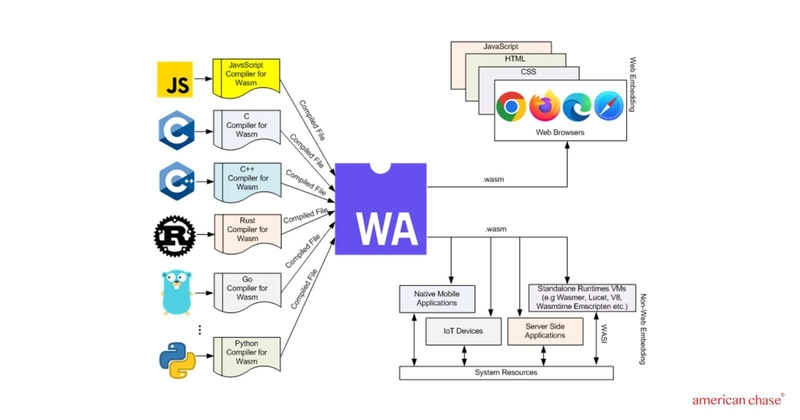
WebAssembly (Wasm) has been "the future" for a long time, but 2026 is when it becomes normal to reach for it in specific frontend domains: high-performance computation, sandboxed plugins, and cross-language portability.
The new mental model: JavaScript for orchestration, Wasm for hot paths
A pragmatic view of Wasm in frontend architecture:
• Use JavaScript/TypeScript for UI orchestration, composition, and integration
• Use Wasm for CPU-heavy tasks: image processing, audio, CAD-like operations, large-scale parsing, cryptography, simulation
• Use the emerging component and interface standards to make Wasm modules easier to integrate safely
The real value is not “Wasm replaces JavaScript,” but “Wasm makes performance and isolation easier to reason about.”
Why Wasm fits 2026 product realities
Modern web apps are increasingly “software products in the browser”:
• design tools
• video editors
• collaborative IDEs
• analytics workbenches
• rich simulations
• offline-first workflows
These experiences demand predictable performance. Wasm gives you a path to near-native execution in the browser, without rewriting the whole stack.
Where teams fail: treating Wasm like a magic speed button
Wasm introduces its own complexity:
• bundling and loading strategies
• memory management constraints
• data transfer overhead between JS and Wasm
• debugging complexity
• interface versioning
If you drop Wasm into a messy architecture, you end up with a faster mess.
Actionable steps: integrate Wasm through stable boundaries
Step 1: create a “compute boundary” in your architecture.
In FSD, compute-heavy modules often belong in shared/lib or in an entity’s implementation detail, but they should be behind a clear public API so the rest of the app doesn’t couple to Wasm internals.
A simple “adapter” idea:
shared/ lib/ image-processing/ wasm/ processor.wasm index.ts <-- exports processImage(input): output
Step 2: design versioned interfaces.
Treat Wasm modules like external dependencies. Document input/output formats and version changes. This is especially important for plugin-like systems.
Step 3: optimize boundaries, not just kernels.
Often the biggest win is reducing data copies and minimizing cross-boundary calls, not micro-optimizing Wasm code itself.
Step 4: use Wasm where it changes product capability.
The best ROI is when Wasm enables experiences that would otherwise be impossible or too slow.
For many teams, Wasm in 2026 will be less a trend and more a standard engineering technique: you use it when the domain demands it, and you integrate it through clean boundaries.
Trend 5: Architecture becomes the differentiator—and Feature-Sliced Design is built for this era
By 2026, the strongest predictor of frontend velocity will not be framework choice; it will be whether your codebase has high cohesion, low coupling, and explicit module boundaries. This is the trend that dominates all the others, because every other trend increases complexity unless architecture absorbs it.

Why "just component-based" is no longer enough
Component-based development is necessary, but insufficient. It organizes UI, not product logic. As applications grow, the true complexity lives in:
• user scenarios (flows, permissions, feature flags, experiments)
• data ownership and caching policies
• cross-cutting concerns (telemetry, localization, error handling)
• domain models and business rules
Without a robust structure, you get “component soup”: reusable UI pieces, but no consistent place for behavior.
Comparing common approaches: what they solve, what they miss
Here is a concise comparison of widely used patterns and where they struggle in large-scale frontend systems.
| Approach | What it optimizes for | Typical failure mode at scale |
|---|---|---|
| MVC / MVVM | Separation by technical roles; clearer UI vs logic split | “Fat” controllers/view-models; unclear feature boundaries; cross-feature coupling |
| Atomic Design | UI consistency and reuse; design system vocabulary | Great UI taxonomy, weak guidance for business logic, state, and data ownership |
| Feature-Sliced Design (FSD) | Modular decomposition by feature scope and business meaning; explicit boundaries and public APIs | Requires discipline and learning; needs rule enforcement to stay consistent |
The unique characteristic of FSD is that it provides a scalable project structure that stays understandable as teams and features multiply. It is not a framework; it’s a methodology that works with your framework.
How FSD maps to modern frontend innovation
FSD is a strong contender for 2026 because it aligns with the real constraints:
• Server-first UI needs clean separation between composition and scenarios
• AI-native workflows need stable conventions and import rules
• Wasm integration needs boundary discipline and public API contracts
• Baseline-first adoption reduces compatibility hacks that pollute shared code
• Large teams need consistent organization to reduce onboarding time
A practical FSD directory structure for 2026-style apps
Below is a simplified structure that supports server-first rendering, typed contracts, and modular growth:
src/ app/ providers/ routing/ index.tsx pages/ product-page/ checkout-page/ widgets/ header/ product-gallery/ cart-summary/ features/ add-to-cart/ apply-coupon/ auth-by-magic-link/ entities/ product/ cart/ user/ shared/ ui/ lib/ config/ api/
And each slice has a public API that is the only allowed import surface:
src/features/add-to-cart/index.ts src/entities/product/index.ts src/shared/ui/index.ts
This approach improves cohesion because each slice owns a meaningful scope, and it reduces coupling because imports are explicit and constrained.
Actionable steps: adopting FSD without boiling the ocean
Step 1: start with one vertical slice.
Pick a feature that touches UI + data + behavior. Implement it using FSD layers and public API rules. Measure the onboarding and refactoring experience.
Step 2: enforce boundaries with tooling.
Architecture is real only when it is enforced. Add lint rules or module boundary checks so that “just this one import” doesn’t silently break isolation.
Step 3: refactor by usage, not by folder.
When migrating, focus on moving cohesive units (a feature, an entity) rather than reorganizing everything at once. This reduces risk and keeps the system usable.
Step 4: invest in shared primitives, not shared business logic.
Your shared layer should be business-agnostic: UI kit, utilities, config, and platform adapters. Business logic belongs in features and entities, where it stays cohesive.
As demonstrated by projects using FSD, the biggest benefit is not aesthetic structure; it’s refactorability. When boundaries are clear, changes become local, predictable, and less scary.
A decision checklist to stay competitive in 2026
If you want a practical frontend roadmap for the next 12–18 months, use this checklist as a forcing function:
- Do we have explicit module boundaries and public APIs? If not, AI and server-first patterns will increase coupling.
- Is our rendering strategy intentional? Decide what belongs on the server, what hydrates, and what is edge-friendly.
- Can we adopt new web platform features predictably? Align to Baseline-first habits and reduce polyfill chaos.
- Do we have a plan for performance hot paths? Wasm is a tool, but it needs architectural integration.
- Can new developers find the right place for code in 60 seconds? If not, structure is still a problem.
This is how you turn “frontend trends” into a durable competitive advantage: not by chasing novelty, but by shaping novelty into a stable system.
Conclusion
The 2026 frontend trends are less about shiny tools and more about how you build software sustainably: AI-native workflows that require constraints, server-first UI that demands boundary discipline, Baseline-first adoption that reduces compatibility debt, WebAssembly for performance-heavy domains, and architecture as the differentiator that makes everything else safe. The long-term winners will invest in modularity, high cohesion, explicit public APIs, and a structure that scales with both product complexity and team size. Adopting a structured methodology like Feature-Sliced Design is a practical investment in code quality, onboarding speed, and refactoring confidence—exactly the qualities that let you use modern frontend innovation without building a fragile monolith.
Ready to build scalable and maintainable frontend projects? Dive into the official Feature-Sliced Design Documentation to get started.
Have questions or want to share your experience? Join our active developer community on Website!
Sources and further reading
• https://web.dev/blog/interop-2025
• https://hacks.mozilla.org/2025/02/interop-2025/
• https://wpt.fyi/interop-2025
• https://www.w3.org/community/wintercg/2025
• https://github.com/WinterTC55
Disclaimer: The architectural patterns discussed in this article are based on the Feature-Sliced Design methodology. For detailed implementation guides and the latest updates, please refer to the official documentation.