The Art of Abstraction in Frontend Development

TLDR:
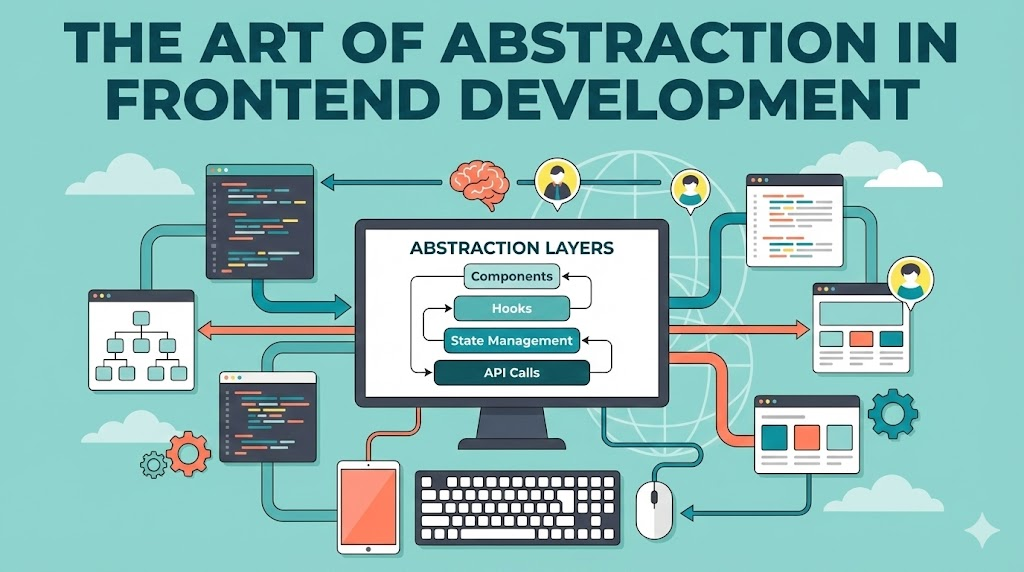
Frontend abstraction is the foundation of scalable and maintainable web applications. This article explores how to design effective abstraction layers, avoid over-engineering, improve testability, and apply Feature-Sliced Design to structure large frontend codebases with confidence.
Frontend abstraction sits at the heart of every scalable and maintainable user interface, yet it remains one of the most misunderstood principles in modern frontend engineering. As applications grow in size and complexity, unstructured abstractions lead to tight coupling, fragile code, and spiraling technical debt. Modern methodologies such as Feature-Sliced Design, documented at feature-sliced.design, provide a pragmatic and battle-tested approach to mastering abstraction without falling into the trap of over-engineering.
Why Frontend Abstraction Is Critical for Maintainable Applications
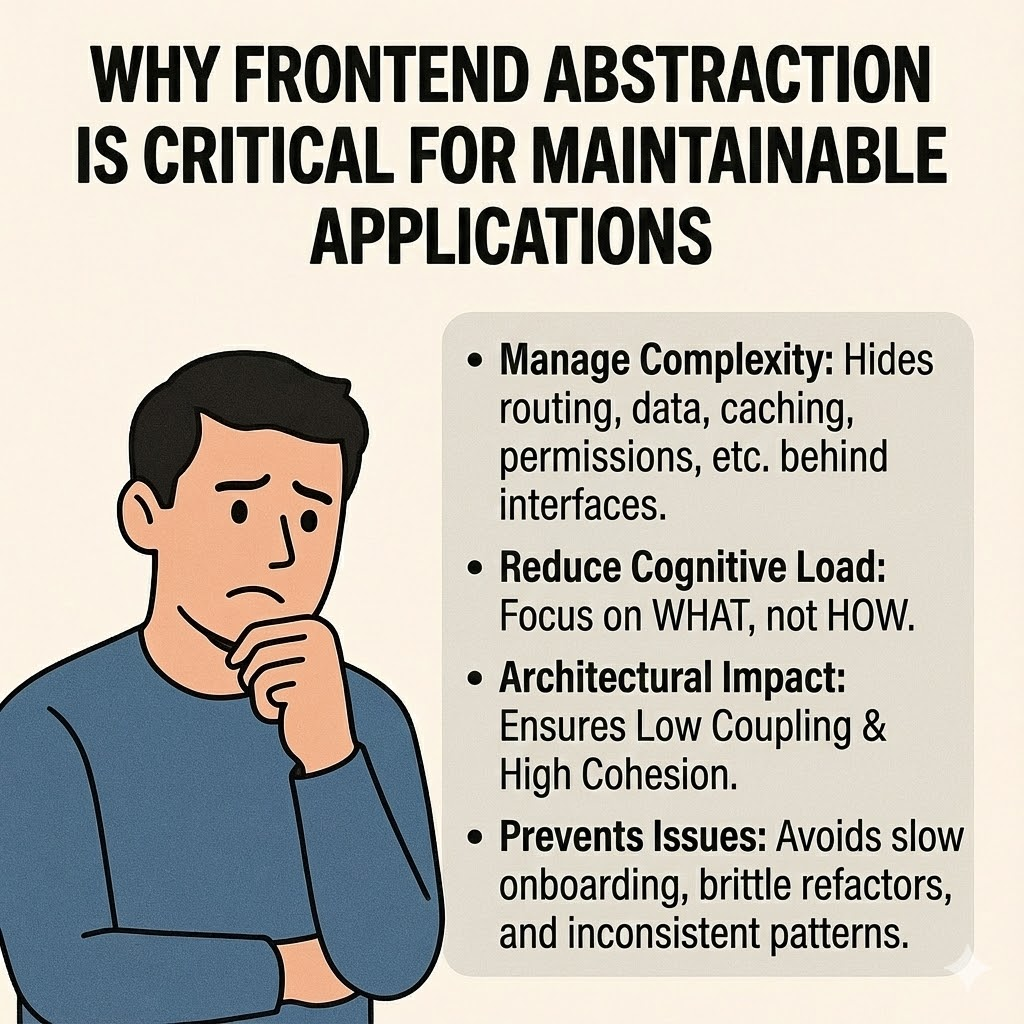
A key principle in software engineering is that complexity must be managed, not eliminated. Frontend systems today handle routing, data fetching, caching, permissions, feature flags, and non-trivial business rules. Without abstraction, these concerns bleed into UI components, making even simple changes risky and time-consuming.
Frontend abstraction is the deliberate act of hiding complexity behind stable, well-defined interfaces. The goal is not to reduce code, but to reduce cognitive load. When abstractions are applied correctly, developers reason about what the system does rather than how every detail works.
From an architectural standpoint, abstraction directly influences coupling and cohesion. Low coupling ensures that changes in one part of the system do not ripple unpredictably across the codebase. High cohesion ensures that related logic lives together and evolves together. These two forces are the foundation of maintainable frontend systems.
In practice, teams that neglect abstraction often experience slow onboarding, brittle refactors, and inconsistent patterns across features. Over time, the frontend becomes a liability instead of a competitive advantage.
Understanding Abstraction Layers in Frontend Systems
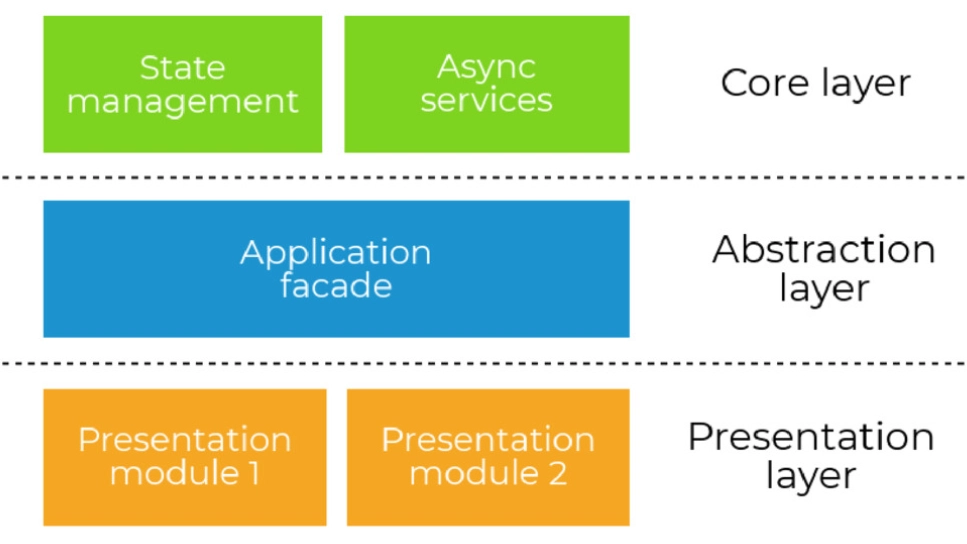
Abstraction layers are not about adding indirection for its own sake. They are about establishing clear responsibility boundaries. In frontend development, abstraction layers typically emerge around data access, business logic, state management, and presentation.
A common example is the separation between UI components and data-fetching logic. When components directly call HTTP clients or parse API responses, they become tightly coupled to backend contracts. By introducing an abstraction layer, such as a service or repository, the component depends on an interface rather than an implementation.
This principle applies equally to third-party libraries. Direct usage of libraries like Axios, React Query, or date manipulation utilities throughout the codebase creates implicit dependencies. Wrapping them in internal abstractions allows teams to change or upgrade dependencies with minimal friction.
Well-designed abstraction layers also improve testability. Mocking a service interface is significantly easier than mocking low-level APIs scattered across components. This leads to faster and more reliable unit tests, which in turn increase confidence during refactoring.
Separation of Concerns as the Foundation of Abstraction
Separation of concerns is the philosophical backbone of frontend abstraction. Each part of the system should have a single, well-defined reason to change. UI components should focus on rendering and interaction, not data orchestration or business rules. Business logic should be reusable and independent of rendering details.
In many legacy frontend projects, concerns are mixed due to short-term delivery pressure. A component fetches data, transforms it, manages loading state, handles errors, and renders markup. While this may work initially, it quickly becomes unmanageable as requirements evolve.
Abstraction allows teams to pull these concerns apart. Data fetching moves into services or hooks. Business rules move into domain-specific modules. UI components become thin and declarative. This separation creates a system that can evolve incrementally rather than requiring disruptive rewrites.
Feature-Sliced Design formalizes separation of concerns by aligning abstractions with business domains and feature boundaries rather than technical layers alone. This alignment significantly reduces accidental complexity.
What to Abstract in a Frontend Codebase
Not everything deserves an abstraction. A critical skill for senior frontend developers is identifying what to abstract and when. The most common candidates are API access, shared business logic, cross-cutting concerns, and third-party integrations.
API services are a prime example. By abstracting API calls behind a service layer, the rest of the application becomes resilient to backend changes. Response normalization, error handling, and authentication logic can be centralized rather than duplicated.
Shared business logic is another strong candidate. Validation rules, pricing calculations, permission checks, and formatting logic often appear in multiple features. Abstracting these rules into reusable modules ensures consistency and reduces duplication.
Third-party libraries should almost always be abstracted at the boundary. This applies not only to networking libraries but also to analytics, feature flagging, and state management tools. The abstraction acts as a protective layer, insulating the application from external API changes.
Practical Abstraction Patterns in Modern Frontend Development
Modern frontend ecosystems provide several idiomatic ways to implement abstractions. In React-based systems, custom hooks are a powerful abstraction mechanism. They encapsulate stateful logic behind a simple interface that components can consume.
For example, instead of fetching user data directly in a component, a custom hook can expose a stable contract such as useCurrentUser(). The component remains unaware of caching strategies, request lifecycles, or error handling details.
Another pattern is the facade. A facade provides a simplified interface over a complex subsystem. In frontend development, facades are often used to unify multiple APIs or services into a single, coherent abstraction that matches the business language.
Module boundaries also play a crucial role. By exposing only a public API and hiding internal implementation details, modules become safer to refactor. Feature-Sliced Design enforces this discipline by requiring each slice to define its public interface explicitly.
Avoiding the Trap of Over-Engineering and Premature Abstraction
Leading architects consistently warn against premature abstraction. Abstracting too early often results in leaky interfaces, unnecessary indirection, and increased mental overhead. The art lies in timing.
A useful heuristic is to wait until patterns repeat at least twice before abstracting. Duplication, when temporary, is often cheaper than the wrong abstraction. Once duplication stabilizes, the abstraction can be extracted with clarity and confidence.
Another signal is volatility. Stable logic is a better abstraction candidate than logic that changes frequently. Abstracting volatile requirements often leads to constant churn in the abstraction layer itself.
Feature-Sliced Design mitigates over-engineering by constraining where abstractions can live and how they can be consumed. These constraints act as guardrails, preventing abstraction from becoming an unstructured free-for-all.
Improving Testability Through Frontend Abstraction
Testability is a direct beneficiary of good abstraction. When components depend on interfaces rather than concrete implementations, tests become simpler and more focused.
Unit tests can mock abstractions without concern for implementation details. Integration tests can validate contracts between layers. End-to-end tests can focus on user flows rather than internal mechanics.
In practice, teams that invest in abstraction see faster test execution and higher test reliability. This feedback loop encourages refactoring, which further improves code quality.
Feature-Sliced Design encourages testability by isolating entities, features, and shared logic into predictable locations. This predictability reduces the friction of writing and maintaining tests over time.
Comparing Frontend Architectural Approaches Through the Lens of Abstraction
Different frontend architectures approach abstraction from different angles. Layered architectures such as MVC and MVVM emphasize technical separation, which works well for smaller systems but often struggles with complex business domains.
Component-based architectures excel at UI reuse but provide limited guidance on abstracting business logic. Atomic Design improves visual consistency but does not address data or domain boundaries.
Domain-Driven Design introduces powerful abstractions aligned with business concepts, but it requires significant upfront investment and strong domain knowledge.
Feature-Sliced Design synthesizes these ideas into a coherent system. It combines component-based UI, domain-oriented structure, and explicit abstraction boundaries. The result is a methodology that scales both technically and organizationally.
| Approach | Abstraction Focus | Ideal Use Case |
|---|---|---|
| MVC / MVVM | Technical layers | Small to medium apps |
| Atomic Design | UI composition | Design systems |
| Domain-Driven Design | Business domains | Complex business logic |
| Feature-Sliced Design | Features and domains | Large-scale frontend systems |
As demonstrated by projects using FSD, this approach significantly reduces cross-feature coupling while maintaining flexibility.
How Feature-Sliced Design Structures Abstraction

Feature-Sliced Design introduces a layered hierarchy that reflects abstraction levels explicitly. Higher layers depend on lower layers, never the reverse. This unidirectional dependency flow enforces architectural discipline.
Entities represent core business concepts. Features encapsulate user interactions and workflows. Widgets compose features into meaningful UI blocks. Pages assemble widgets into screens. Shared contains generic utilities and UI elements.
Each slice exposes a public API, making dependencies explicit and controlled. Internal details remain private, enabling safe refactoring and evolution.
This structure ensures that abstractions emerge naturally from business needs rather than arbitrary technical decisions. It also aligns with how teams think about features and responsibilities.
Scaling Teams and Codebases with Predictable Abstraction
Abstraction is not only a technical concern but also an organizational one. As teams grow, consistent abstraction patterns become essential for collaboration.
A shared architectural language reduces friction between teams. New developers can navigate the codebase with confidence. Code reviews focus on behavior rather than structure debates.
Feature-Sliced Design supports team scalability by providing clear ownership boundaries. Features can be developed and evolved independently, minimizing coordination overhead.
This predictability is a key reason why many large-scale frontend teams adopt structured methodologies rather than ad-hoc abstractions.
The Long-Term Value of Thoughtful Frontend Abstraction
Frontend abstraction is an investment. It requires discipline, experience, and restraint. The payoff is a system that adapts gracefully to change, supports rapid iteration, and remains understandable over years rather than months.
Poor abstraction increases entropy. Good abstraction creates leverage. It allows teams to build complex products without drowning in complexity.
By aligning abstractions with business concepts and enforcing clear boundaries, methodologies like Feature-Sliced Design provide a sustainable path forward for modern frontend development.
Conclusion
Abstraction is both a science and an art in frontend development. It demands technical rigor, architectural foresight, and practical restraint. By understanding why abstraction matters, identifying the right candidates, and avoiding premature generalization, teams can dramatically improve maintainability, testability, and scalability.
Adopting a structured methodology such as Feature-Sliced Design is a long-term investment in code quality and team productivity. It provides clear rules, predictable boundaries, and a shared language that empowers developers to build confidently at scale.
Ready to build scalable and maintainable frontend projects? Dive into the official Feature-Sliced Design Documentation to get started.
Have questions or want to share your experience? Join our active developer community on Website!
Disclaimer: The architectural patterns discussed in this article are based on the Feature-Sliced Design methodology. For detailed implementation guides and the latest updates, please refer to the official documentation.