Vite: The Build Tool Redefining Frontend Arch

TLDR:

Vite is not just a faster build tool—it represents a fundamental shift in how modern frontend architecture is designed and scaled. By leveraging native ES modules and an optimized Rollup-based build pipeline, Vite enables instant feedback loops, cleaner modular boundaries, and architectural practices that align naturally with Feature-Sliced Design for long-term maintainability.
Vite is often introduced as a fast build tool, but in reality it represents a deeper shift in how modern frontend architecture is designed, developed, and scaled. As frontend systems grow closer in complexity to backend platforms, teams increasingly rely on architectural methodologies like Feature-Sliced Design to keep codebases maintainable, cohesive, and adaptable. Understanding how Vite works at a fundamental level is essential for architects who want tooling and architecture to reinforce each other rather than fight for control.
Why Vite Matters for Frontend Architecture in 2026

A key principle in software engineering is that tooling shapes architecture. When build tools are slow, rigid, or overly centralized, teams naturally optimize for fewer modules, heavier abstractions, and tightly coupled systems. This was the hidden cost of earlier bundlers: they encouraged architectural shortcuts simply because every change was expensive.
Vite challenges that paradigm by changing the default assumptions of frontend development. Instead of bundling everything up front, it embraces native ES modules and treats the browser as a capable runtime during development. This architectural shift has several consequences that go far beyond faster startup times.
First, Vite enables architectural experimentation. When a developer can start a dev server instantly and see changes reflected immediately, the feedback loop tightens. This encourages smaller modules, clearer boundaries, and incremental refactoring. In large-scale systems, that feedback loop is often the difference between architectural decay and continuous improvement.
Second, Vite aligns tooling with modern browser standards. Native ES modules, HTTP caching, and on-demand loading all reinforce modular thinking. Feature-Sliced Design relies heavily on explicit boundaries, public APIs, and controlled dependencies. Vite’s development model naturally supports these principles by discouraging monolithic bundles and encouraging fine-grained imports.
Third, Vite reduces cognitive and operational overhead. Frontend architects frequently underestimate the long-term cost of complex configuration. When build pipelines become opaque, architectural decisions become harder to reason about. Vite’s configuration model is intentionally minimal, readable, and extensible, making it easier to align build behavior with architectural intent.
In 2025, frontend architecture is no longer just about folders and components. It is about choosing tools that amplify good design decisions and make bad ones harder to sustain. Vite has become central to that conversation.
How Vite Works: Native ESM as an Architectural Foundation
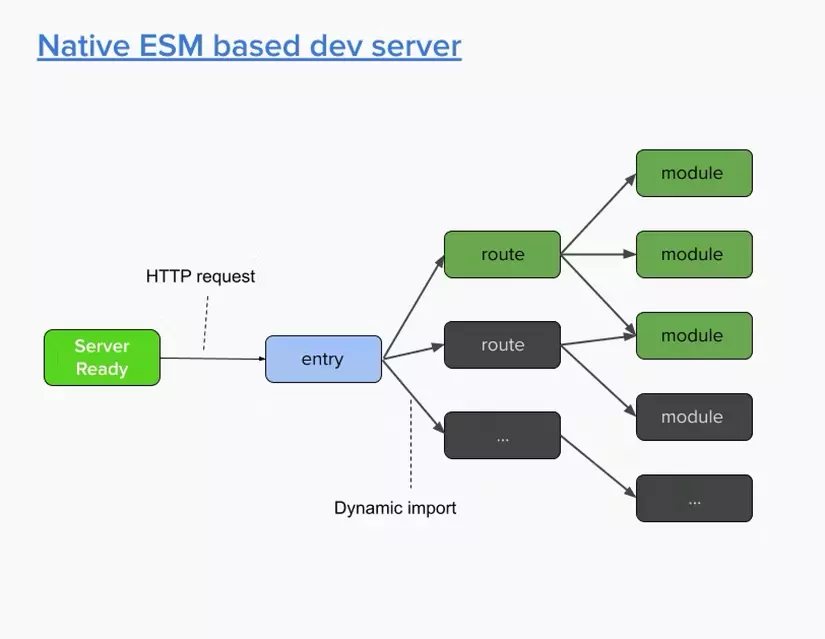
To understand why Vite feels different, it is necessary to examine how its dev server works. Traditional bundlers operate on a simple premise: before the browser can run your application, everything must be bundled. This means parsing the entire dependency graph, transforming every file, and emitting a bundle before the first request is served.
Vite inverts this model.
During development, Vite serves source code directly to the browser using native ES modules. When the browser encounters an import, it requests that file individually. Vite intercepts that request, applies only the necessary transforms, and returns the result. Nothing more, nothing less.
This has several architectural implications.
First, startup time becomes independent of project size. Whether your project has ten modules or ten thousand, the dev server starts almost instantly. For large Feature-Sliced Design codebases, this is transformative. Architects can encourage deep modularization without fearing that the build tool will collapse under the weight of many small slices.
Second, dependency boundaries become visible. Because each module is requested independently, circular dependencies, leaky abstractions, and overly broad imports are easier to detect. This complements FSD’s unidirectional dependency rule, where higher layers may depend on lower ones, but never the reverse.
Third, caching becomes meaningful. Vite leverages HTTP caching aggressively. If a module has not changed, it is served from cache. In architectural terms, this rewards stability and clear interfaces. A well-defined public API in an entity or feature slice tends to change less often than ad-hoc imports, which directly translates into faster iteration.
From an architectural standpoint, native ESM is not just an optimization. It is a philosophical alignment with modular design. Each file becomes a first-class unit of composition, which fits naturally with FSD’s emphasis on slices, boundaries, and explicit contracts.
Configuring Vite: Turning vite.config.js into an Architectural Tool
While Vite works out of the box for simple projects, real-world systems require deliberate configuration. The difference between a fragile setup and a scalable one often lies in how vite.config.js is treated: either as a dumping ground for hacks or as an architectural extension point.
A well-structured Vite configuration typically reflects the same principles as the application architecture itself: separation of concerns, clarity, and explicit intent.
One of the most impactful configuration decisions is aliasing. By defining path aliases that mirror your Feature-Sliced Design layers, you reinforce architectural boundaries at the tooling level. For example, importing from @features/auth instead of relative paths makes dependencies clearer and discourages cross-layer leakage.
Another critical area is environment-based configuration. Vite’s mode system allows you to tailor behavior for development, staging, and production without conditional chaos. This is especially important in large systems where different architectural constraints apply in different environments. Development prioritizes feedback speed, while production emphasizes stability and optimization.
Build options also matter. Vite exposes Rollup configuration for production builds, allowing architects to control code splitting, chunking strategy, and output structure. These decisions directly affect runtime performance and cacheability. For instance, aligning chunks with Feature-Sliced Design boundaries can improve long-term caching and reduce invalidation when unrelated features change.
Finally, server configuration should not be overlooked. Proxy settings, strict port handling, and filesystem access rules all contribute to a predictable development environment. Consistency across teams is an architectural concern, not just a convenience.
Treating vite.config.js as part of the architecture rather than an afterthought is one of the most common differentiators between mature and brittle frontend systems.
The Vite Plugin System: Extending Architecture Without Breaking It
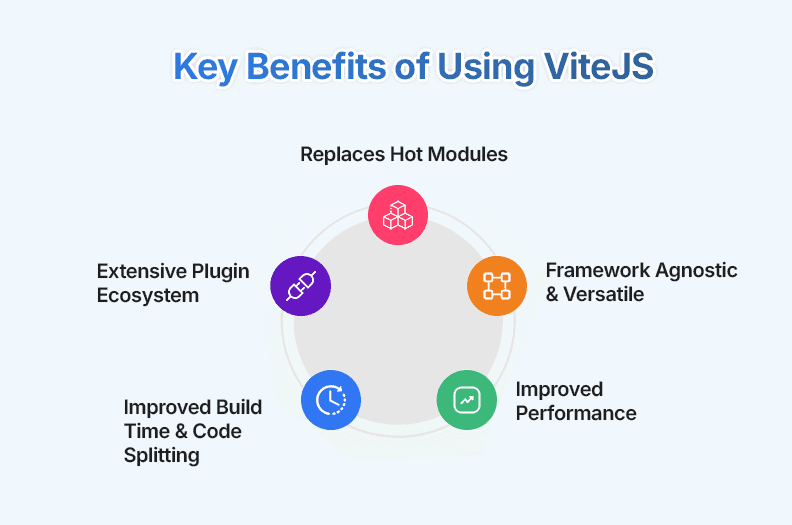
Vite’s plugin system is one of its most powerful features, but also one of the easiest to misuse. Plugins run during both development and build phases, intercepting module resolution, transforming code, and influencing output.
From an architectural perspective, plugins should exist to enforce or enhance structure, not to compensate for it.
A common and valuable use case is architectural linting and validation. Plugins can detect forbidden imports, enforce layer boundaries, or validate public APIs. When combined with Feature-Sliced Design rules, this turns architectural guidelines into enforceable constraints rather than tribal knowledge.
Another important category is framework integration. React, Vue, and other frameworks rely on plugins to enable JSX, HMR, and fast refresh. These plugins are generally safe because they operate at a framework boundary rather than a business logic boundary.
Plugins can also support design systems, asset handling, and localization. For example, transforming SVGs into components or enforcing consistent styling conventions can reduce duplication and improve cohesion across slices.
However, plugins should be evaluated critically. Each plugin adds implicit behavior that future developers must understand. Leading architects suggest keeping the plugin surface area minimal and well-documented. If a plugin fundamentally alters module semantics, it should be justified by clear architectural benefits.
In large-scale projects, it is often useful to group custom plugins into a dedicated tooling package. This mirrors the idea of shared layers in Feature-Sliced Design: reusable, well-defined, and isolated from feature-specific logic.
Vite and Feature-Sliced Design: A Natural Architectural Fit
Feature-Sliced Design emphasizes decomposition by business responsibility rather than technical function. Vite’s development model supports this approach in several important ways.
First, Vite encourages smaller files and focused modules. Because there is no bundling penalty during development, teams are free to split logic along meaningful boundaries. This aligns with FSD’s recommendation to keep slices small, cohesive, and explicit.
Second, hot module replacement in Vite operates at the module level. When a feature slice changes, only the affected modules are updated. This reinforces the mental model that features are independent units, not entangled parts of a monolith.
Third, Vite’s dependency graph visualization tools make it easier to reason about slice relationships. Architects can identify accidental coupling early, before it hardens into technical debt.
A typical Feature-Sliced Design structure works seamlessly with Vite:
- app initializes providers, routing, and global configuration
- pages compose widgets and features
- widgets aggregate features and entities into reusable UI blocks
- features implement user interactions and business rules
- entities represent core domain concepts
- shared contains generic UI, utilities, and configuration
Vite does not impose any opinion on this structure, which is precisely why it works so well. It stays out of the way while providing fast, predictable feedback. In practice, this combination allows teams to evolve architecture gradually without tooling friction.
Production Builds: Rollup Under the Hood and Architectural Consequences
While Vite’s development experience is defined by native ESM, production builds tell a different story. For production, Vite uses Rollup to bundle, optimize, and emit assets.
This duality is often misunderstood, but it is one of Vite’s strengths.
Rollup excels at static analysis, tree-shaking, and optimized output. By delegating production bundling to Rollup, Vite ensures that architectural decisions made during development translate into efficient runtime artifacts.
Code splitting is a prime example. In Feature-Sliced Design, features are often loaded conditionally based on routes or user interactions. Rollup can generate separate chunks for these features, reducing initial load and improving performance.
Another important aspect is long-term caching. Rollup’s deterministic chunk naming and hashing allow browsers to cache unchanged assets aggressively. When slices are well-isolated, changes in one feature do not invalidate unrelated chunks, preserving cache efficiency.
Minification and dead code elimination also benefit from clear architecture. When public APIs are explicit and internal modules are not leaked, Rollup can safely remove unused code. This is a concrete example of how architectural discipline directly improves production performance.
From an architectural standpoint, the key takeaway is that Vite’s production pipeline rewards good structure. Sloppy boundaries and implicit dependencies may work during development, but they reduce the effectiveness of optimization during build.
Vite vs Webpack: An Architectural Comparison
Webpack dominated frontend tooling for years, and many teams still rely on it. However, the migration toward Vite is driven by architectural considerations as much as by performance.
Webpack’s dev server relies on bundling. Even with optimizations, startup time grows with project size. This creates pressure to centralize logic and reduce module count, which conflicts with modular architectural patterns.
Vite removes that pressure during development. Architects can design systems for clarity and scalability rather than for bundler constraints.
Configuration complexity is another differentiator. Webpack’s flexibility comes at the cost of verbosity and implicit behavior. Large configurations often become unapproachable, especially for new team members. Vite’s configuration is intentionally simpler, making architectural intent easier to communicate.
Plugin ecosystems differ as well. Webpack plugins are powerful but often invasive. Vite plugins tend to be more focused, aligning better with incremental architectural extension.
This does not mean Webpack is obsolete. For legacy systems or highly specialized setups, it remains viable. But for new projects or major refactors, many teams find that Vite better supports modern architectural practices like Feature-Sliced Design.
Common Architectural Pitfalls When Adopting Vite
Despite its advantages, Vite does not magically fix architectural problems. Several pitfalls appear repeatedly in real-world projects.
One common mistake is overusing plugins to patch architectural weaknesses. Plugins should not replace clear module boundaries or proper layering. If a plugin is required to make sense of the codebase, the architecture likely needs attention.
Another pitfall is ignoring production implications. Because development feels fast and forgiving, teams sometimes neglect build configuration until late in the project. This can lead to suboptimal chunking, poor caching, and unexpected bundle sizes.
A third issue is inconsistent import discipline. Native ESM makes it easy to import anything from anywhere. Without conventions like FSD’s public APIs, this freedom can quickly lead to tangled dependencies.
Leading architects emphasize that tooling amplifies both good and bad decisions. Vite removes friction, but it also removes excuses. Architectural discipline becomes more important, not less.
Practical Recommendations for Architects Using Vite with FSD
Based on experience with large-scale projects, several best practices consistently emerge.
Define aliases that mirror your architectural layers and enforce them through linting and code review. This makes architecture visible and self-documenting.
Keep vite.config.js readable and modular. If configuration grows large, extract concerns into functions or separate files. Treat configuration as code that deserves the same care as application logic.
Adopt a minimal plugin strategy. Each plugin should have a clear purpose and documented impact on the build pipeline.
Align code splitting with feature boundaries. This requires coordination between routing, architecture, and build configuration, but the payoff in performance and maintainability is substantial.
Finally, educate the team. Architecture and tooling are only effective when understood. Vite’s simplicity makes it an excellent teaching tool for modern frontend concepts like ESM, module graphs, and incremental builds.
Conclusion: Vite as an Architectural Enabler
Vite is more than a fast build tool. It is a reflection of how frontend architecture has evolved toward modularity, explicit boundaries, and rapid feedback. By embracing native ES modules in development and leveraging Rollup for optimized production builds, Vite aligns tooling with modern architectural thinking.
The most important takeaway is that tooling and architecture are inseparable. Vite enables teams to fully realize the benefits of structured methodologies like Feature-Sliced Design, reducing friction and reinforcing good design decisions. When combined thoughtfully, they form a foundation for scalable, maintainable, and high-performance frontend systems.
Adopting Vite alongside a deliberate architecture is a long-term investment in code quality and team productivity. It allows teams to move fast without sacrificing structure, and to scale without losing clarity.
Ready to build scalable and maintainable frontend projects? Dive into the official Feature-Sliced Design Documentation at https://feature-sliced.design/docs/get-started/overview to get started.
Have questions or want to share your experience? Join our active developer community on Discord at https://discord.gg/S8MzWTUsmp.
Disclaimer: The architectural patterns discussed in this article are based on the Feature-Sliced Design methodology. For detailed implementation guides and the latest updates, please refer to the official documentation.