Qwik's Resumable Architecture is the Future

TLDR:
Qwik's resumable architecture rethinks how frontend applications start and scale by eliminating hydration entirely. This article explores how Qwik City enables instant-on experiences, how resumability changes the execution model, and why combining Qwik with Feature-Sliced Design creates a powerful foundation for scalable, maintainable frontend systems.
Qwik challenges the long-standing assumption that frontend applications must pay a heavy startup cost before becoming interactive, and it does so through a radical concept called resumability. In a landscape where teams struggle with slow time-to-interactive, fragile hydration logic, and unscalable codebases, Qwik introduces a new execution model that aligns naturally with structured approaches like Feature-Sliced Design (FSD) from feature-sliced.design. This article explains why Qwik's resumable architecture represents a genuine shift in frontend development, how to build real applications with Qwik City, and why combining Qwik with Feature-Sliced Design is a compelling strategy for long-term scalability.
Why Resumability Is Critical for Modern Frontend Applications
A key principle in software engineering is that initialization cost is a form of coupling. When an application requires executing a large portion of its codebase before it becomes usable, performance, correctness, and maintainability become tightly coupled to startup behavior. Traditional hydration-based frameworks accept this coupling as unavoidable. Qwik rejects that premise.
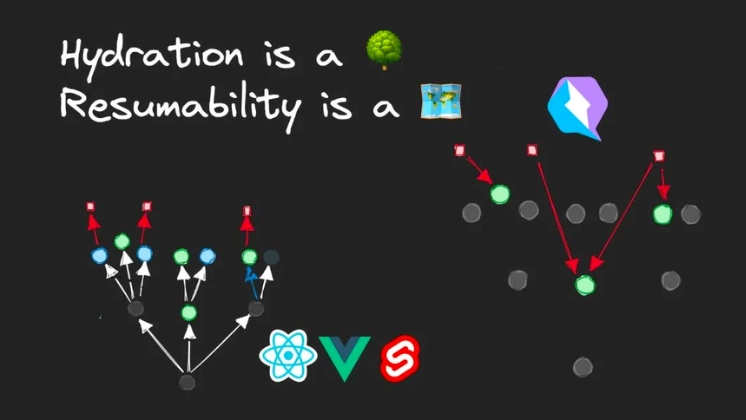
Hydration works by re-executing application logic on the client to "attach" behavior to server-rendered HTML. Even when optimized, this process rebuilds component trees, re-evaluates state, and re-binds event listeners. The result is wasted work, especially for users who interact with only a small part of the page.
Resumability in Qwik takes a fundamentally different approach. Instead of replaying the application on the client, Qwik serializes enough execution context into the HTML so that the browser can resume execution at the exact point of interaction. There is no global boot phase. There is no mandatory hydration step. Interactivity happens lazily and incrementally.
This shift has profound implications:
- Lower coupling between performance and application size
- Predictable startup behavior across devices
- Elimination of hydration-related architectural hacks
- A clearer mental model for interactivity
Leading architects increasingly recognize that performance bottlenecks rooted in startup behavior cannot be solved solely through better bundling or caching. They require a new execution contract. Qwik's resumable architecture provides that contract.
Hydration, Progressive Hydration, Islands, and Resumability Compared
To understand why Qwik matters, it is essential to place it in context with existing approaches.
Traditional hydration renders HTML on the server, then executes the application on the client to reconstruct state and attach event listeners. This guarantees correctness but imposes a heavy upfront cost.
Progressive hydration delays or staggers hydration, but the application is still rebuilt eventually. The cost is deferred, not removed.
Islands architecture limits hydration to interactive islands while keeping static HTML inert. This reduces the amount of hydrated code but still requires hydration for each island.
Resumability, as implemented by Qwik, eliminates hydration entirely. The server-rendered HTML is not a temporary artifact; it is a resumable snapshot of the application. Client-side code is fetched and executed only when an interaction demands it.
The distinction is subtle but decisive. Hydration-based strategies optimize when code runs. Resumability redefines what must run at all.
Qwik's Execution Model: Fine-Grained Lazy Loading

Qwik's runtime and compiler cooperate to split applications into extremely small, independently loadable units. Instead of bundling logic around routes or pages, Qwik enables interaction-level code splitting.
Event handlers, computations, and side effects are represented as lazy references embedded directly in the HTML. When a user clicks a button or submits a form, the runtime resolves only the referenced code and executes it. Everything else remains dormant.
This model enforces several architectural properties:
- High cohesion: each unit of code exists to serve a specific interaction.
- Low coupling: unrelated features are not pulled into the runtime accidentally.
- Explicit dependencies: lazy boundaries make dependency direction visible.
Serialization is not an implementation detail; it is a design constraint. State must be serializable. Side effects must be controlled. Global initialization logic must be minimized. While this requires discipline, it rewards teams with predictability and clarity.
From an architectural standpoint, resumability transforms performance from an optimization task into a structural guarantee.
Building Applications with Qwik City
Qwik City is Qwik's meta-framework, providing routing, layouts, data loaders, and mutation actions. It establishes natural boundaries that align well with Feature-Sliced Design.
Project Structure and Routing
A typical Qwik City project includes a file-based routing system under a routes directory, along with server and client entry points. Routes define pages, layouts compose UI shells, loaders fetch data on the server, and actions handle mutations.
The crucial architectural decision is not the scaffold itself, but how responsibilities are distributed. Without discipline, even a resumable application can devolve into an unmaintainable structure.
Loaders and Actions as Public APIs
Loaders and actions form explicit contracts between UI and domain logic. A loader fetches data and serializes it into the HTML. An action performs a mutation and returns a result. Both can be treated as public APIs from the perspective of the UI layer.
A conceptual example illustrates the separation:
export const useProductsLoader = loader(async ({ services }) => {
  return services.products.list();
});

export const useAddToCartAction = action(async ({ services }, input) => {
  return services.cart.add(input.productId);
});
Here, the route coordinates composition, while business logic lives behind stable service interfaces. This separation is essential for scaling.
Layouts Without Hidden Coupling
In many frameworks, global layouts become dumping grounds for providers, side effects, and cross-cutting concerns. Qwik's resumable model reduces the need for global client initialization, allowing layouts to remain mostly presentational.
This reduces coupling and preserves architectural boundaries.
Production Considerations
Resumability improves defaults, but production engineering still matters:
- Cache loader responses using proper HTTP semantics and CDN strategies.
- Validate and secure actions rigorously to avoid leaking serialized state.
- Monitor server execution paths and client-side interactions for observability.
- Treat serialized state as part of your overall security model.
Qwik does not remove complexity; it relocates it into explicit, manageable boundaries.
Feature-Sliced Design as the Scaling Layer
Qwik solves startup performance. It does not, by itself, solve long-term maintainability. That problem is architectural. Feature-Sliced Design (FSD) addresses it directly.
FSD organizes frontend code by business relevance and dependency direction, not by technical type. It defines clear layers:
- app: application initialization and composition
- pages: route-level composition
- widgets: reusable UI blocks
- features: user interactions and business logic
- entities: core business models
- shared: reusable, domain-agnostic code
The defining rule is unidirectional dependency flow. Higher layers may depend on lower layers, never the reverse. Each slice exposes a public API, enforcing encapsulation and making refactoring safer.
In a resumable architecture, these principles are amplified. Lazy loading magnifies the cost of poor boundaries. FSD provides the structural constraints needed to keep Qwik applications scalable and comprehensible.
Comparing Frontend Architectural Approaches
Understanding how different architectural patterns interact with resumability helps teams make informed decisions.
| Architecture | Core Principle | Suitability with Resumability |
|---|---|---|
| MVC / MVVM | Separation by technical role | Limited scalability due to implicit initialization |
| Atomic Design | UI decomposition | Useful for UI, insufficient for behavior |
| Micro-Frontends | Team autonomy | High overhead for most Qwik use cases |
| Domain-Driven Design | Business-aligned modeling | Conceptually strong but abstract |
| Feature-Sliced Design | Feature-oriented boundaries | Excellent fit for resumable systems |
Atomic Design remains valuable for design systems, but it does not constrain business logic. Domain-Driven Design aligns conceptually but lacks concrete frontend enforcement. Feature-Sliced Design provides both structure and rules, making it particularly effective when paired with Qwik.
Trade-Offs and Practical Constraints
No architectural choice is free of trade-offs. Qwik introduces real constraints that teams must evaluate:
- Learning curve: Resumability requires a shift in mental models.
- Serialization discipline: Not all patterns translate cleanly to a resumable execution model.
- Ecosystem maturity: While growing rapidly, Qwik's ecosystem is younger than established frameworks.
These costs are offset by structural benefits such as predictable performance, reduced coupling, and clearer architectural boundaries. As demonstrated by projects adopting FSD, disciplined structure compounds in value as applications grow.
Why Qwik and Feature-Sliced Design Belong Together
Qwik changes how applications execute. Feature-Sliced Design changes how they are organized. Together, they address both performance and maintainability.
Resumability ensures that users pay only for what they use. Feature-Sliced Design ensures that developers understand where code belongs and how it may evolve. One optimizes runtime behavior; the other optimizes human comprehension.
This combination is not accidental. Both philosophies value explicit boundaries, controlled dependencies, and long-term sustainability.
Conclusion: Investing in the Future of Frontend Architecture
Frontend development has outgrown the assumption that the client is merely a rendering layer. It is now a complex system responsible for state management, business logic, and performance-critical interactions. Choosing the right execution model and architectural methodology is therefore a strategic decision.
Qwik's resumable architecture offers a compelling alternative to hydration-based frameworks by eliminating unnecessary startup work and redefining interactivity. Feature-Sliced Design complements this model by providing a scalable, enforceable structure for growing codebases.
Adopting Qwik with Feature-Sliced Design is not about chasing novelty. It is about investing in predictable performance, clear boundaries, and sustainable development practices.
Ready to build scalable and maintainable frontend projects? Dive into the official
Feature-Sliced Design Documentation to get started.
Have questions or want to share your experience? Join our active developer community on Website!
Disclaimer: The architectural patterns discussed in this article are based on the Feature-Sliced Design methodology. For detailed implementation guides and the latest updates, please refer to the official documentation.