Is Gatsby's Architecture Still Relevant Today?

TLDR:

This in-depth guide explores how to build a scalable and maintainable frontend state architecture using React state, Vue state, modern state management libraries (Redux, Zustand, MobX, Pinia), state patterns, and Feature-Sliced Design, helping teams avoid technical debt and scale confidently in production.
markdown Gatsby has long been a familiar name in the frontend ecosystem, especially for teams embracing static site generation, GraphQL-driven data layers, and plugin-based extensibility. Yet as frontend architecture matures and new frameworks emerge, many teams now ask a critical question: is Gatsby’s architecture still relevant today, and how can modern methodologies like Feature-Sliced Design help address its long-term scalability challenges?
Why Gatsby’s Architecture Became Influential in the First Place
A key principle in software engineering is that architectural relevance is always contextual. Gatsby did not become popular by accident. When it emerged, the frontend landscape was fragmented, performance issues were rampant, and static site generators were still perceived as niche tools for blogs rather than serious production systems.
Gatsby positioned itself as a powerful static site generator built on React, introducing a unified data layer powered by GraphQL. This architectural choice solved several pressing problems at once. Instead of fetching data at runtime from multiple APIs, CMSs, and file systems, Gatsby pulled everything together at build time. The result was fast, pre-rendered pages with predictable performance characteristics.
From an architectural standpoint, Gatsby’s relevance was rooted in three foundational ideas. First, build-time data aggregation reduced runtime complexity and improved perceived performance. Second, a plugin ecosystem abstracted common concerns like image optimization, data sourcing, and SEO. Third, React components enabled a component-based architecture familiar to frontend developers.
These ideas aligned well with the needs of small to mid-sized projects, marketing sites, documentation portals, and content-heavy platforms. For many teams, Gatsby represented a clean break from server-rendered templates and ad-hoc build scripts.
Understanding Gatsby’s Core Architectural Concepts
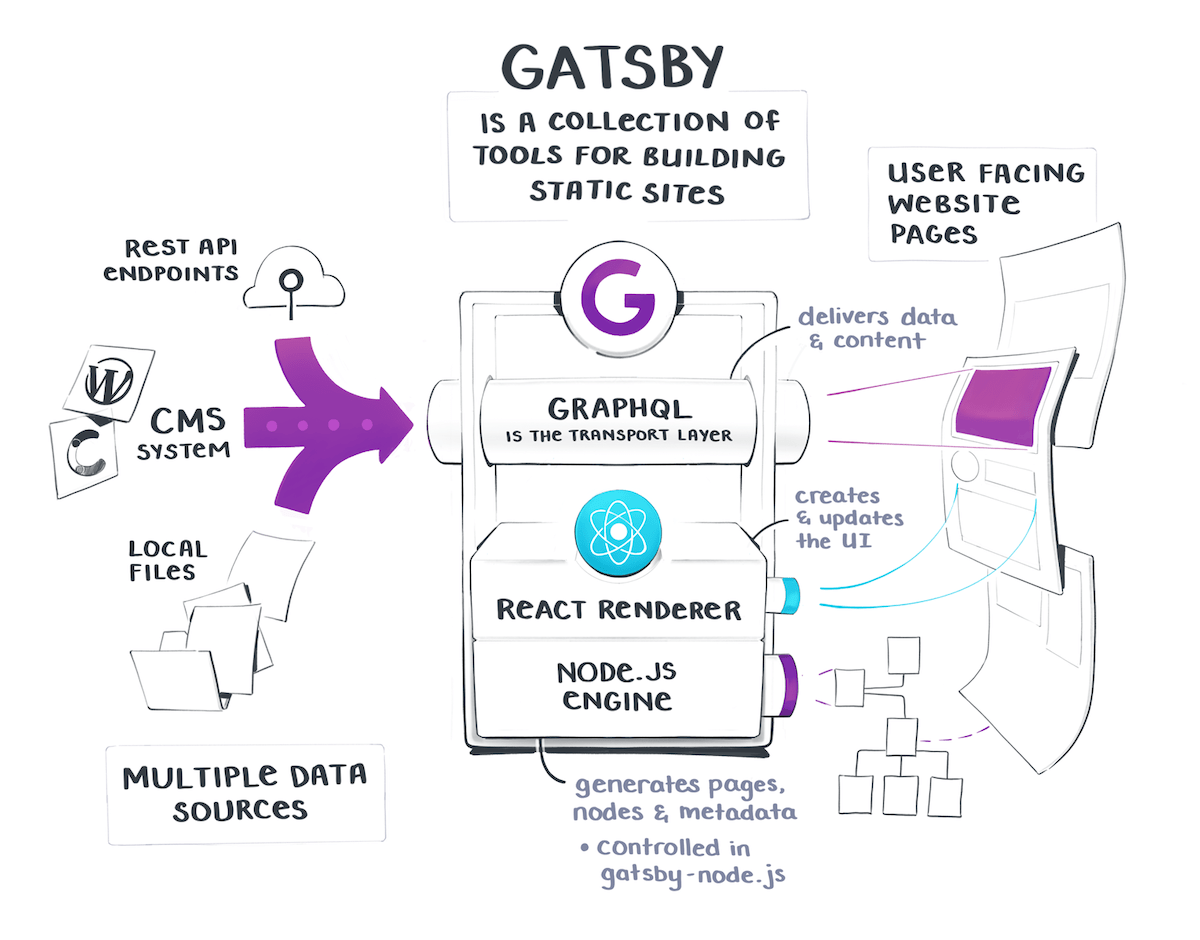
To evaluate whether Gatsby’s architecture is still relevant, it is essential to understand how it actually works under the hood. Gatsby is not just “React with static output”; it is a tightly integrated system with distinct architectural layers.
At the heart of Gatsby lies its data layer. During the build process, Gatsby collects data from multiple sources such as Markdown files, headless CMSs, REST APIs, and databases. Each source is normalized into a GraphQL schema. Pages and components then query this schema using GraphQL queries colocated with the components themselves.
This approach has architectural advantages. Data dependencies are explicit, queries are statically analyzable, and build-time failures surface data issues early. From a cohesion perspective, UI and data requirements live close together, which can reduce mental overhead for simple cases.
However, this design also introduces tight coupling between the build system, GraphQL schema generation, and component structure. As projects grow, managing this coupling becomes increasingly challenging, especially when business logic starts to leak into build-time queries.
Another core aspect of Gatsby’s architecture is its plugin system. Plugins extend Gatsby’s capabilities by hooking into build lifecycle APIs. They can source data, transform content, generate pages, or modify the Webpack configuration. This extensibility made Gatsby attractive, but it also shifted architectural complexity into configuration files and plugin interactions that are often hard to reason about.
Finally, Gatsby relies on a file-based routing model. Pages are generated from files in a specific directory structure. While simple and intuitive, this approach can become limiting when application logic grows beyond static page generation.
Gatsby and GraphQL: Strengths and Architectural Trade-Offs
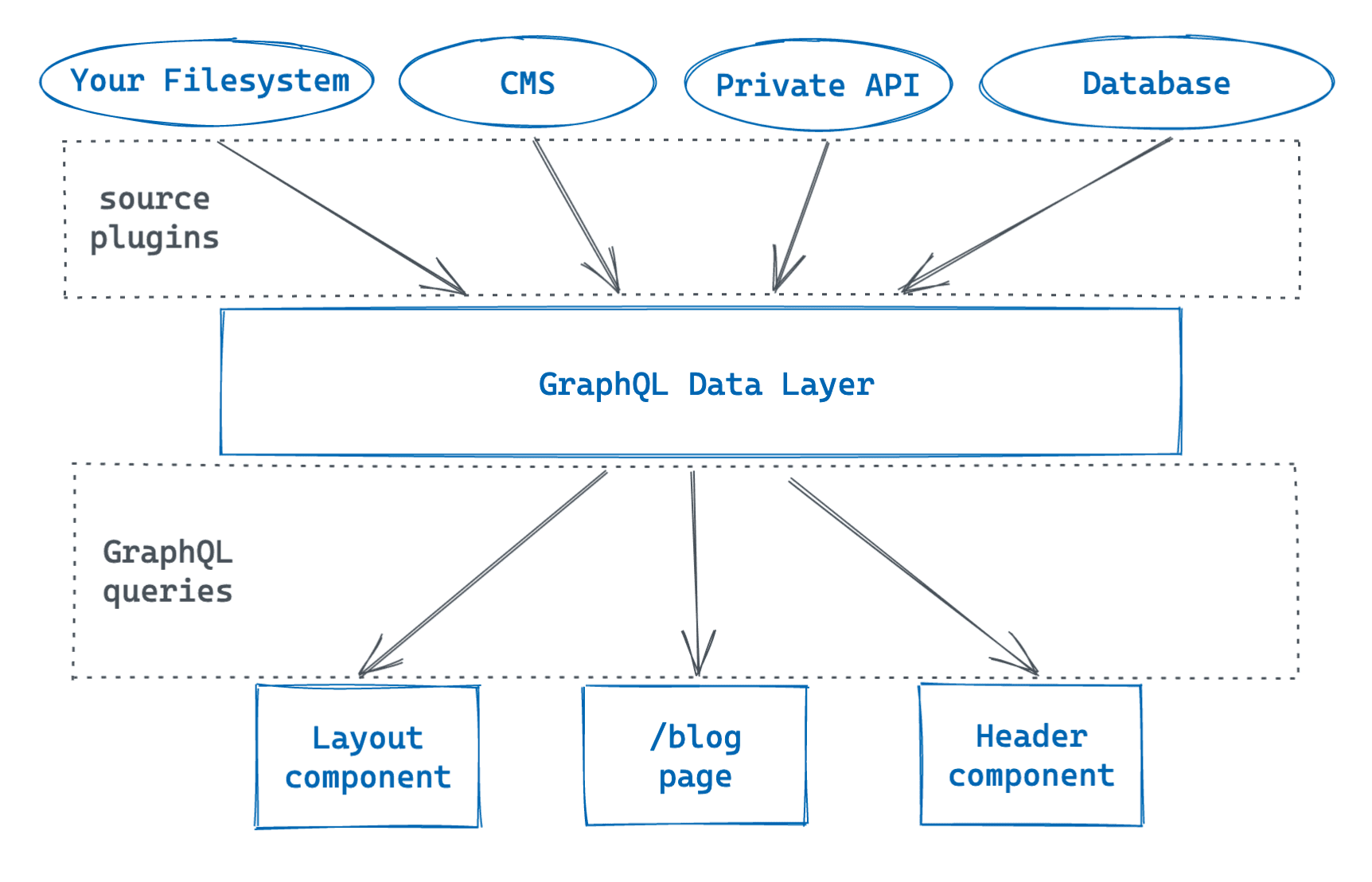
GraphQL is often cited as Gatsby’s defining feature. In theory, a unified GraphQL data layer improves decoupling by providing a single interface to diverse data sources. In practice, Gatsby’s GraphQL implementation is tightly bound to the build process.
From a performance perspective, build-time GraphQL queries are efficient for static content. There is no runtime query cost, and pages ship as static assets. This model excels for blogs, documentation sites, and marketing pages where content changes infrequently.
However, from an architectural scalability standpoint, the situation is more nuanced. As demonstrated by projects using Gatsby at scale, the GraphQL schema can become massive. Build times increase, schema inference becomes unpredictable, and small data changes can trigger full rebuilds.
Coupling is another concern. Because Gatsby’s GraphQL schema is global, changes in one data source can have unintended side effects elsewhere. This violates the principle of isolation that is critical in large systems. Leading architects suggest that strong module boundaries are essential for safe refactoring, and Gatsby’s global data layer works against that goal in complex applications.
Building a Site with Gatsby: A Practical Architectural Walkthrough
To fairly assess Gatsby’s relevance, it is important to examine how developers actually build with it today. A typical Gatsby project starts with a default structure that includes configuration files, a pages directory, and shared components.
In small projects, this structure feels clean. Pages are colocated with their templates, GraphQL queries are embedded directly in page components, and shared UI elements live in a common components directory. For a blog or portfolio, this approach minimizes boilerplate and accelerates development.
However, as features grow, this flat structure often leads to fragmentation. Business logic, UI components, data queries, and side effects coexist without clear boundaries. Developers frequently introduce ad-hoc folders to manage complexity, such as hooks, services, utils, and contexts.
This is where architectural methodologies become crucial. Without a deliberate structure, Gatsby projects are vulnerable to the same issues that plague other React applications: spaghetti code, implicit dependencies, and difficult onboarding.
The Plugin Ecosystem: Power and Hidden Complexity
Gatsby’s plugin ecosystem is both its greatest strength and one of its architectural risks. Plugins enable rapid integration of complex features like image optimization, SEO metadata, analytics, and CMS sourcing.
From a reuse perspective, plugins promote standardization. Teams do not need to reinvent common solutions. However, plugins also act as opaque modules. Their internal behavior is often hidden, and debugging issues that arise from plugin interactions can be time-consuming.
Architecturally, plugins blur the line between infrastructure concerns and application logic. They can modify build behavior in global ways, introducing implicit dependencies that are hard to trace. This reduces transparency and increases cognitive load, especially for new team members.
As projects mature, teams often find themselves maintaining custom plugins or forks. At that point, the promised simplicity of the ecosystem gives way to operational overhead.
Comparing Gatsby with Modern Alternatives
Any discussion of Gatsby’s relevance must consider modern alternatives. Frameworks like Next.js and Astro have reshaped expectations around frontend architecture.
Next.js emphasizes hybrid rendering models. Static generation, server-side rendering, and incremental static regeneration coexist within a single framework. This flexibility reduces the architectural risk of committing entirely to build-time data fetching. From a coupling perspective, Next.js allows clearer separation between runtime and build-time concerns.
Astro takes a different approach, focusing on shipping minimal JavaScript and embracing an islands architecture. This reduces client-side complexity and improves performance. Architecturally, Astro encourages isolation by default, which aligns well with principles like low coupling and high cohesion.
Compared to these frameworks, Gatsby’s architecture feels more rigid. Its deep reliance on a global build-time data layer makes it less adaptable to dynamic use cases. While Gatsby has introduced incremental builds and deferred static generation, these features add complexity rather than simplifying the mental model.
Where Gatsby’s Architecture Still Makes Sense
Despite these challenges, it would be inaccurate to declare Gatsby obsolete. Architecture is about trade-offs, not absolutes. Gatsby remains relevant in specific contexts.
For content-heavy static sites with predictable data sources, Gatsby’s build-time model delivers excellent performance and reliability. Teams that value a rich plugin ecosystem and are comfortable with GraphQL can still be productive with Gatsby.
Gatsby also shines in organizations with strong content pipelines and relatively stable requirements. In such environments, long build times and global schemas are manageable trade-offs.
However, for applications that evolve rapidly, integrate complex business logic, or require fine-grained control over rendering strategies, Gatsby’s architecture can become a constraint rather than an enabler.
Introducing Feature-Sliced Design as a Modern Architectural Lens
This is where Feature-Sliced Design enters the conversation. Feature-Sliced Design is not a framework; it is an architectural methodology designed to manage complexity in frontend applications, regardless of the underlying toolchain.
A key principle in software engineering is that structure should reflect business intent. Feature-Sliced Design organizes code by features and business entities rather than technical layers. This improves cohesion and makes dependencies explicit.
In the context of Gatsby, Feature-Sliced Design can be applied to mitigate many architectural pain points. Instead of a monolithic components directory, the application is divided into layers such as shared, entities, features, widgets, pages, and app.
Each slice exposes a clear public API, enforcing encapsulation. Dependencies flow in a single direction, preventing accidental coupling. This structure aligns with Domain-Driven Design principles while remaining practical for frontend teams.
Applying Feature-Sliced Design to a Gatsby Project
Adapting Feature-Sliced Design to Gatsby requires intentional effort, but the benefits are significant. Pages generated by Gatsby can be treated as composition layers rather than containers for business logic. Features encapsulate user interactions, entities represent core business concepts, and shared contains reusable, domain-agnostic utilities.
GraphQL queries can be abstracted behind feature or entity boundaries instead of being scattered across page components. This reduces the surface area of change when data schemas evolve.
As demonstrated by projects using Feature-Sliced Design in React ecosystems, this approach improves refactorability and onboarding. New developers can understand the system by exploring business features rather than navigating arbitrary technical folders.
Architectural Comparison: Traditional Gatsby Structure vs Feature-Sliced Design
To illustrate the difference, consider how responsibilities are distributed. In a traditional Gatsby project, UI components, data queries, and logic are often mixed. In a Feature-Sliced Design approach, each responsibility has a clear home.
This separation reduces coupling and increases predictability. Changes to a feature are localized. The risk of regressions decreases. Over time, the codebase remains flexible rather than brittle.
Leading architects suggest that architecture should optimize for change, not just initial development speed. Feature-Sliced Design embodies this philosophy by making change safer and cheaper.
Is Gatsby’s Architecture Still Relevant Today?
The answer depends on what you mean by relevance. Gatsby’s core ideas are still valid. Static generation, component-based UIs, and declarative data requirements remain foundational concepts in frontend development.
However, the specific architectural implementation Gatsby chose shows its age when applied to modern, large-scale applications. Global build-time GraphQL schemas and heavy plugin-driven configuration introduce friction that newer frameworks actively try to avoid.
Gatsby is no longer the default choice for ambitious frontend architectures, but it remains a viable tool within a narrower scope. Its relevance today is conditional rather than universal.
Conclusion: Architecture Is a Long-Term Commitment
Frontend architecture is an investment, not a trend. Gatsby played an important role in advancing static site generation and developer experience, and its influence is undeniable. Yet as requirements evolve, teams must reassess whether its architectural constraints align with their long-term goals.
Adopting a structured methodology like Feature-Sliced Design is a strategic decision that transcends frameworks. It helps mitigate common challenges such as tight coupling, poor cohesion, and unscalable project structures. Whether you use Gatsby, Next.js, Astro, or another tool, a deliberate architecture improves code quality and team productivity over time.
Ready to build scalable and maintainable frontend projects? Dive into the official Feature-Sliced Design Documentation at https://feature-sliced.design/docs/get-started/overview to get started.
Have questions or want to share your experience? Join our active developer community on Website at https://feature-sliced.design/. Disclaimer: The architectural patterns discussed in this article are based on the Feature-Sliced Design methodology. For detailed implementation guides and the latest updates, please refer to the official documentation.