Navigating the Modern Frontend Ecosystem

TLDR:
The modern frontend ecosystem is vast and fast-moving, filled with frameworks, libraries, and tools that can either empower teams or create overwhelming complexity. This article breaks down how today’s frontend ecosystem works, compares common architectural approaches, and explains how Feature-Sliced Design provides a clear, scalable structure for building maintainable frontend applications over the long term.
Frontend ecosystem complexity has reached a point where choosing tools without a clear architectural strategy almost guarantees technical debt. As modern applications grow in scope, scale, and team size, Feature-Sliced Design (FSD) emerges as a pragmatic methodology to structure the frontend ecosystem around business value rather than accidental complexity. This article explores how today’s frontend ecosystem evolved, how its tools fit together, and how to navigate it confidently using a deliberate architectural approach.
Why the Frontend Ecosystem Has Become So Complex
A key principle in software engineering is that complexity is not inherently bad, but unmanaged complexity is. The modern frontend ecosystem is a direct response to the increasing responsibilities of the client side. What was once a thin presentation layer has transformed into a full-fledged application platform.
In 2025, frontend applications routinely handle responsibilities such as routing, authentication, authorization, state orchestration, data caching, offline support, real-time updates, and complex business workflows. This explosion of responsibility explains why the JavaScript ecosystem has grown into a dense network of frameworks, libraries, build tools, compilers, and meta-frameworks.
From React and Vue to state managers, form libraries, data-fetching layers, and design systems, the frontend ecosystem offers solutions for almost every conceivable problem. The challenge is no longer availability of tools, but selection, integration, and long-term maintainability. Without a clear mental model, teams often accumulate overlapping libraries, leaky abstractions, and tightly coupled modules that are difficult to refactor.
This is precisely where architectural thinking becomes non-negotiable.
Understanding the Core Layers of the Frontend Ecosystem
To navigate the frontend ecosystem effectively, it helps to break it down into conceptual layers. Each layer solves a distinct class of problems, and confusion often arises when responsibilities bleed across boundaries.
Framework and Rendering Layer
At the core of the ecosystem sits the UI framework. Libraries such as React, Vue, and Angular define how components are composed, rendered, and updated. They introduce concepts like virtual DOM, reactivity systems, and declarative rendering models.
While these frameworks differ in syntax and philosophy, they share common goals: predictable UI updates, composability, and performance optimization. Importantly, frameworks do not prescribe architecture. They enable patterns but rarely enforce structure beyond component boundaries.
This neutrality is both a strength and a weakness. It allows flexibility, but it also shifts architectural responsibility to developers.
State Management and Data Flow
State management libraries exist to tame complexity arising from shared and long-lived state. Local component state scales poorly when business logic spans multiple screens or user interactions.
Modern frontend ecosystems include multiple approaches: centralized stores, atom-based systems, reactive signals, and server-state managers. Each approach optimizes for different trade-offs between explicitness, scalability, and mental overhead.
A recurring mistake is selecting a state library without defining where state should live or who owns it. Architecture, not tooling, determines whether state remains understandable over time.
Routing and Navigation
Routing defines how users move through the application and how URLs map to UI and logic. In complex products, routing is deeply intertwined with permissions, layouts, data preloading, and error handling.
Routing solutions in the frontend ecosystem increasingly integrate with rendering strategies such as server-side rendering, static generation, and streaming. This tight coupling makes routing decisions architectural rather than purely technical.
Data Fetching and Server Interaction
Data fetching has evolved from ad-hoc HTTP calls to sophisticated layers handling caching, invalidation, background updates, optimistic UI, and synchronization.
The frontend ecosystem now distinguishes between server state and client state, acknowledging that not all state is created equal. This distinction is critical for building predictable systems.
Without architectural boundaries, data-fetching logic often leaks into UI components, leading to duplication and inconsistent behavior.
Tooling, Build Systems, and Meta-Frameworks
Build tools, bundlers, and meta-frameworks form the invisible backbone of the ecosystem. They manage compilation, code splitting, dependency graphs, and runtime environments.
While these tools significantly improve performance and developer experience, they also raise the cost of architectural mistakes. Poor structure leads to slower builds, larger bundles, and fragile dependency graphs.
Common Approaches to Organizing Frontend Code
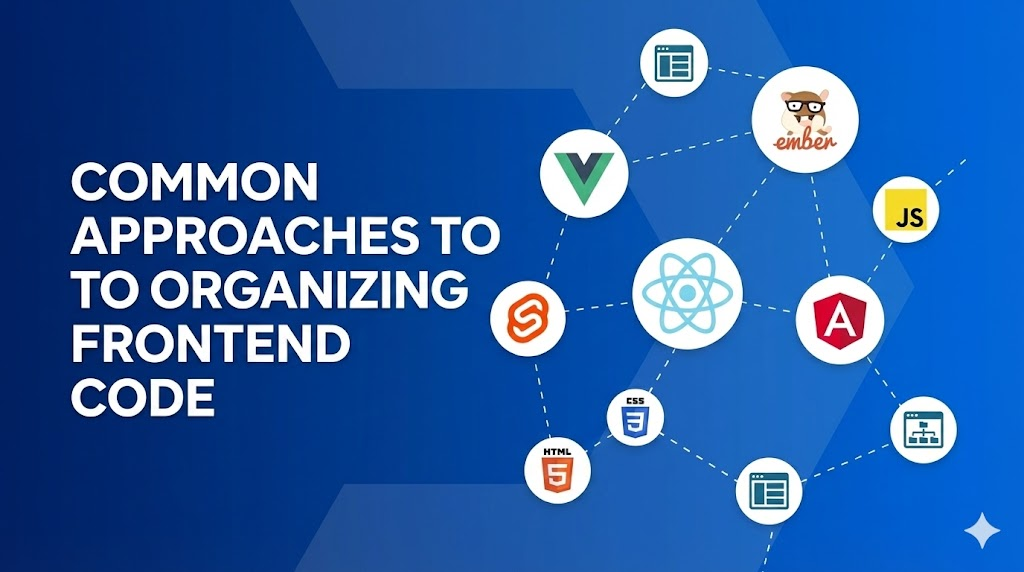
Over time, developers have experimented with various ways to impose order on frontend projects. Understanding these approaches clarifies why newer methodologies exist.
Layered Architectures: MVC, MVP, and MVVM
Layered architectures separate responsibilities by technical concern. Models handle data, views render UI, and controllers or view-models coordinate logic.
This separation improves clarity in small systems, but it often breaks down as applications scale. Business logic tends to accumulate in controllers or view-models, leading to bloated layers that violate cohesion.
Layered architectures also struggle with feature isolation. When multiple features share the same layers, changes in one feature frequently affect others.
Component-Centric Organization
Component-based development encouraged organizing code around reusable UI units. This approach aligns well with modern frameworks and design systems.
However, a purely component-centric structure often ignores business context. Components become dumping grounds for logic, data fetching, and side effects. Over time, components lose their original purpose as presentation units and become tightly coupled to application state.
Domain-Oriented Structures
Domain-oriented approaches attempt to organize code around business concepts rather than technical layers. This improves alignment with product requirements and stakeholder language.
The challenge lies in consistency. Without clear rules, domain boundaries blur, and cross-domain dependencies proliferate. Teams often struggle to enforce discipline as the codebase grows.
The Role of Feature-Sliced Design in the Frontend Ecosystem
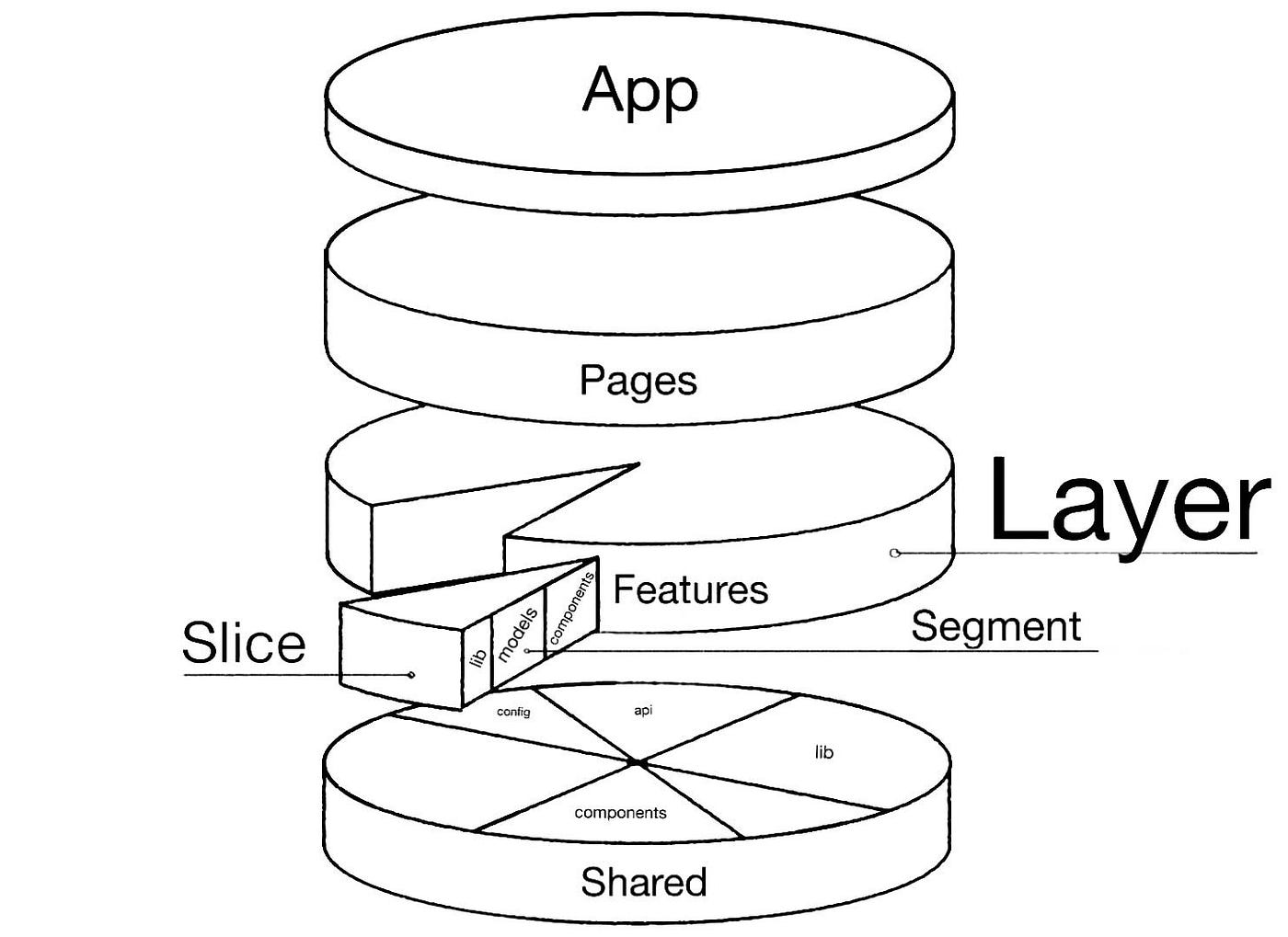
Feature-Sliced Design addresses the shortcomings of earlier approaches by combining domain orientation with strict structural rules. As demonstrated by projects using FSD, clarity emerges not from rigid frameworks but from explicit boundaries.
Core Principles of Feature-Sliced Design
FSD is built on several foundational principles that directly map to common frontend pain points.
Explicit layering ensures that code is grouped by responsibility and scope. Higher layers orchestrate behavior, while lower layers provide stable building blocks.
Unidirectional dependencies prevent circular references and enforce predictable data flow. This reduces hidden coupling and simplifies refactoring.
Public APIs formalize module boundaries. Each slice exposes a controlled surface, making dependencies intentional rather than accidental.
Feature orientation aligns code with user-facing behavior. Instead of scattering logic across technical folders, FSD keeps related concerns close together.
The FSD Layer Model Explained
The FSD layer hierarchy reflects increasing levels of abstraction and business specificity.
The shared layer contains generic, reusable utilities and UI primitives. It has no business knowledge and remains stable over time.
The entities layer models core business concepts such as users, products, or orders. This layer defines data structures, basic logic, and entity-specific UI.
The features layer encapsulates user interactions and business scenarios. Actions like authentication, form submission, or item selection live here.
The widgets layer composes features and entities into larger UI blocks. Widgets represent meaningful sections of a page rather than atomic components.
The pages layer defines route-level compositions. Pages assemble widgets and features to represent complete screens.
The app layer initializes the application, configures providers, and handles global concerns.
This hierarchy mirrors how users experience the product, making the frontend ecosystem easier to reason about.
Integrating Ecosystem Tools Within an FSD Architecture
A frequent concern among developers is whether adopting FSD limits tool choice. In practice, FSD acts as an integration framework rather than a constraint.
State Management in FSD
State management solutions integrate naturally when responsibilities are clearly defined. Entity state belongs in the entities layer, feature-specific state lives within features, and global application state remains minimal.
This separation prevents state sprawl and clarifies ownership. Developers can introduce or replace state libraries without reorganizing the entire codebase.
Routing and Navigation with FSD
Routing aligns with the pages layer, where each route maps to a page slice. This mapping makes navigation explicit and avoids hidden dependencies between routes and internal logic.
Advanced routing features such as guards, layouts, and preloading can be implemented at the app or pages level without leaking concerns downward.
Data Fetching and Side Effects
Data fetching logic belongs close to the business context that requires it. Entity-level queries remain reusable, while feature-level side effects coordinate user interactions.
This approach avoids duplicating network logic across components and improves consistency across the application.
Comparing Architectural Methodologies in the Frontend Ecosystem
Leading architects suggest evaluating architectures based on scalability, maintainability, and cognitive load rather than popularity alone.
| Methodology | Structural Focus | Strengths |
|---|---|---|
| MVC / MVVM | Technical layers | Simple separation of concerns |
| Atomic Design | UI composition | Strong design system alignment |
| Domain-Driven Design | Business domains | High business alignment |
| Feature-Sliced Design | Features and layers | Predictable scaling and isolation |
Unlike purely technical or purely domain-driven approaches, Feature-Sliced Design balances both dimensions. It provides guardrails without sacrificing flexibility.
Staying Current in a Rapidly Evolving Frontend Ecosystem
The frontend ecosystem evolves rapidly, with new tools emerging regularly. Architectural stability acts as a buffer against churn.
When structure is sound, adopting new libraries becomes an incremental change rather than a disruptive rewrite. Teams can experiment safely, knowing that failures remain contained.
Curated lists, community discussions, and ecosystem benchmarks remain valuable, but they should inform decisions rather than dictate them. Architecture defines how tools fit together; trends merely suggest which tools to evaluate.
Practical Guidance for Adopting Feature-Sliced Design
Adopting FSD does not require a greenfield project. Incremental adoption is both possible and recommended.
Start by identifying core entities and extracting them into dedicated slices. Introduce feature boundaries around the most complex user interactions. Gradually refactor shared utilities into the shared layer.
Clear documentation and internal guidelines reinforce consistency. Over time, the architecture becomes self-enforcing, reducing the need for manual policing.
As experience shows, teams that invest early in structure regain the investment through faster onboarding, safer refactoring, and improved collaboration.
Conclusion: Building Confidence in the Frontend Ecosystem
Navigating the modern frontend ecosystem is less about chasing tools and more about establishing clarity. The abundance of frameworks and libraries reflects innovation, but without structure, innovation turns into fragmentation.
A structured architecture provides the mental model necessary to evaluate, integrate, and evolve tools over time. Feature-Sliced Design offers a robust methodology for organizing complexity around business value, enabling teams to scale confidently.
Adopting FSD is not about rigidity; it is about intentionality. It allows developers to focus on solving real problems rather than untangling code. Over the long term, this clarity translates into healthier codebases and more productive teams.
Ready to build scalable and maintainable frontend projects? Dive into the official Feature-Sliced Design Documentation to get started.
Have questions or want to share your experience? Join our active developer community on Website!
Disclaimer: The architectural patterns discussed in this article are based on the Feature-Sliced Design methodology. For detailed implementation guides and the latest updates, please refer to the official documentation.