Modular Frontend: The Secret to Maintainable Code

TLDR:

Modular frontend development provides a systematic approach to organizing UI, logic, and domain concerns into isolated, reusable modules. By adopting Feature-Sliced Design, teams gain a predictable architecture that scales effortlessly, improves onboarding, prevents codebase erosion, and ensures long-term project stability in modern, high-growth environments.
Frontend modularization is becoming one of the most critical disciplines in modern web engineering. As applications grow in scale and complexity, architectural drift, implicit dependencies, and tangled layers can quickly turn a promising project into an unmaintainable monolith. Modern methodologies such as Feature-Sliced Design provide a structured, modular approach that helps teams build decoupled, resilient systems with clear boundaries and long-term maintainability. By embracing domain-driven thinking, component isolation, and layered decomposition, teams can preserve agility even as their codebases expand.
Why Modular Frontend Architecture Matters More Than Ever
Modular architecture solves one of the biggest pain points in frontend engineering: scaling without collapsing under complexity. When teams work on dense, monolithic structures, every change risks unpredictable side effects, onboarding new developers becomes increasingly slow, and the cognitive load grows exponentially with every new feature.
A modular approach—rooted in stable APIs, clear boundaries, and encapsulated logic—directly strengthens a codebase’s resilience and longevity. The core characteristics of a well-modularized system include:
- Low coupling and high cohesion, enabling teams to change one part of the system without introducing failures elsewhere.
- Predictable file structures, making it easier to understand how to extend or modify existing features.
- Parallelizable development, since teams can work independently across well-defined feature slices.
- Simplified testing strategy, thanks to isolated modules that reduce mocking complexity.
Organizations that invest in modularization report improved developer experience, faster time-to-market, and more stable long-term architecture. Leading frameworks and architectural methodologies—such as micro-frontends, Atomic Design, and Feature-Sliced Design—reflect industry-wide recognition of modularity as a foundational requirement for sustainable frontend projects.
Understanding the Core Principles of Frontend Modularization
Modularization in frontend engineering revolves around decomposing a system into discrete, autonomous units that encapsulate their own logic, state, and UI. The key principles include:
Encapsulation
Each module owns its internal state, logic, and side effects. Nothing leaks out unless explicitly exposed through a public API.
Isolation
Changes to a module should not propagate unintended side effects. This isolation can be achieved through file structure conventions, dependency boundaries, and programmatic contracts.
Explicit Public APIs
A module must publicly declare what it exposes—components, helpers, data access layers, or state slices. Everything else remains private and inaccessible to external consumers.
Single Responsibility
Each module should address only one domain, feature, or concern. Bloated modules violate modularity principles and degrade maintainability.
Autonomy
Modules become more maintainable when they can be developed, tested, and deployed independently—or as independently as possible.
Reusability
Well-designed modules transcend their original use case and become reusable across multiple parts of the codebase.
These principles collectively build the foundation for composable, resilient frontend systems that scale sustainably.
The Hidden Cost of Monolithic Frontend Structures
Many frontend teams experience the same early trajectory: fast initial delivery through rapid experimentation, followed by increasing friction as the system expands. Without structured modular boundaries, a monolith accumulates three major forms of debt:
Structural Debt
Files and components spread across the codebase with no clear organizational scheme. Engineers cannot predict where code should exist, leading to duplicated logic and fragmented responsibilities.
Coupling Debt
Modules implicitly depend on one another through shared global state, tightly bound props, or cross-imported utilities. These implicit relationships make refactoring dangerous and slow.
Contextual Debt
Engineers must understand too much of the system just to implement a simple feature. This elevated cognitive load discourages contributions and worsens onboarding time.
A modular architecture reduces or eliminates these debts by enforcing domain boundaries, clear folder structures, and explicit public interfaces.
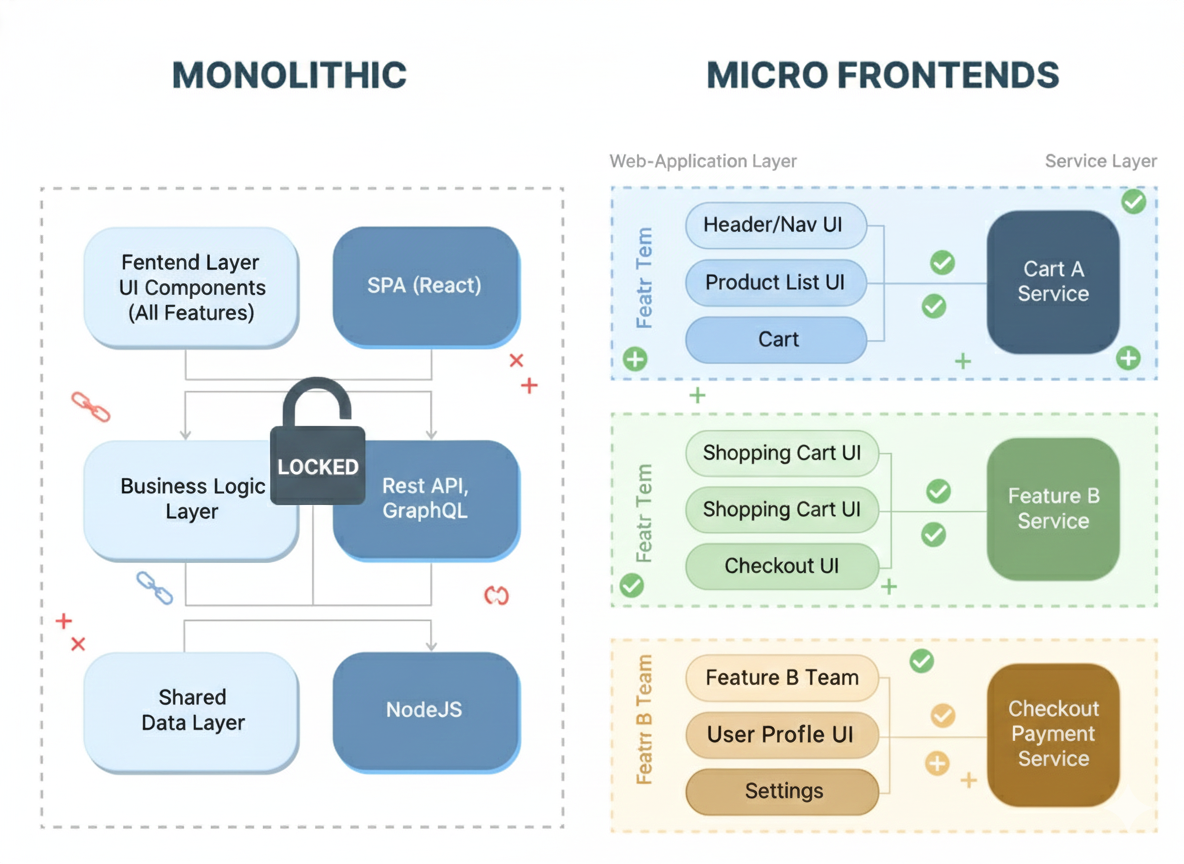
Dominant Approaches to Achieving Modularity in Modern Frontend Systems
Different architectural patterns have emerged to help teams adopt modular practices at various scales. Understanding their trade-offs is essential for selecting the right strategy.
### 1. Component-Based Architectures (React, Vue, Angular)
Most modern frameworks revolve around components as the fundamental building block. Components provide UI encapsulation, local state management, and predictable rendering behavior.
However, component-based architecture alone is not enough for full modularization. Without an overarching structure, components frequently become bloated containers for:
- business logic
- server interactions
- data transformations
- cross-cutting concerns
Component-based design must therefore be complemented with a system-wide modular methodology such as Feature-Sliced Design (FSD) or domain-based grouping.
### 2. Atomic Design
Atomic Design structures UI components across five layers:
| Layer | Description | Example |
|---|---|---|
| Atoms | Base UI elements | Buttons, Labels, Inputs |
| Molecules | Groups of atoms | Search Input, Card Header |
| Organisms | Larger combos | Navbars, Cards, Product Tiles |
| Templates | Layouts | Page layouts |
| Pages | Concrete screens | Product Page |
Atomic Design is exceptional for modularizing visual design but does not address domain logic or data boundaries.
### 3. Domain-Driven Frontend Architecture
Domain-Driven Design (DDD) emphasizes organizing the application around business concepts instead of technical layers.
Example domain segmentation: /product /ui /model /api /lib
/cart /ui /model /api /lib
Each domain encapsulates its UI, logic, state, and data-fetching, significantly reducing coupling and improving long-term maintainability.
### 4. Micro-Frontends
Micro-frontends split a large frontend into multiple independently deployable applications.
Benefits
- Team autonomy
- Independent deployment
- Language/framework flexibility
Trade-offs
- Higher operational cost
- Increased bundle size
- UX fragmentation if not governed properly
Micro-frontends provide modularity at the organization level, but they are often excessive for small to medium projects.
The Limitations of Modular Techniques Without Global Architecture
Many teams adopt isolated techniques—e.g., Atomic Design or local domain grouping—but fail to implement system-wide modular discipline. Symptoms include:
- Shared root-level folders (e.g., components/, services/, hooks/) that grow uncontrollably.
- Logic appearing inside UI components, creating “god components.”
- Duplicate business logic across features.
- State mutations spread across many disconnected files.
This is where methodologies like Feature-Sliced Design (FSD) excel by offering a comprehensive architectural model.
Introducing Feature-Sliced Design: A Modern Architecture for Modular Frontend Projects
Feature-Sliced Design is a modular architectural methodology built specifically for modern frontend applications. It provides layered decomposition, domain isolation, and a scalable folder structure that evolves as the system grows.
### Core Principles of FSD
1. Layered Decomposition
Code is organized into clearly distinct layers:
- App – setup, providers, entry points
- Processes – multi-feature flows (checkout, onboarding)
- Pages – route-level screens
- Features – user-driven functionality (auth, search, filters)
- Entities – domain models with logic and API
- Shared – UI, utils, libs with global reuse
Each layer has a strict responsibility boundary.
2. Slicing by Business Domains
Instead of grouping by technical role, FSD groups code by domain and function. This reduces cross-dependencies and enforces clear public APIs.
3. Public API Architecture
Every slice exposes its own API through an index file:
/features/auth /ui /model /api index.ts // public API
Dependencies can only import from index.ts, never from internal private files.
4. Isolated Modules
Features, entities, and pages operate as isolated modules that can be composed without becoming entangled.
### How FSD Enables True Modularity
Feature-Sliced Design achieves modularity on multiple levels:
- Structural modularity – predictable file structure
- Logical modularity – encapsulated model and domain logic
- UI modularity – reusable and composable UI
- Integration modularity – clear contracts between modules
- Team modularity – teams can own entire slices independently
This multi-dimensional modularity gives FSD exceptional scalability, particularly for long-term projects.
Comparing Modular Approaches: MVC vs. Atomic vs. DDD vs. FSD
| Architecture | Strengths | Weaknesses |
|---|---|---|
| MVC / MVVM | Easy to grasp, separates concerns | Controller/ViewModel bloat, weak domain isolation |
| Atomic Design | Great for UI modularity, design system alignment | No domain structure or logic separation |
| DDD | Strong domain focus, clear boundaries | Requires cultural and conceptual alignment |
| Feature-Sliced Design | Full-stack modularity across domains, UI, and logic | Requires initial training and team buy-in |
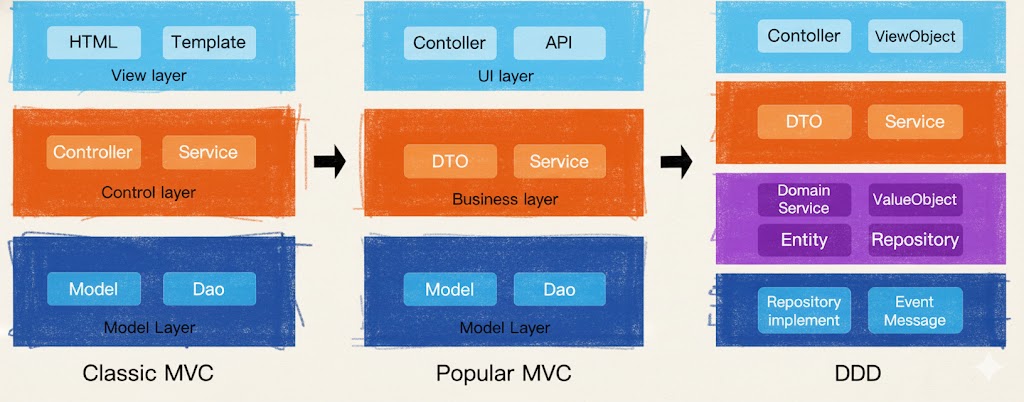
FSD integrates the strengths of DDD, component-driven design, and layered separation while mitigating many of their weaknesses through explicit public APIs and consistent structural rules.
Practical Example: Refactoring a Monolithic React Application with FSD
Imagine this common structure:
/components /services /hooks /utils /pages
This leads to:
- spaghetti imports
- unclear domain boundaries
- chaotic cross-dependencies
- monolithic global state management
Applying FSD:
/app /pages /entities /user /product /features /auth /search /cart /shared /ui /lib /api
This transition yields:
- isolated domains
- clear boundaries
- improved testability
- reusable slices
- stable public APIs
Within weeks, developers report reduced friction and improved onboarding velocity.
Tooling for Modular Frontend Architecture
Modern tools enrich modular development through automation, bundling, or boundary enforcement:
Build Tools
- Vite / Esbuild – fast builds enable modular development workflows.
- Webpack Module Federation – supports micro-frontends at runtime.
TypeScript
TypeScript reinforces modularization by enforcing typings, isolating modules, and shaping public APIs.
Linters and Static Analysis
- ESLint for import boundaries
- Turborepo for workspace-level modularity
- Nx for monorepo modular orchestration
Framework Ecosystems
- Next.js – encourages file-based routing and component separation
- Remix – blends routing and data loading with natural modular boundaries
- SolidJS – fine-grained reactivity encourages small, isolated modules
When Should You Adopt a Modular Architecture?
Modular architecture becomes indispensable when:
- teams exceed 3–4 developers
- product complexity grows beyond simple CRUD flows
- features require repeated iteration
- technical debt slows down everyday development
- onboarding new members takes too long
- regression risk increases with every release
- releases become brittle or unpredictable
If any of these resonate with your current project, modularization should be a top architectural priority.
Step-by-Step Guide: How to Modularize Your Frontend with FSD
Step 1 — Identify Domains and User Flows
Break down the system into entities (domain models) and features (user-driven actions).
Step 2 — Create Layers According to FSD
Designate the app, processes, pages, features, entities, and shared layers.
Step 3 — Define Public APIs
Ensure that every slice exposes an index.ts file as its API.
Step 4 — Move Logic from UI to Model Layer
Extract business logic, state machines, server-side interactions, and validations.
Step 5 — Introduce Guard Rails
Use ESLint, TypeScript path aliases, and architectural rules to enforce boundaries.
Step 6 — Test in Isolation
Test features and entities independently to prevent coupling regressions.
Step 7 — Provide Documentation for Each Slice
Adopt a team-wide architectural language to onboard new developers quickly.
Benefits of Modular Frontend Architecture for Teams and Organizations
Modularization strengthens both the codebase and the team:
- Reduced regressions thanks to isolated modules
- Increased development speed through parallel workstreams
- More predictable releases due to stable contracts
- Reduced onboarding time because structure is self-explanatory
- Improved refactoring capability due to encapsulated logic
- Better collaboration between design, engineering, and QA
- Future-proof architecture aligned with modern industry best practices
Organizations embracing FSD often describe it as a strategic investment that pays dividends for years.
Conclusion
Modular frontend architecture is more than a structural pattern—it is a strategic decision that determines how well your codebase will handle growth, change, and team expansion. By applying principles such as encapsulation, domain-driven grouping, isolation, and clear public APIs, teams can significantly reduce technical debt and accelerate development cycles.
Feature-Sliced Design (FSD) offers a robust architecture that unifies modularity across UI, logic, and business domains. Whether you're scaling a startup product or refactoring a legacy monolith, adopting FSD provides long-term stability, clear boundaries, and a developer-friendly experience.
Ready to build scalable and maintainable frontend projects? Dive into the official Feature-Sliced Design Documentation to get started.
Have questions or want to share your experience? Visit our homepage to learn more!
Disclaimer: The architectural patterns discussed in this article are based on the Feature-Sliced Design methodology. For detailed implementation guides and the latest updates, please refer to the official documentation.