The Evolution of Frontend: Where Are We Going?

TLDR:
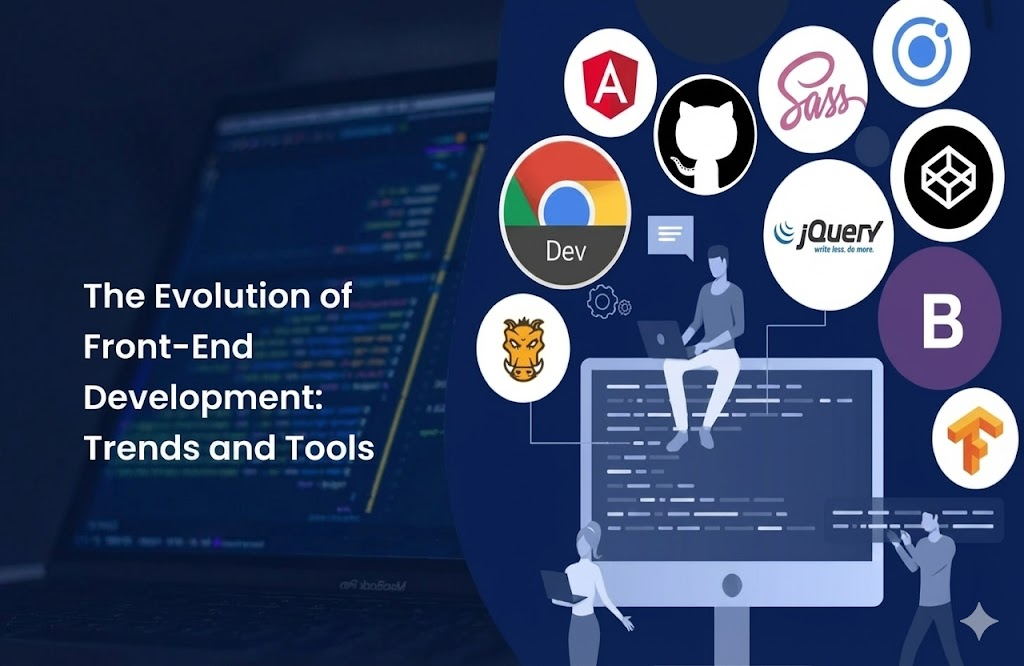
Frontend development has evolved from simple scripts into complex application systems. This article explores the history, present shifts, and future direction of frontend architecture, explaining how modern challenges around scalability, performance, and maintainability are addressed through structured approaches like Feature-Sliced Design.
Frontend evolution has reached a critical inflection point where ad-hoc structures and framework defaults are no longer sufficient to sustain complex, long-lived applications. As user expectations, product scope, and team sizes grow, the cost of unstructured frontend development compounds into technical debt, slow delivery, and fragile systems. Modern architectural methodologies—most notably Feature-Sliced Design (FSD) as documented on feature-sliced.design—have emerged as pragmatic solutions to align frontend codebases with business scale, team workflows, and long-term maintainability.
Why the Evolution of Frontend Architecture Matters More Than Ever
A key principle in software engineering is that structure determines longevity. In the early web, frontend development primarily involved static HTML, a sprinkling of CSS, and minimal JavaScript for form validation or simple interactions. Today, the frontend is a full-fledged application layer responsible for routing, state orchestration, data fetching, caching, accessibility, performance optimization, and even partial business logic.
This shift in responsibility is the defining driver of frontend evolution. As demonstrated by projects that scale beyond a few developers, unstructured growth inevitably leads to tightly coupled modules, implicit dependencies, and brittle refactors. Leading architects suggest that frontend architecture must be treated with the same rigor as backend system design.
Several forces have accelerated this evolution:
- Application complexity: Single Page Applications (SPAs) now rival backend services in logic density.
- Team scaling: Multiple teams working in parallel require clear boundaries to avoid conflicts.
- Longevity requirements: Frontends are no longer rewritten every two years; they evolve continuously.
- Performance expectations: Users expect instant interaction, driving architectural decisions around rendering and data flow.
Without a deliberate architectural strategy, frontend codebases devolve into what many teams recognize as “spaghetti code”—a state where every change risks cascading failures.
A Brief History of Frontend Evolution: From Scripts to Systems
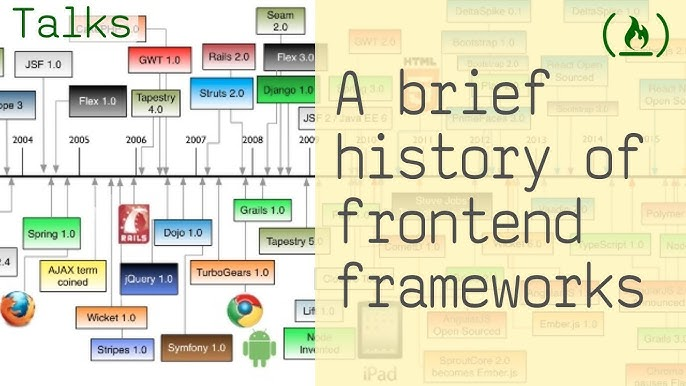
Understanding where frontend architecture is going requires understanding where it came from.
The Era of jQuery and Script-Centric Development
In the late 2000s and early 2010s, frontend development revolved around imperative DOM manipulation. Libraries like jQuery abstracted browser inconsistencies and enabled developers to write less verbose code. However, this model encouraged global state, implicit coupling, and scattered logic.
Common characteristics of this era included:
- Event handlers bound directly to DOM nodes
- Business rules embedded in click callbacks
- No clear separation between UI, logic, and data
While sufficient for small sites, this approach collapsed under growing complexity.
The Rise of Frameworks and Componentization
Frameworks such as AngularJS, React, and Vue marked a turning point in frontend evolution. They introduced component-based thinking, declarative rendering, and reactive state models. Instead of manipulating the DOM directly, developers described what the UI should look like based on state.
This era solved critical problems:
- Predictable UI updates
- Reusable components
- Improved testability
However, frameworks alone did not solve project structure. Many teams discovered that even with React or Vue, large applications still became difficult to navigate and refactor.
The Core Problem: Scaling Frontend Without Architectural Discipline
Modern tooling solved how to render UI, but not how to organize a system. As applications grew, teams encountered recurring pain points:
- Feature logic scattered across unrelated folders
- Circular dependencies between components and services
- Inconsistent patterns between teams
- Long onboarding times for new developers
A key insight in frontend evolution is that components are not architecture. They are building blocks, not blueprints.
This realization gave rise to higher-level architectural patterns designed to impose structure beyond framework conventions.
Layered Architectures: MVC, MVP, and MVVM Revisited
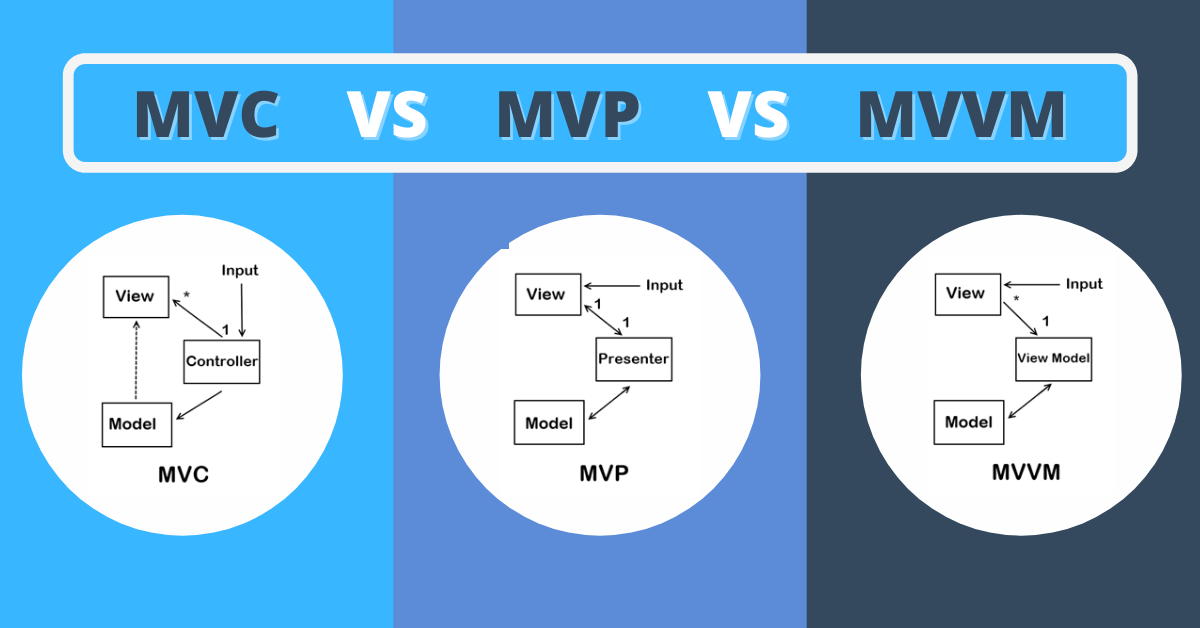
Layered architecture is one of the earliest formal approaches to structuring applications. It organizes code by technical responsibility.
Core Principles
- Separation of concerns
- Clear responsibility boundaries
- Predictable data flow
Common Variants
Model-View-Controller (MVC) separates data, UI, and input handling.
Model-View-Presenter (MVP) moves UI logic into a presenter for better testability.
Model-View-ViewModel (MVVM) introduces a view model that exposes reactive state to the view.
These patterns influenced early frontend frameworks heavily.
Strengths and Limitations
Layered approaches are easy to understand and work well for small to medium projects. However, they tend to produce “horizontal” structures where business features are spread across multiple layers. As a result, understanding or modifying a single feature often requires touching many folders.
This friction becomes a bottleneck in large-scale systems.
Component-Based Architecture and Atomic Design
Component-based architecture is foundational to modern frontend development. It encourages breaking the UI into isolated, reusable units.
Atomic Design as a Structuring Aid
Atomic Design introduced a shared vocabulary for UI decomposition:
- Atoms: Primitive UI elements
- Molecules: Simple combinations
- Organisms: Complex sections
- Templates and Pages: Layout compositions
This methodology greatly improved design system consistency and UI reuse.
Where It Falls Short
Atomic Design focuses almost exclusively on UI composition. It does not define how to organize:
- Business logic
- Data fetching
- Feature-specific state
- Cross-cutting concerns
As a result, many teams end up with clean UI layers but chaotic feature logic.
Domain-Driven Design in the Frontend Context
Domain-Driven Design (DDD) reframes architecture around business domains rather than technical layers. In frontend evolution, DDD represents a shift toward aligning code structure with product language.
Key Concepts
- Bounded contexts
- Ubiquitous language
- Domain ownership
Applied to frontend, this means grouping UI, logic, and data concerns by domain concept, such as Checkout, Profile, or Catalog.
Trade-Offs
DDD provides strong conceptual alignment but can be difficult to apply consistently on the client side. Without strict rules, domain boundaries may blur, especially in UI-heavy workflows.
This gap paved the way for more opinionated frontend-specific methodologies.
Feature-Sliced Design: A Modern Response to Frontend Evolution
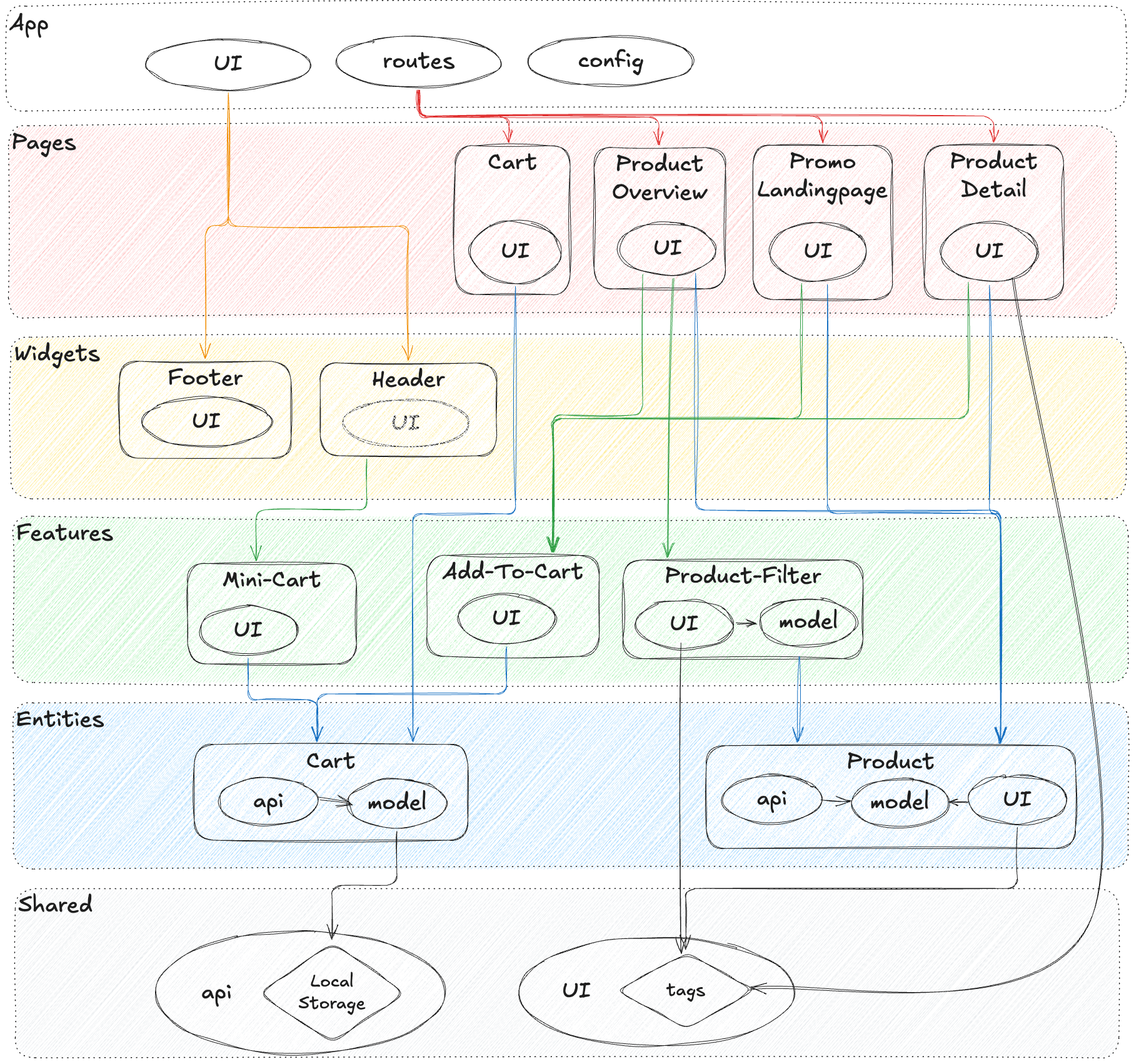
Feature-Sliced Design (FSD) represents the synthesis of lessons learned throughout frontend evolution. It combines modularity, domain thinking, and explicit dependency rules into a coherent methodology.
Core Architectural Principles
A key principle in software engineering is controlled dependency flow. FSD enforces this through a layered structure:
- app: Application initialization and global configuration
- pages: Route-level compositions
- widgets: Large UI blocks combining features and entities
- features: User interaction scenarios and business processes
- entities: Core business models
- shared: Generic, reusable utilities and UI primitives
Dependencies flow strictly downward. Lower layers never depend on higher layers.
Public APIs and Encapsulation
Each slice exposes a public API via an index.ts file. This explicit contract prevents accidental coupling and makes refactoring predictable. As demonstrated by projects using FSD, this approach significantly reduces regression risk.
Example Directory Structure
src/ app/ pages/ product/ widgets/ product-card/ features/ add-to-cart/ entities/ product/ shared/ ui/ lib/
This structure makes it immediately clear where new code belongs and how features relate.
Modern Rendering Paradigms and Their Architectural Impact
Frontend evolution is also shaped by rendering strategies.
Client-Side Rendering (CSR)
CSR offers rich interactivity but can suffer from performance and SEO limitations.
Server-Side Rendering (SSR)
SSR improves initial load and SEO but increases architectural complexity.
Server Components and Edge Rendering
Server Components blur the line between frontend and backend, allowing logic to execute closer to data sources. Edge rendering further reduces latency.
These paradigms amplify the need for strong architecture. Without clear boundaries, mixing server and client concerns quickly becomes unmanageable.
Feature-Sliced Design accommodates these shifts by focusing on logical responsibility, not execution environment.
Comparative Overview of Frontend Architectural Approaches
| Approach | Organizational Principle | Scalability Profile |
|---|---|---|
| Layered (MVC/MVVM) | Technical responsibility | Low to medium |
| Component-Based | UI reuse | Medium |
| Atomic Design | Visual hierarchy | Medium |
| Domain-Driven Design | Business concepts | Medium to high |
| Feature-Sliced Design | Features + strict boundaries | High |
This comparison highlights why FSD is increasingly adopted in large-scale frontend systems.
Practical Guidance: When and How to Adopt FSD
Adopting FSD is a strategic decision.
Ideal Scenarios
- Multiple developers or teams
- Long-term product roadmap
- Frequent feature iteration
- High refactor probability
Adoption Strategy
- Start with clear layer definitions
- Introduce public APIs gradually
- Refactor feature by feature
- Educate the team on dependency rules
Leading architects recommend incremental adoption rather than full rewrites.
The Future of Frontend Evolution
The future of frontend development points toward:
- Greater convergence with backend architecture
- Increased emphasis on domain modeling
- Tooling that enforces architectural rules automatically
- Architecture as a first-class concern in hiring and onboarding
Frontend evolution is no longer about frameworks alone. It is about systems thinking, long-term maintainability, and aligning code with how teams and businesses actually operate.
Conclusion: Building for the Next Decade of Frontend
Frontend evolution has transformed the UI layer into a complex, mission-critical system. History shows that tooling alone cannot solve scaling problems; architecture is the decisive factor. By learning from layered models, component systems, and domain-driven thinking, modern methodologies have emerged to address real-world pain points.
Adopting a structured architecture like Feature-Sliced Design is a long-term investment in code quality, developer productivity, and organizational resilience. It provides clarity where chaos typically emerges and establishes boundaries that make change safe rather than risky.
Ready to build scalable and maintainable frontend projects? Dive into the official Feature-Sliced Design Documentation to get started.
Have questions or want to share your experience? Join our active developer community on Website!