Edge Rendering: The New Frontier of Frontend

TLDR:

Edge rendering is reshaping frontend architecture by pushing rendering logic closer to users, drastically reducing latency and enabling real-time personalization. This article explores how edge computing works, when to use it, and why Feature-Sliced Design provides a robust, scalable foundation for building maintainable edge-rendered frontend systems.
Edge rendering is rapidly redefining how modern frontend systems are designed, deployed, and experienced by users. As latency expectations shrink and personalization demands grow, traditional server-side rendering models struggle to keep up. In this new landscape, Feature-Sliced Design (FSD), as documented on feature-sliced.design, emerges as a powerful architectural methodology that aligns perfectly with the distributed, low-latency nature of edge computing.
Why Edge Rendering Has Become a Critical Concern for Modern Frontend Systems
A key principle in software engineering is that user experience is bounded by the slowest component in the request lifecycle. Over the last decade, frontend performance optimization focused heavily on bundling, code splitting, caching, and client-side rendering strategies. While these techniques remain important, they no longer address the dominant bottleneck for globally distributed applications: network latency between users and centralized servers.
Edge rendering shifts execution closer to the user by running rendering logic on CDN nodes instead of a single regional server. This architectural shift fundamentally changes how frontend systems are composed, deployed, and scaled. Rather than sending requests halfway across the world to a monolithic backend, edge-rendered applications respond from geographically proximate nodes, often within tens of milliseconds.
From a business perspective, the impact is measurable. Industry benchmarks consistently show that even a 100 ms delay in page response can reduce conversion rates, engagement, and retention. From a technical perspective, edge rendering introduces new constraints around runtime APIs, execution limits, and architectural boundaries. These constraints make ad-hoc or poorly structured codebases especially fragile.
This is where a deliberate frontend architecture becomes non-negotiable. Without clear boundaries, strong modularity, and explicit public APIs, edge-rendered systems quickly devolve into tightly coupled logic that is hard to test, reason about, and evolve. Feature-Sliced Design provides a structural foundation that allows teams to adopt edge rendering without sacrificing maintainability or developer productivity.
What Edge Rendering Actually Is and How It Works Under the Hood
Edge rendering refers to executing rendering logic—HTML generation, request handling, personalization, or routing—on edge nodes located within a content delivery network. These nodes are geographically distributed and designed to handle requests with minimal latency.
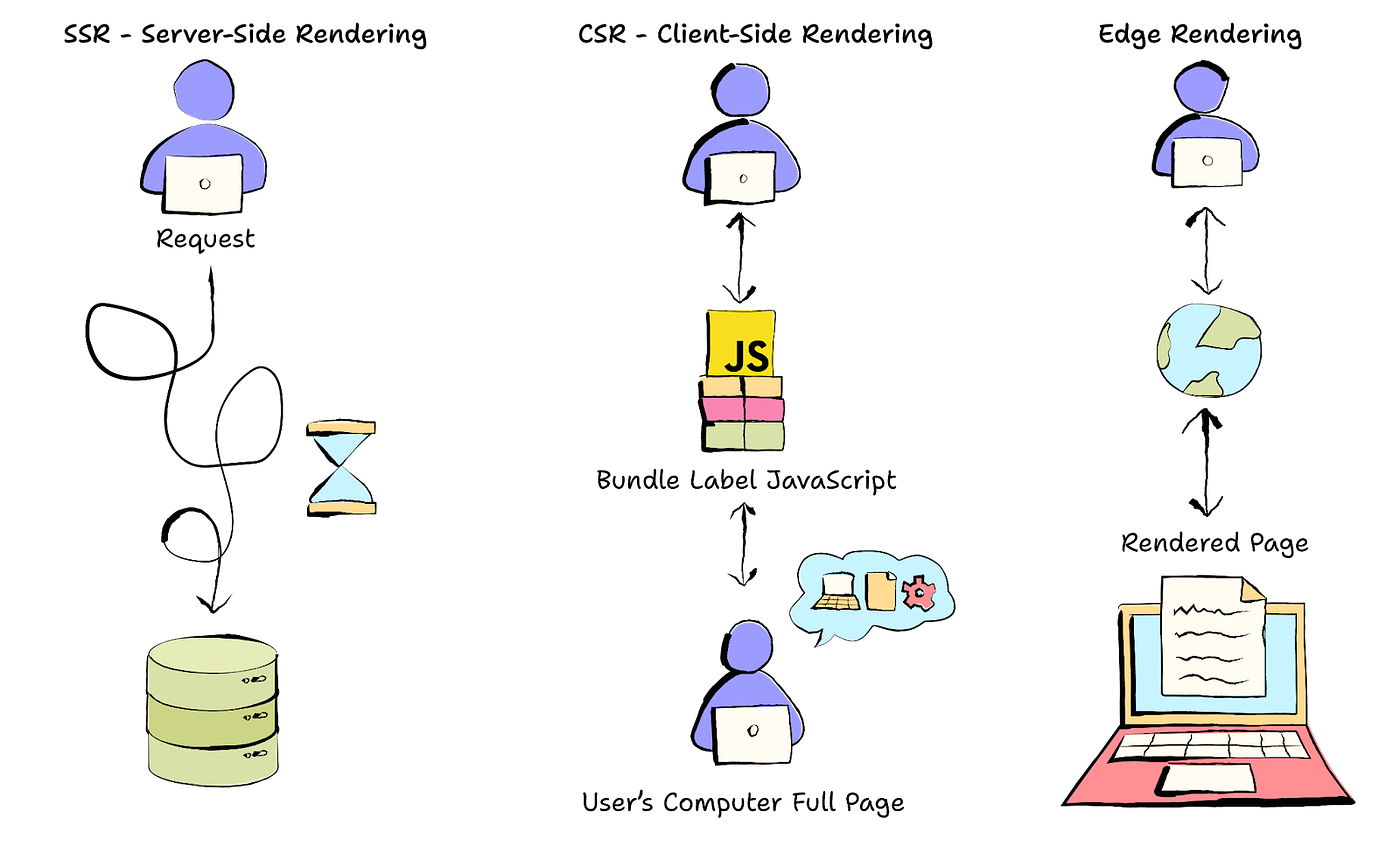
In practical terms, edge rendering environments differ from traditional servers in several important ways:
• Execution happens close to the user, often within the same country or region
• Cold starts are minimized due to lightweight isolates rather than full virtual machines
• Runtime APIs are intentionally restricted for security and performance reasons
• Execution time and memory limits are significantly tighter
Most edge platforms rely on isolate-based runtimes, such as V8 isolates, instead of container-based execution. This allows them to start almost instantly and handle massive concurrency. However, it also means that common Node.js APIs, such as filesystem access or native modules, are unavailable.
From an architectural standpoint, edge rendering is not simply “SSR but faster.” It is a distinct execution model that favors stateless, composable, and deterministic code. Rendering logic must be predictable, fast, and free of hidden side effects. These characteristics strongly align with architectural principles such as high cohesion, low coupling, and explicit dependency management.
Edge Rendering Versus Traditional SSR and Serverless Functions
To understand the value of edge rendering, it is useful to compare it with two familiar approaches: traditional server-side rendering and serverless functions.
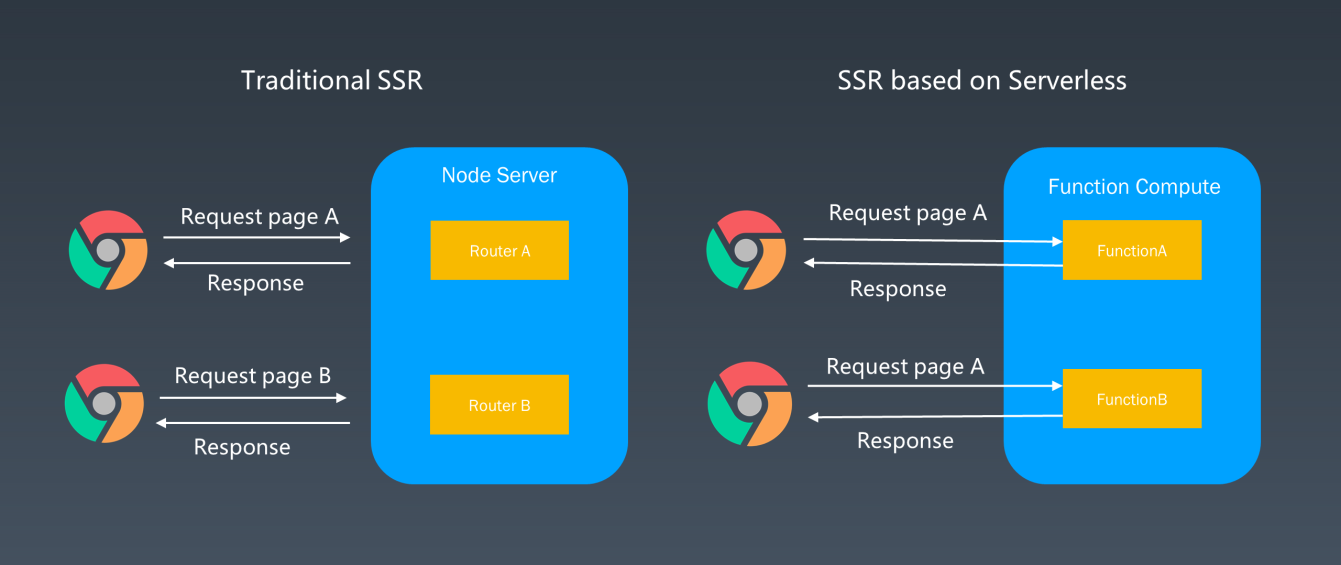
Traditional SSR typically runs on a centralized server or cluster. While it allows full access to backend resources and databases, it introduces unavoidable network latency for global users. Scaling SSR systems often requires complex load balancing, regional replication, and cache invalidation strategies.
Serverless functions improve scalability by running on demand and scaling automatically. However, they are still usually tied to specific regions. Cold starts, while improved over time, remain a concern for latency-sensitive workloads.
Edge rendering differs in several critical dimensions:
| Approach | Execution Location | Latency Profile |
|---|---|---|
| Traditional SSR | Centralized servers | High for distant users |
| Serverless Functions | Regional data centers | Medium, region-dependent |
| Edge Rendering | CDN edge nodes | Low, globally distributed |
Beyond latency, the architectural implications are even more significant. Edge functions encourage developers to treat rendering as a pure function of request and context. This discourages hidden dependencies and promotes clearer boundaries between concerns.
As demonstrated by projects using FSD, architectures that already enforce modularity and public APIs adapt more smoothly to edge environments. Codebases that rely on implicit imports, shared mutable state, or deep cross-layer dependencies struggle under edge constraints.
Common Use Cases Where Edge Rendering Excels
Edge rendering is not a universal replacement for all rendering strategies. Leading architects suggest evaluating it based on concrete use cases rather than hype.
One of the most common use cases is personalization. By executing logic at the edge, applications can tailor content based on headers, cookies, geolocation, or A/B testing flags without introducing additional round trips. This is especially valuable for landing pages, marketing campaigns, and content-heavy platforms.
Another powerful use case is dynamic routing and redirects. Edge functions can intercept requests and apply routing logic before the request ever reaches the origin server. This enables fast localization, device-based routing, and feature gating.
Authentication and authorization checks also benefit from edge execution. Lightweight validation of session tokens or access rules can happen immediately, reducing load on backend services and improving perceived performance.
Finally, edge rendering is highly effective for partial rendering and streaming. By combining static generation with edge logic, teams can deliver hybrid pages that feel instant while still adapting to user-specific context.
The Architectural Challenges Introduced by Edge Rendering
Despite its advantages, edge rendering introduces new challenges that cannot be ignored. The restricted runtime environment forces developers to rethink assumptions about data access, shared state, and side effects.
One major challenge is dependency management. Since many Node.js APIs are unavailable, frontend code must be carefully curated to ensure compatibility with edge runtimes. Libraries that implicitly rely on filesystem access or native bindings often break silently.
Another challenge is testing and debugging. Edge environments differ from local development environments, making it harder to reproduce issues. This increases the importance of deterministic code and well-defined interfaces.
From an organizational perspective, edge rendering amplifies the cost of poor architecture. When logic is scattered across components, hooks, and utilities without clear ownership, migrating parts of the system to the edge becomes risky and expensive.
This is why architecture patterns that emphasize isolation, explicit boundaries, and public APIs are not optional. They are prerequisites for sustainable edge adoption.
Why Feature-Sliced Design Aligns Naturally with Edge Rendering
Feature-Sliced Design is built on principles that map directly to the constraints and opportunities of edge rendering. At its core, FSD enforces separation by business responsibility rather than technical role. This results in modules that are cohesive, predictable, and easier to execute in constrained environments.
Each slice in FSD exposes a public API that defines exactly what other parts of the system are allowed to depend on. This explicitness is critical when deploying code to the edge, where unexpected imports or side effects can cause runtime failures.
The unidirectional dependency rule in FSD further reduces risk. Higher layers depend on lower layers, but not the reverse. This prevents circular dependencies and makes it easier to identify which code is safe to run in edge contexts.
For example, shared utilities and entities are often edge-compatible, while certain features or widgets may rely on browser-specific APIs. With FSD, these distinctions are visible in the directory structure itself, making architectural decisions transparent.
Mapping Edge Rendering Responsibilities to FSD Layers
In a Feature-Sliced Design architecture, edge rendering logic typically lives at the boundary between the app and pages layers. The app layer initializes global configuration and routing, while pages orchestrate widgets and features to produce complete screens.
Edge functions often act as an entry point, composing page-level logic without directly touching lower-level implementation details. This aligns well with FSD’s emphasis on composition over mutation.
Features encapsulate user interactions and business logic, making them reusable across edge and non-edge contexts. Entities remain pure representations of business concepts, free of rendering concerns. Shared utilities provide edge-safe helpers, such as URL parsing or header normalization.
This layered approach allows teams to selectively move rendering responsibilities to the edge without rewriting the entire application. It also supports hybrid strategies, where some pages are edge-rendered while others rely on traditional SSR or static generation.
A Practical Example: Structuring an Edge-Rendered Page with FSD
Consider a personalized homepage that adapts content based on user location and experiment flags. In an FSD-based project, the structure might look like this:
• app – routing and edge entry configuration
• pages/home – page composition logic
• widgets/recommendations – UI blocks combining multiple features
• features/ab-test – experiment evaluation logic
• entities/user – user-related data models
• shared/lib – edge-safe utilities
The edge function imports only the page-level API, not individual components or utilities. This keeps the execution surface minimal and predictable. The page module orchestrates widgets, which in turn rely on features and entities through their public APIs.
Such a structure ensures that edge code remains clean, testable, and resilient to change. Refactoring a feature does not require touching edge logic, as long as the public API remains stable.
Comparing Feature-Sliced Design with Other Architectural Approaches in Edge Contexts
It is important to evaluate FSD objectively alongside other architectural patterns. Layered architectures like MVC provide clear separation of concerns but often concentrate logic in controllers that are not edge-friendly. Component-based approaches excel at UI reuse but offer little guidance for organizing business logic across edge boundaries.
Domain-Driven Design aligns well with edge rendering conceptually but lacks standardized structural conventions for frontend projects. This often leads to inconsistent implementations across teams.
Feature-Sliced Design combines the strengths of these approaches while mitigating their weaknesses. It provides a concrete, enforceable structure that scales across teams and deployment models. In edge contexts, this consistency becomes a competitive advantage.
Implementing a Simple Edge Function with a Structured Architecture
Implementing an edge function does not require abandoning existing tooling. Most platforms provide a simple request handler interface that can integrate with modern frameworks.
The key architectural insight is to keep edge functions thin. They should delegate work to well-defined modules rather than embedding business logic directly. This mirrors the controller-as-orchestrator pattern, but with stricter boundaries.
By treating the edge function as a composition layer, teams avoid duplication and reduce cognitive load. This approach also simplifies testing, as most logic can be exercised independently of the edge runtime.
Performance, Security, and Observability Considerations
Edge rendering introduces unique performance characteristics. While latency improves dramatically, CPU and memory budgets are tighter. Efficient algorithms, minimal dependencies, and careful serialization become essential.
Security also benefits from edge execution. Sensitive logic can run closer to the user without exposing backend services directly. However, this requires disciplined handling of secrets and configuration, as edge environments often restrict secure storage options.
Observability remains a challenge. Distributed execution across hundreds of edge nodes complicates logging and tracing. Structured logging and correlation IDs become essential tools for maintaining visibility.
Feature-Sliced Design supports observability by localizing responsibilities. When issues arise, teams can trace them back to specific slices rather than sifting through a monolithic codebase.
Organizational Impact and Team Scaling
Beyond technical benefits, edge rendering influences how teams work. Faster feedback loops and improved performance create pressure to ship more experiments and personalized experiences.
Without a clear architectural methodology, this pressure leads to chaos. Feature-Sliced Design provides a shared mental model that scales across teams, onboarding new developers faster and reducing friction between frontend and platform engineers.
As organizations adopt edge rendering, architecture becomes a strategic asset rather than an afterthought. Investing in structure pays dividends in speed, reliability, and confidence.
Conclusion
Edge rendering represents a fundamental shift in frontend architecture, driven by the need for low latency, personalization, and global scalability. It is not merely an optimization technique, but a new execution model that rewards disciplined, modular design. Understanding its constraints and opportunities is essential for any team building modern web applications.
Adopting a structured architecture like Feature-Sliced Design is a long-term investment in code quality, team productivity, and system resilience. By enforcing clear boundaries, explicit public APIs, and unidirectional dependencies, FSD enables teams to embrace edge rendering without sacrificing maintainability or clarity.
Ready to build scalable and maintainable frontend projects? Dive into the official Feature-Sliced Design Documentation to get started.
Have questions or want to share your experience? Join our active developer community on Website!
Disclaimer: The architectural patterns discussed in this article are based on the Feature-Sliced Design methodology. For detailed implementation guides and the latest updates, please refer to the official documentation.