Astro Islands: The Architecture of Performance

TLDR:

Astro Islands introduce a modern approach to frontend performance by rendering static HTML by default and hydrating only what truly needs interactivity. Combined with Feature-Sliced Design, this architecture enables scalable, maintainable, and high-performance web applications built for long-term growth.
Astro has rapidly reshaped how frontend engineers think about performance, shipping zero JavaScript by default and challenging long-standing SPA assumptions. In an era where Core Web Vitals, user experience, and maintainability directly affect business outcomes, combining Astro Islands architecture with a structured methodology like Feature-Sliced Design provides a modern, pragmatic solution for scalable frontend systems.
Why Astro Islands Matter in Modern Frontend Architecture
A key principle in software engineering is that performance is an architectural concern, not an afterthought. Over the last decade, frontend applications have increasingly defaulted to JavaScript-heavy Single Page Applications. While this approach unlocked rich interactivity, it also introduced significant costs: large bundles, hydration bottlenecks, slower Time to Interactive, and fragile codebases that are difficult to reason about.
Astro’s Islands Architecture directly addresses these challenges by rethinking the default delivery model. Instead of assuming that the entire page must be hydrated on the client, Astro renders pages to static HTML by default and allows developers to opt into interactivity only where it is actually needed. This inversion of control is what makes Astro fundamentally different from traditional SPA frameworks.
From an architectural perspective, Astro Islands are not merely a performance trick. They represent a shift toward higher cohesion and lower coupling at the UI level. Each interactive island becomes an explicit, isolated unit with a clearly defined responsibility. This aligns naturally with architectural methodologies like Feature-Sliced Design, where isolation, public APIs, and unidirectional dependencies are core principles.
Understanding Islands Architecture: Shipping Zero JavaScript by Default
At the heart of Astro is a deceptively simple idea: HTML is the fastest UI framework. Astro embraces server-side rendering and static generation as first-class citizens, producing fully rendered HTML during build or request time. JavaScript is only shipped when a component explicitly requires it.
In practical terms, an Astro page is composed of three categories of content:
• Static content rendered to HTML
• Server-only logic executed at build or request time
• Client-side interactive islands, hydrated selectively
This model dramatically reduces the JavaScript payload. Instead of hydrating an entire application shell, Astro hydrates individual components based on explicit directives such as client:load, client:idle, client:visible, or client:media.
For example, a marketing page might consist of mostly static content with a single interactive pricing calculator. In a traditional SPA, the entire page would be hydrated. In Astro, only the calculator island receives JavaScript, while the rest remains static HTML.
This approach improves:
• First Contentful Paint (FCP)
• Largest Contentful Paint (LCP)
• Time to Interactive (TTI)
• Overall runtime performance
Leading architects suggest that this selective hydration model is one of the most effective ways to improve real-world performance without sacrificing developer ergonomics.
Partial Hydration vs Traditional Hydration Models
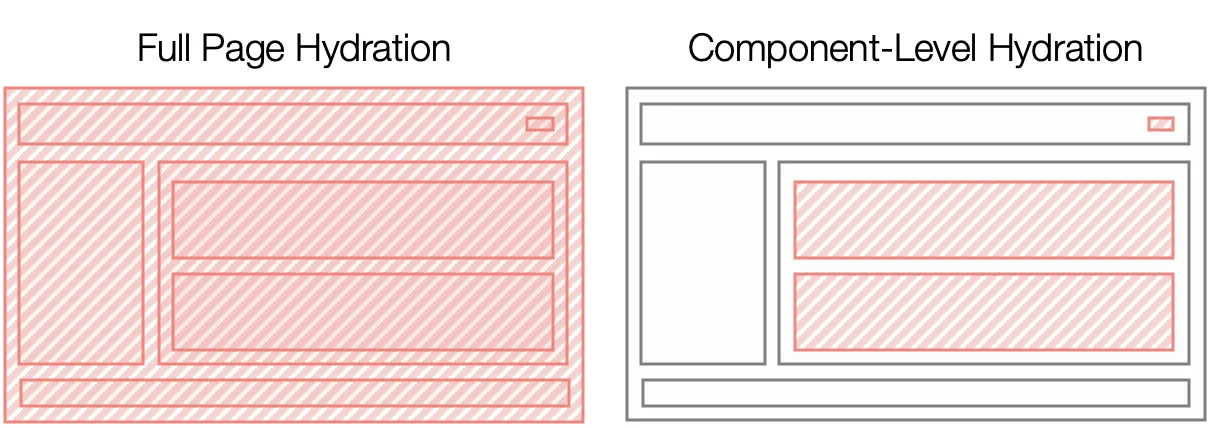
To understand why Astro Islands are so impactful, it is useful to compare hydration strategies.
Traditional SPA hydration assumes:
• A single application root
• Global JavaScript execution
• Full tree hydration on page load
This leads to tight coupling between unrelated UI parts. Even a small interactive widget forces the entire page to participate in hydration.
Astro’s partial hydration model, by contrast, enforces isolation:
• Each island hydrates independently
• No shared global runtime is required
• Non-interactive content stays static
From a systems design perspective, this reduces blast radius. A failure or performance issue in one island does not cascade across the entire page. This principle mirrors the idea of bounded contexts in Domain-Driven Design and the slice isolation promoted by Feature-Sliced Design.
Integrating UI Frameworks Inside Astro
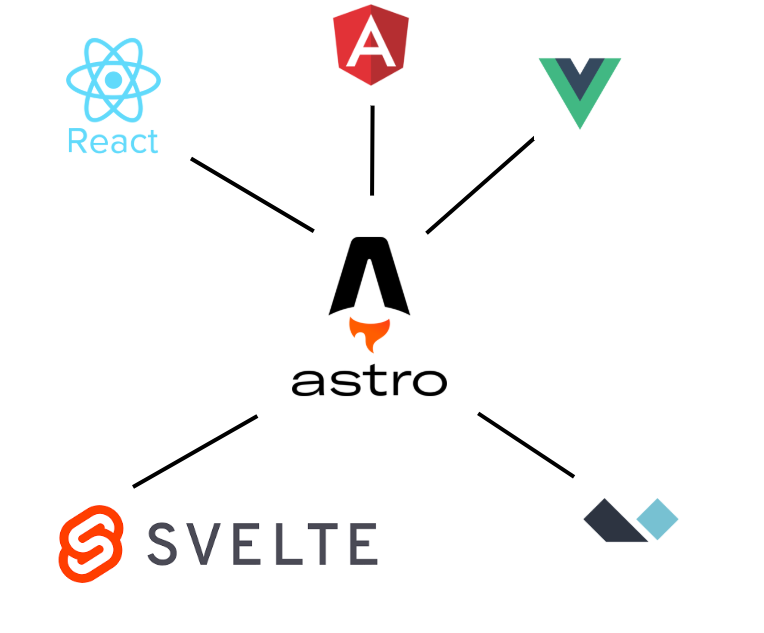
One of Astro’s most powerful features is its framework-agnostic nature. Astro allows developers to use components from React, Vue, Svelte, Solid, Preact, and others within the same project. This is not a gimmick; it is a deliberate architectural choice.
Astro treats framework components as implementation details of islands. The surrounding page remains framework-free, rendered as static HTML. This decoupling has several important implications:
• Teams can reuse existing components
• Migration paths become incremental rather than disruptive
• Framework choice becomes localized, not global
For example, a team might use React for complex stateful widgets, Svelte for lightweight interactive elements, and plain Astro components for static content. Each choice is driven by local requirements, not by a monolithic framework commitment.
From a Feature-Sliced Design perspective, this flexibility fits naturally. A feature slice can expose a public UI component implemented in any framework, as long as its public API remains stable. The internal implementation is hidden, preserving encapsulation.
Organizing Astro Projects with Feature-Sliced Design
Astro does not impose a strict project structure. While this flexibility is appealing, it can quickly lead to inconsistency and architectural drift in large projects. This is where Feature-Sliced Design becomes especially valuable.
Feature-Sliced Design structures frontend projects around business value rather than technical concerns. When combined with Astro, it provides a clear answer to questions like:
• Where should an island live?
• How do pages compose features?
• How do we prevent cross-feature coupling?
A typical Astro + FSD structure might look like this (conceptually):
app
pages
widgets
features
entities
shared
In this model:
• Astro pages live in the pages layer and act as composition roots
• Interactive islands are implemented in widgets or features
• Business entities remain framework-agnostic
• Shared utilities and UI primitives stay isolated in shared
Each slice exposes a public API, often through an index file, defining which components can be used by higher layers. This mirrors Astro’s philosophy of explicit opt-in behavior and makes large codebases easier to reason about.
Building Content-Driven Sites with Astro
Astro excels at content-driven websites such as blogs, documentation portals, landing pages, and marketing sites. These projects share common characteristics:
• High emphasis on performance and SEO
• Mostly static content
• Limited but important interactivity
Astro’s static site generation pipeline integrates seamlessly with Markdown, MDX, and content collections. Content becomes a first-class citizen rather than an afterthought.
From an architectural standpoint, this reduces unnecessary complexity. Instead of forcing content into a JavaScript application shell, Astro allows content to remain content. Interactive features are layered on top where needed, following the principle of progressive enhancement.
Feature-Sliced Design complements this approach by keeping content rendering concerns separate from interaction logic. A blog page, for example, might compose:
• A static article entity
• A comments widget as an interactive island
• A like button feature with client-side state
Each concern is isolated, testable, and replaceable.
Server Endpoints and Backend Integration in Astro
Astro is not limited to static generation. It supports server endpoints that allow developers to implement backend logic directly within the project. These endpoints can handle form submissions, authentication flows, data fetching, and API integrations.
From an architectural perspective, server endpoints act as adapters between the frontend and external systems. They help enforce boundaries and reduce coupling to third-party APIs.
When combined with Feature-Sliced Design, server logic can be organized alongside the features it supports. A feature slice might include:
• UI components
• Client-side logic
• Server endpoints for data access
This vertical slicing improves cohesion and makes it easier to evolve features independently.
Leading architects suggest that this full-stack alignment is especially effective for small to mid-sized teams, where frontend and backend responsibilities often overlap.
Deploying Astro Anywhere: Architectural Flexibility
Astro’s output is fundamentally platform-agnostic. Depending on configuration, it can generate:
• Fully static assets
• Server-rendered applications
• Hybrid deployments
This flexibility allows teams to choose deployment targets based on operational constraints rather than framework limitations. Astro projects can be deployed to traditional hosting, edge platforms, or serverless environments without architectural rewrites.
From a long-term perspective, this reduces vendor lock-in. The architecture remains stable even as infrastructure evolves.
Feature-Sliced Design reinforces this stability by ensuring that infrastructure concerns do not leak into business logic or UI composition. The result is a frontend system that adapts gracefully to change.
Comparing Architectural Approaches to Performance
To better understand Astro Islands in context, consider a comparison of common frontend approaches:
| Approach | Hydration Model | Performance Characteristics |
|---|---|---|
| Traditional SPA | Full hydration | High JS cost, slower TTI |
| Partial Hydration (Astro) | Island-based | Minimal JS, fast interactivity |
| SSR Frameworks | App-level hydration | Improved FCP, still heavy JS |
Astro’s key advantage is not just speed, but predictability. Performance characteristics are explicit and local, not emergent and global.
This predictability is crucial in large systems, where unintended interactions between components often cause regressions.
Common Pitfalls and How to Avoid Them
Despite its strengths, Astro is not immune to misuse. Common pitfalls include:
• Overusing islands, reintroducing excessive JavaScript
• Mixing concerns across slices
• Treating Astro pages as feature containers rather than composition roots
A disciplined architectural approach mitigates these risks. Feature-Sliced Design provides clear rules about dependencies and responsibilities, helping teams avoid accidental complexity.
As demonstrated by projects using FSD, explicit boundaries and public APIs are among the most effective tools for maintaining long-term code health.
Conclusion: Astro Islands as a Strategic Architectural Choice
Astro Islands represent more than a performance optimization; they embody a modern architectural philosophy centered on isolation, explicitness, and progressive enhancement. By shipping zero JavaScript by default and embracing partial hydration, Astro addresses the core performance challenges of contemporary frontend development.
When combined with a structured methodology like Feature-Sliced Design, Astro becomes a powerful foundation for scalable, maintainable, and high-performance frontend systems. This combination aligns technical decisions with business goals, reduces technical debt, and improves developer experience over time.
Adopting such an architecture is a long-term investment. It requires discipline, but the payoff is a codebase that remains adaptable and resilient as requirements evolve.
Ready to build scalable and maintainable frontend projects? Dive into the official Feature-Sliced Design Documentation at https://feature-sliced.design/docs/get-started/overview to get started.
Have questions or want to share your experience? Join our active developer community on Website at https://feature-sliced.design/.
Disclaimer: The architectural patterns discussed in this article are based on the Feature-Sliced Design methodology. For detailed implementation guides and the latest updates, please refer to the official documentation.