특징
명시적 비즈니스 로직
도메인별로 코드를 구분해 필요한 로직을 즉시 찾을 수 있습니다.
유연성
요구사항이 바뀌어도 구성 요소를 간편하게 교체·확장합니다.
기술 부채 최소화
모듈을 독립적으로 수정·리팩터링해 부작용을 없앱니다.
명시적 코드 재사용
DRY 원칙과 로컬 커스터마이징 사이에서 균형을 잡습니다.
개념
공용 API
모든 모듈은 최상위 수준에 공용 API를 노출해야 합니다.
격리
같은 Layer 또는 상위 Layer에 직접 의존하지 않습니다.
요구사항 중심
비즈니스와 사용자 요구를 설계의 기준으로 삼습니다.
구조
FSD 도입 기업
Feature-Sliced Design: Concept and Importance
Feature-Sliced Design is a modern architectural methodology tailored for building scalable front-end applications, particularly in the React ecosystem. The core principle is to organize project structure by focusing on application features rather than purely technical layers. In traditional paradigms, developers often group code by technical concerns—such as components, services, or styles—leading to monolithic files and complicated dependencies. Feature-Sliced Design addresses these issues by placing features at the forefront. This approach promotes a cleaner, more intuitive structure that streamlines collaboration and maintenance. From an EEAT standpoint (Expertise, Experience, Authoritativeness, and Trustworthiness), Feature-Sliced Design demonstrates its value by emphasizing best practices that are well-recognized within the React community. Its feature-centered mindset ensures each piece of functionality remains coherent and easier to extend, contributing to a trustworthy and robust codebase.
History and Origin
The roots of Feature-Sliced Design can be traced back to ongoing community discussions about how to effectively manage complexity in large-scale front-end projects. Developers realized that standard file-grouping methods, whether by type or layer (for instance, "components," "containers," "services"), often failed to scale gracefully. Over time, the concept evolved through collaborative input from open-source contributors and thought leaders who recognized the need for a more intuitive and business-oriented approach. Although Feature-Sliced Design shares conceptual similarities with domain-driven design and modular architectures, it is specifically tailored to tackle React's component-driven nature, ensuring that complexities remain compartmentalized and that boundaries are clearly defined.
Key Elements of Feature-Sliced Design
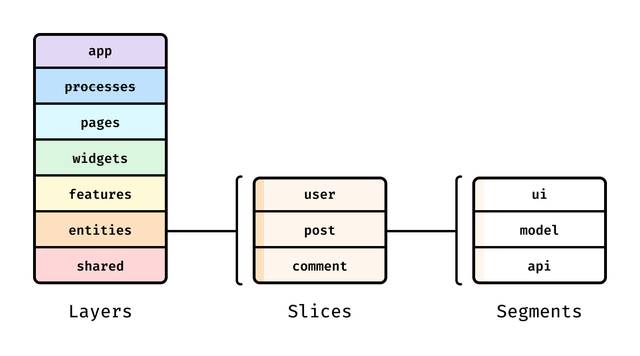
At the heart of this methodology are distinct layers, slices, and segments. Each layer groups the application's parts in a way that reflects the user's journey and the business logic rather than technical minutiae. Slices break down major features into smaller domains, and segments provide clarity within those slices, capturing subtasks or subcomponents in a logically separated manner. By structuring a project with these elements, developers create code that is more approachable, testable, and easier to onboard new team members into.
Benefits for Large-Scale React Projects
One of the major advantages in adopting Feature-Sliced Design is that it naturally accommodates growth. Large-scale React applications often suffer from tangled dependencies as features expand. By centering each part of the application on specific features, it becomes far simpler to isolate bugs, roll out new functionality, and refactor existing code. This architectural clarity drives higher maintainability and reduces the likelihood of regressions. From a team perspective, individuals can work in parallel on different slices without stepping on each other's toes, accelerating both feature development and knowledge sharing across the organization.
When to Apply Feature-Sliced Design
Although suitable for projects of various sizes, Feature-Sliced Design truly shines when an application begins to scale beyond a few simple pages or components. If your React project is rapidly growing or when multiple teams are collaborating, it is prudent to apply Feature-Sliced Design. This structured approach provides a robust foundation that can gracefully adapt to new requirements. Even in smaller projects, adopting at least some of its principles can help maintain a tidy and future-proof codebase.
Comparison with Traditional Architectures (MVC, MVP)
In frameworks such as MVC (Model-View-Controller) or MVP (Model-View-Presenter), functionality is commonly separated by layers of responsibility. While these approaches have been foundational in software development, they don't always align neatly with modern, component-based libraries like React. Feature-Sliced Design, by contrast, goes a step further in aligning the entire codebase around features and user flows, making it more intuitive when dealing with reusable components and complex state management. In essence, MVC or MVP can sometimes force front-end developers to mold their code around classical backend-centric architecture, whereas Feature-Sliced Design embraces the patterns that best suit React's inherently modular design.
Distinguishing Feature-Sliced from Atomic Design
Atomic Design focuses on building interfaces from the smallest possible elements (atoms) up to more complex structures (molecules, organisms, templates, and pages). Feature-Sliced Design also embraces modularity but is primarily driven by business logic and user features. While Atomic Design is powerful for creating reusable UI libraries, Feature-Sliced Design explicitly addresses how features relate to each other and to the overall application. Both can coexist in a single project, but their focal points are different: Atomic Design is primarily concerned with UI consistency and reusability, whereas Feature-Sliced centers around application flow and domain complexity.
Common Terms (Layer, Slice, Segment)
Layers encapsulate the architectural tiers that group related parts of the application. In many examples, these layers might be labeled as apps, processes, pages, features, entities, and shared. Slices are the conceptual boundaries for distinct features, ensuring each set of functionalities or modules stands on its own. Within those slices, segments represent more granular subdivisions for organizing components, logic, and utilities specific to that particular feature. These terms collectively form a mental model that keeps the application tidy and easy to navigate.
Initial Difficulties and Learning Curve
Developers coming from more traditional file- or component-based structures may find it challenging to adopt Feature-Sliced Design. The primary learning curve often involves training one's mindset to think in terms of features rather than simply components or services. Configuring the directory layout can also seem daunting at first, especially when deciding how to slice the application's functionalities. Nonetheless, once these initial hurdles are overcome, teams usually discover that Feature-Sliced Design fosters a more maintainable and intuitive workflow.
Case Study: Building a Simple To-Do App with Feature-Sliced Design
Imagine a small to-do application with features like adding tasks, marking tasks complete, and filtering active or completed items. Under Feature-Sliced Design, each feature—task creation, task completion, and task filtering—would be its own slice, containing components, logic, and styles specifically for that function. The layers would separate application-level concerns (like user authentication or routing) from shared utilities and UI elements. Each slice might have its own local state management for tasks, which can be lifted or shared at the higher layers if global state becomes necessary. Although the app remains simple, the immediate benefit is clear: any developer joining the project can quickly see where each functionality resides and how it interacts with the rest of the application, eliminating guesswork and streamlining future enhancements.
In summary, Feature-Sliced Design presents a practical and forward-looking approach to structuring React projects. By prioritizing features as the foundational building blocks, it offers clarity and scalability that traditional architectures often lack. Whether you are building a small side project or architecting an enterprise-level platform, incorporating Feature-Sliced Design principles can be a catalyst for more organized development, smoother collaboration, and a codebase that stands the test of time.