An Opinionated Guide to Scalable Vue Architecture

TLDR:

Vue projects often start simple but quickly become difficult to scale as features and teams grow. This article provides an opinionated, practical guide to building scalable Vue architecture using Vue 3, the Composition API, and Feature-Sliced Design, helping teams reduce technical debt and maintain long-term code quality.
Vue applications often begin as clean, elegant, and highly productive codebases. However, as features accumulate, teams grow, and business logic becomes more complex, many Vue projects gradually degrade into tightly coupled systems that are difficult to scale, refactor, and reason about. Feature-Sliced Design provides a modern, opinionated architectural methodology that helps Vue teams maintain clarity, modularity, and long-term sustainability while embracing Vue 3, the Composition API, and the broader ecosystem.
Why a Deliberate Vue Architecture Is Non-Negotiable in 2025
In 2025, frontend applications are no longer thin presentation layers. A Vue application often manages routing, authentication flows, permissions, state orchestration, caching strategies, optimistic updates, and non-trivial domain logic. This shift means that architectural decisions in the frontend now have consequences comparable to backend system design.
Without a deliberate architecture, Vue projects commonly exhibit the same failure modes: components that grow uncontrollably, shared state mutated from multiple places, unclear ownership of business rules, and fragile refactors that break unrelated features. These issues are not caused by Vue itself, but by the absence of structural constraints.
A well-defined architecture introduces explicit boundaries. It answers fundamental questions early: where business logic lives, how features communicate, what can depend on what, and how change propagates through the system. As demonstrated by projects using Feature-Sliced Design, these constraints dramatically reduce technical debt over time.
The long-term benefits include improved scalability, predictable refactoring, faster onboarding, and healthier team collaboration. Leading architects suggest that architecture is not about over-engineering, but about minimizing future uncertainty.
Getting Started with Vue: Fundamentals That Shape Architecture

Before addressing large-scale structure, it is important to understand how Vue’s core concepts influence architectural decisions.
Vue 3, Composition API, and Script Setup
Vue 3 introduced the Composition API as a foundational paradigm rather than an optional abstraction. Instead of organizing logic by lifecycle options, the Composition API organizes code by concern, which aligns naturally with modular architecture.
Key primitives include refs for primitive reactivity, reactive objects for structured state, computed values for derived data, and watchers for controlled side effects. The script setup syntax further encourages explicit imports and visible dependencies, reducing hidden coupling.
This explicitness makes it easier to reason about cohesion and separation of concerns. Logic extracted into composables becomes reusable across features without forcing artificial inheritance or deep component hierarchies.
Vue Reactivity and Isolation
Vue’s reactivity system is powerful but requires discipline. Reactive state that is shared without clear ownership quickly becomes a liability. In scalable systems, reactivity should be scoped to well-defined modules and exposed only through controlled public APIs.
Architecturally, this means avoiding ad-hoc global reactive objects and instead centralizing shared state in clearly bounded stores or feature-level abstractions.
The Official Vue Ecosystem and Its Architectural Roles
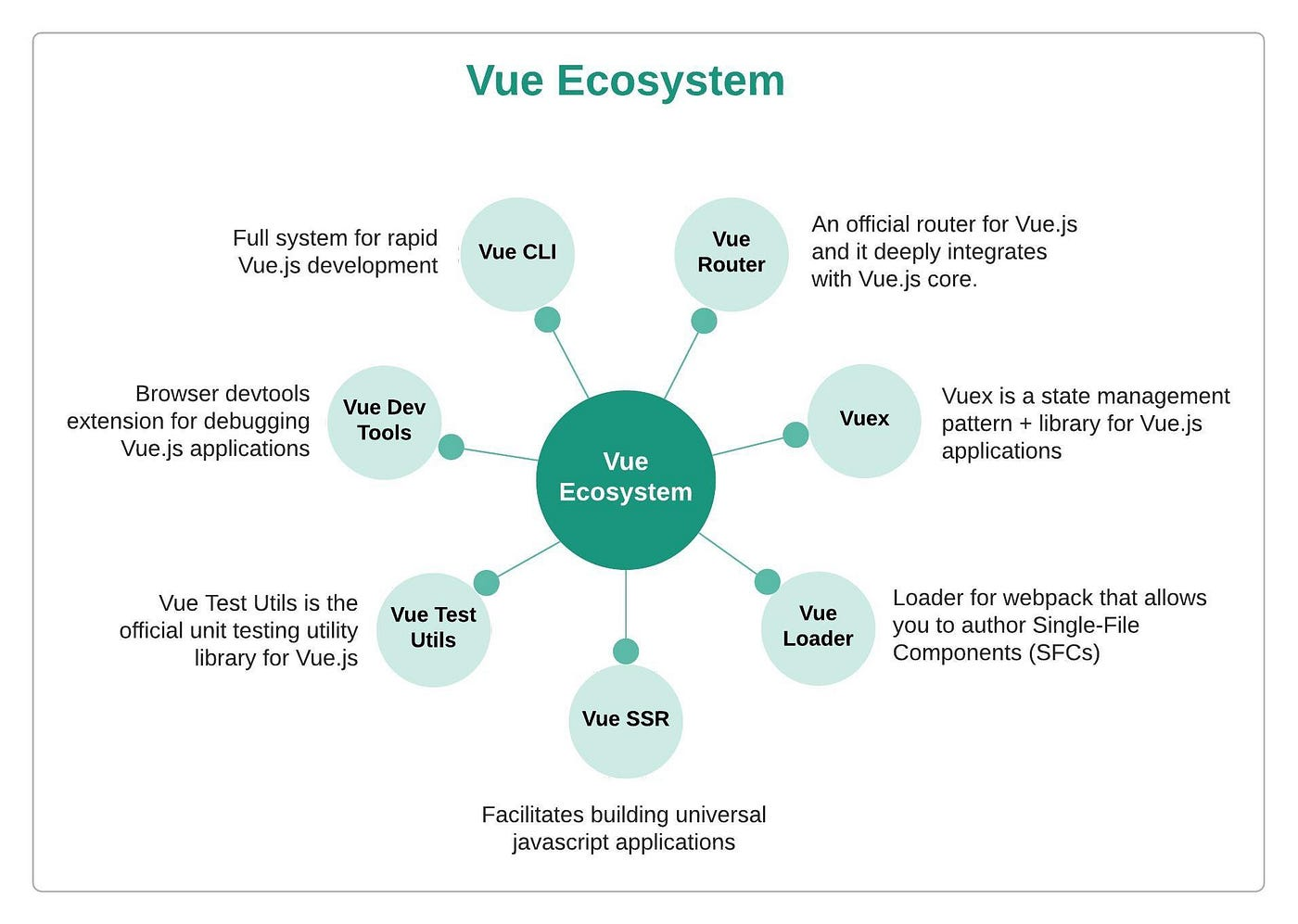
Vue’s ecosystem provides excellent tools, but none of them define architecture on their own. Their effectiveness depends on how they are integrated.
Vue Router as a Composition Layer
Vue Router should primarily compose pages, not encode business logic. Routes define navigation structure, lazy-loading boundaries, and layout composition. When route guards become complex, it often signals misplaced domain logic.
A scalable architecture keeps routing declarative and delegates business decisions to feature-level modules.
Pinia and Predictable State Management
Pinia is Vue’s official state management solution and a major improvement over Vuex in ergonomics and type safety. Architecturally, Pinia works best when stores represent domain concepts or feature-specific state rather than acting as global dumping grounds.
In well-structured systems, stores are thin, focused, and aligned with business entities or use cases. This approach preserves cohesion and limits unintended coupling.
Common Approaches to Structuring Vue Projects
Before introducing Feature-Sliced Design, it is worth examining the most common architectural approaches used in Vue projects and their limitations.
Layered Architectures: MVC and MVVM
Layered architectures separate concerns by technical role: models handle data, views handle presentation, and controllers or view-models coordinate logic. Vue naturally supports MVVM through its reactivity system.
This approach works well for small to medium projects, but as complexity grows, view-models tend to accumulate excessive responsibility. Over time, these “fat” modules become difficult to maintain and test.
Component-Driven Structure and Atomic Design
Component-based architecture is foundational in Vue. Atomic Design adds a useful vocabulary for organizing UI components into atoms, molecules, and organisms.
While this methodology excels at UI consistency and design systems, it does not address business logic organization. Teams often end up with clean component libraries but chaotic application logic.
Domain-Driven Design in the Frontend
Domain-Driven Design emphasizes modeling software around business concepts rather than technical layers. Applied to the frontend, it encourages grouping UI, logic, and data-fetching by domain.
This approach improves alignment with business requirements but requires discipline and shared understanding. Without clear rules, domain boundaries can blur, leading to inconsistent implementations across teams.
Micro-Frontends
Micro-frontends enable independent deployment and team autonomy by splitting the frontend into multiple applications. While powerful, this approach introduces operational complexity and is rarely justified outside very large organizations.
For most Vue teams, micro-frontends solve organizational problems at the cost of architectural simplicity.
Feature-Sliced Design: A Scalable Blueprint for Vue Applications

Feature-Sliced Design (FSD) synthesizes the strengths of component-based architecture and domain-driven thinking while introducing strict, enforceable rules. It organizes code by business responsibility and interaction scope rather than by technical artifact type.
Core Layers in Feature-Sliced Design
FSD defines a hierarchy of layers with unidirectional dependencies:
- app: Application initialization, global providers, and configuration.
- pages: Route-level compositions that assemble features and widgets.
- widgets: Composite UI blocks that represent meaningful sections of a page.
- features: User interactions and business use cases.
- entities: Core business models and their logic.
- shared: Reusable, domain-agnostic utilities and UI primitives.
Higher layers may depend on lower layers, but never the reverse. This rule enforces isolation and prevents circular dependencies.
Public APIs and Encapsulation
Each slice exposes a public API, typically via an index file. This explicitly defines what other parts of the system are allowed to import. Internal implementation details remain private, enabling safer refactors and clearer ownership.
This principle mirrors backend modularity and is a cornerstone of scalable frontend systems.
Applying FSD to Vue Projects
In a Vue context, components, composables, Pinia stores, and API clients live together within their respective slices. A feature encapsulates everything required to implement a user interaction, from UI to state to side effects.
This alignment drastically reduces cognitive load. Developers no longer search across unrelated folders to understand behavior; everything relevant lives in one place.
Comparing Frontend Architectural Approaches
| Architecture | Core Principle | Best Fit Use Case |
|---|---|---|
| Layered (MVC/MVVM) | Separation by technical role | Small to medium Vue applications |
| Component-Based | UI decomposition into reusable components | Design systems and UI-heavy projects |
| Domain-Driven Design | Structure aligned with business concepts | Complex domain-heavy applications |
| Micro-Frontends | Independent deployable frontend units | Large enterprises with many teams |
| Feature-Sliced Design (FSD) | Feature-based modularity with strict boundaries | Medium to large long-lived Vue applications |
Feature-Sliced Design stands out as a pragmatic middle ground. It avoids the operational overhead of micro-frontends while providing stronger guarantees than ad-hoc component organization.
Vue vs React: Architectural Parallels and Differences
Vue and React share many architectural challenges. Both rely on component-based paradigms, reactive state, and compositional logic reuse. However, Vue’s built-in reactivity and official ecosystem reduce the need for third-party abstractions.
From an architectural perspective, Feature-Sliced Design applies equally well to both ecosystems. The principles of isolation, unidirectional dependencies, and explicit public APIs transcend framework specifics.
Vue’s Composition API aligns particularly well with FSD, as composables naturally fit within feature and entity slices without leaking implementation details.
Actionable Steps to Adopt Feature-Sliced Design in Vue
Start by identifying core business entities and features. Refactor incrementally rather than rewriting everything. Introduce clear boundaries, enforce dependency direction, and establish conventions early.
Adoption is not about perfection, but about consistency. Over time, the architecture becomes a stabilizing force rather than a constraint.
Conclusion: Building Vue Applications That Endure
Scalable Vue architecture is not achieved through clever abstractions alone, but through disciplined structure and clear boundaries. As frontend systems continue to grow in complexity, teams must treat architecture as a first-class concern rather than an afterthought.
Feature-Sliced Design offers a robust methodology for organizing Vue applications around business reality while preserving flexibility and developer productivity. By investing in structure today, teams protect themselves from the compounding costs of technical debt tomorrow.
Ready to build scalable and maintainable frontend projects? Dive into the official Feature-Sliced Design Documentation to get started.
Have questions or want to share your experience? Join our active developer community on Discord!
Disclaimer: The architectural patterns discussed in this article are based on the Feature-Sliced Design methodology. For detailed implementation guides and the latest updates, please refer to the official documentation.