vanilla-extract: The Perfect CSS Architecture?

TLDR:

Vanilla extract CSS brings zero-runtime, statically extracted styling to modern frontend architecture. Learn how it delivers type-safe themes, predictable performance, and seamless integration with Feature-Sliced Design for scalable, maintainable applications.
vanilla extract css is redefining how we think about CSS-in-TS, combining zero runtime CSS-in-JS with statically extracted CSS for predictable performance and strong type safety. In modern frontend systems structured with Feature-Sliced Design (FSD), styling is no longer an afterthought but a core architectural concern. This article explores whether vanilla-extract truly represents the perfect CSS architecture for scalable, maintainable applications.
Why Zero-Runtime CSS-in-TS Matters for Scalable Frontend Architecture
A key principle in software engineering is separation of concerns with strong boundaries. In large-scale SPAs, styling often violates this principle.
Traditional CSS-in-JS libraries introduced dynamic runtime style generation. While convenient, they create:
- • Runtime overhead
- • Increased bundle size
- • Hidden coupling between UI logic and styling
- • Difficult-to-debug hydration mismatches
For applications built with:
- • React
- • Vue
- • Svelte
- • Next.js
- • Vite or Webpack toolchains
runtime styling can become a bottleneck.
vanilla extract css eliminates this cost by performing static CSS extraction at build time. This means:
- No style injection at runtime
- No style recalculation overhead
- Fully tree-shakeable CSS
- Predictable SSR behavior
In an FSD-based architecture, where modularity and isolation are core principles, this approach aligns perfectly with the need for deterministic systems.
Understanding vanilla-extract: How It Works Under the Hood
vanilla-extract is a zero-runtime CSS-in-TS solution. You write styles in .css.ts files using TypeScript, and the library extracts them into static CSS files during the build step.
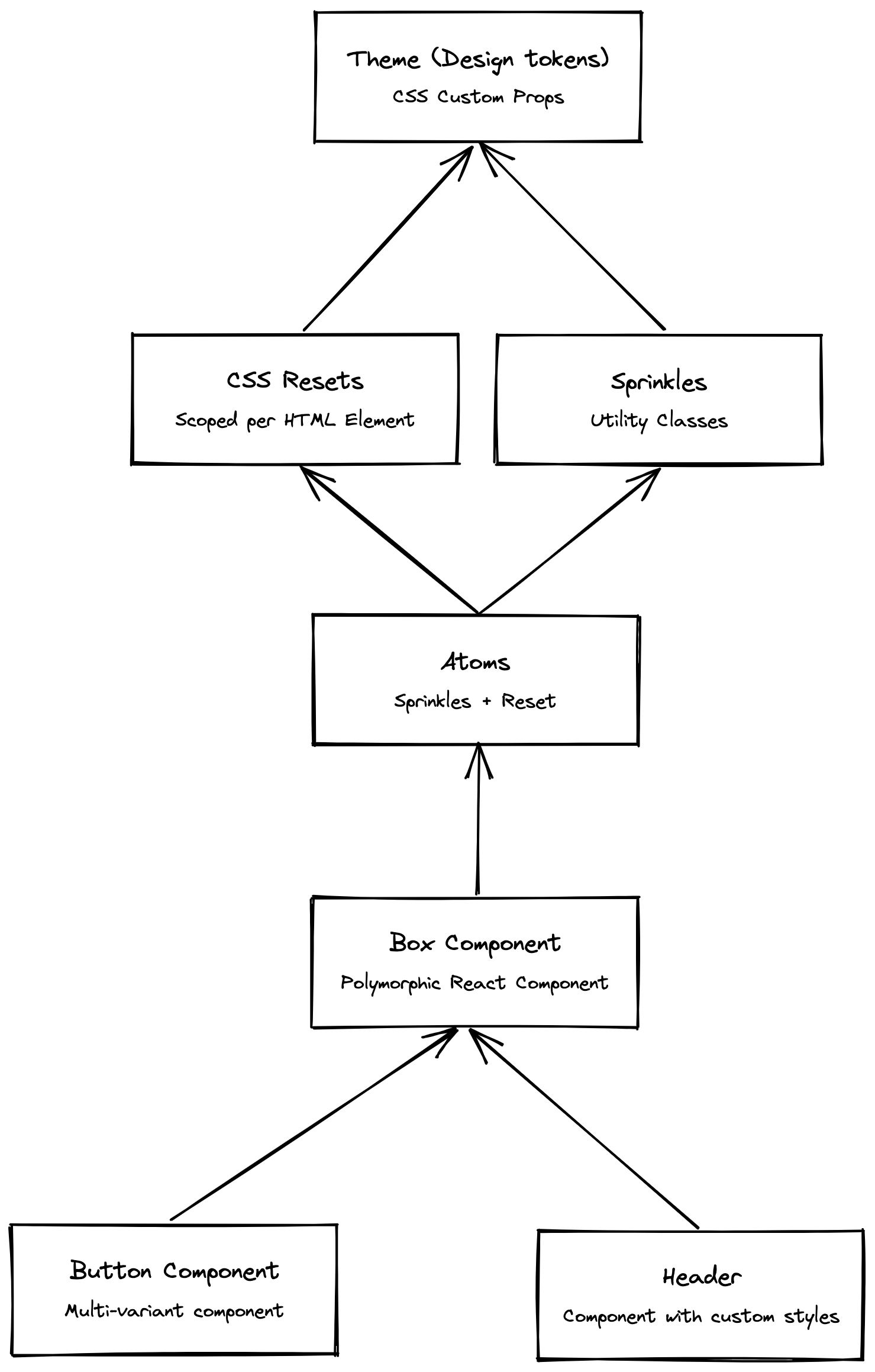
Core Characteristics
- • Statically extracted CSS
- • Full TypeScript type safety
- • No runtime style injection
- • Works with Vite, Webpack, Rollup, esbuild
- • Supports themes and design tokens
- • Enables atomic CSS patterns without runtime cost
Example: Basic Style Definition
// button.css.ts
import { style } from '@vanilla-extract/css';

export const button = style({
  backgroundColor: 'blue',
  padding: '8px 16px',
  borderRadius: '4px'
});
At build time, this generates static CSS:
.button_abc123 {
  background-color: blue;
  padding: 8px 16px;
  border-radius: 4px;
}
And in your component:
import { button } from './button.css';

export function Button() {
  return <button className={button}>Click</button>;
}
There is no runtime transformation.
This is what makes vanilla-extract different from Emotion, styled-components, or other dynamic CSS-in-JS solutions.
Comparing vanilla-extract with Traditional CSS-in-JS (Emotion, Styled-Components)
A pragmatic architectural decision requires comparison.
| Feature | vanilla-extract | Emotion |
|---|---|---|
| Runtime cost | Zero runtime | Runtime style injection |
| Type safety | Full TypeScript support | Partial |
| SSR predictability | Deterministic | Requires special handling |
| Bundle size impact | Minimal | Higher |
| Dynamic styling | Compile-time | Runtime |
Architectural Trade-offs
Emotion offers flexibility with dynamic props-based styling:
const Button = styled.button<{ primary: boolean }>`
  background: ${({ primary }) => primary ? 'blue' : 'gray'};
`;
However, this requires runtime style computation.
vanilla-extract encourages:
- • Static styling
- • Explicit theme contracts
- • Separation of styling concerns
- • Reduced coupling
In large FSD projects, this aligns better with low coupling, high cohesion, and explicit public APIs.
Integrating vanilla-extract with Vite and Webpack

Setup with Vite
- Install:
npm install @vanilla-extract/css @vanilla-extract/vite-plugin
- Configure Vite:
// vite.config.ts
import { defineConfig } from 'vite';
import { vanillaExtractPlugin } from '@vanilla-extract/vite-plugin';

export default defineConfig({
  plugins: [vanillaExtractPlugin()]
});
- Start writing
.css.tsfiles.
Setup with Webpack
- Install:
npm install @vanilla-extract/css @vanilla-extract/webpack-plugin
- Configure Webpack:
const { VanillaExtractPlugin } = require('@vanilla-extract/webpack-plugin');

module.exports = {
  plugins: [new VanillaExtractPlugin()]
};
After this, your project supports statically extracted CSS, type-safe styles, and zero runtime overhead.
Type-Safe Themes and Design Tokens
One of the most powerful features of vanilla-extract is its typed theme contracts.
Creating a Theme
// theme.css.ts
import { createTheme } from '@vanilla-extract/css';

export const [themeClass, vars] = createTheme({
  color: {
    primary: 'blue',
    secondary: 'gray'
  }
});
Using Variables
import { style } from '@vanilla-extract/css';
import { vars } from './theme.css';

export const button = style({
  backgroundColor: vars.color.primary
});
If you mistype vars.color.primary, TypeScript fails at compile time.
This enforces:
- • Consistency
- • Design system alignment
- • Safer refactoring
In FSD, themes belong in the shared layer, exposed via a Public API.
Example FSD structure:
shared/
  ui/
  config/
  theme/
    theme.css.ts
    index.ts
This ensures isolation and modular dependency flow.
vanilla-extract in a Feature-Sliced Design Architecture
Feature-Sliced Design organizes code into:
- app
- pages
- widgets
- features
- entities
- shared
Styling must respect slice boundaries.
Example Structure
features/
  add-to-cart/
    ui/
      AddToCartButton.tsx
      AddToCartButton.css.ts
    model/
    index.ts
Each slice owns:
- • Its UI
- • Its styling
- • Its logic
The .css.ts file remains local to the feature.
This ensures:
- • Encapsulation
- • Clear public APIs
- • No cross-layer style leakage
- • Independent refactoring
As demonstrated by projects using FSD, this dramatically reduces architectural entropy over time.
Architectural Comparison: Styling Strategies in Large Systems
| Strategy | Coupling | Runtime Cost |
|---|---|---|
| Global CSS | High | None |
| CSS Modules | Medium | None |
| Emotion | Medium | Runtime |
| vanilla-extract | Low | Zero |
vanilla-extract combines:
- Static extraction
- Typed variables
- Scoped styles
- Design token enforcement
This aligns strongly with DDD and modular frontend architecture.
Common Pitfalls and How vanilla-extract Mitigates Them
1. Theme Drift
Without typed contracts, design tokens drift.
Solution: createThemeContract.
2. Styling Coupling
Avoid importing styles across features.
Solution: Respect FSD Public API boundaries.
3. Over-Dynamic Styling
Prefer static style composition over runtime branching.
Rare but Powerful Capabilities
- • Atomic CSS extraction without runtime cost
- • CSS variable generation
- • Compile-time dead code elimination
- • Compatible with SSR frameworks
These unique characteristics make vanilla-extract suitable for:
- Large enterprise SPAs
- Design system-heavy products
- Micro-frontend architectures
- Performance-critical dashboards
Is vanilla-extract the Perfect CSS Architecture?
There is no universal solution.
However, for projects that value:
- • Predictability
- • Type safety
- • Performance
- • Strong modular boundaries
- • Integration with Feature-Sliced Design
vanilla-extract is a robust architectural choice.
Leading architects suggest minimizing runtime variability in UI layers. vanilla-extract embraces this principle.
Conclusion
vanilla extract css represents a significant evolution in CSS-in-TS architecture. By combining zero-runtime execution, static extraction, type-safe theming, and seamless integration with modular methodologies like Feature-Sliced Design, it solves many long-standing frontend challenges. While it may not fit every project, for scalable, performance-oriented applications, it offers a compelling balance of safety and flexibility.
Adopting a structured architecture like FSD is a long-term investment in code quality, maintainability, and team productivity.
Ready to build scalable and maintainable frontend projects? Dive into the official Feature-Sliced Design Documentation to get started.
Have questions or want to share your experience? Join our active developer community on Discord!
Disclaimer: The architectural patterns discussed in this article are based on the Feature-Sliced Design methodology. For detailed implementation guides and the latest updates, please refer to the official documentation.