A Framework for Ensuring Frontend Code Quality

TLDR:

Frontend code quality is the foundation of scalable, maintainable, and high-performing web applications. This article presents a practical framework for ensuring frontend quality through architecture, metrics, automation, and team practices, with Feature-Sliced Design as a modern, battle-tested methodology for long-term success.
Frontend quality has become one of the most critical challenges in modern web development as applications grow in complexity, team size, and business impact. Poorly structured frontend code leads to low maintainability, rising technical debt, slow onboarding, and fragile user interfaces that resist change. Modern architectural methodologies such as Feature-Sliced Design, documented and evolved at feature-sliced.design, provide a practical framework to systematically ensure frontend quality while supporting long-term scalability and team productivity.
Why Frontend Code Quality Is a Strategic Concern, Not a Cosmetic One
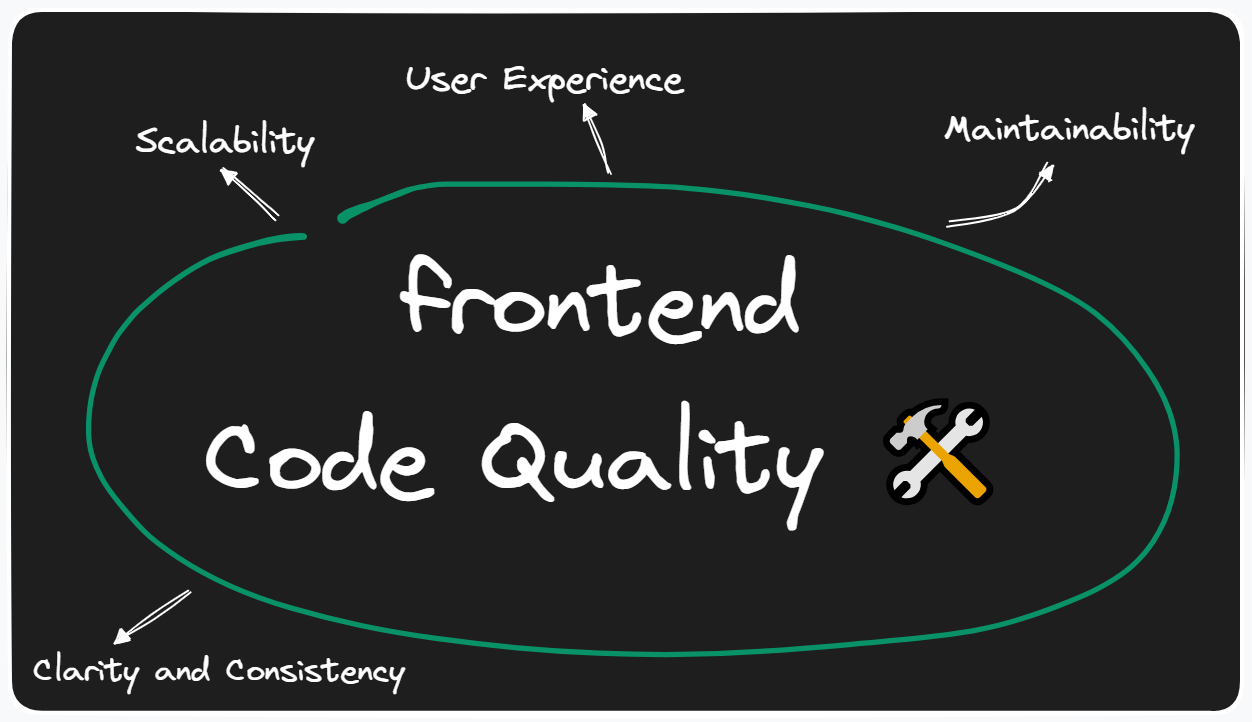
A key principle in software engineering is that quality is not an afterthought but an emergent property of architecture, process, and discipline. In frontend development, code quality directly influences user experience, delivery speed, system reliability, and organizational cost. Unlike early web projects where frontend logic was thin, contemporary frontend applications handle routing, authorization, data orchestration, caching, validation, state synchronization, and complex business workflows.
When frontend quality degrades, teams encounter familiar symptoms: duplicated logic, unpredictable side effects, tightly coupled components, and brittle dependencies. These issues reduce the maintainability index of the codebase and make refactoring risky and expensive. As demonstrated by projects operating at scale, frontend quality failures often become the bottleneck long before backend or infrastructure limitations appear.
Ensuring frontend quality therefore requires a deliberate framework that combines technical standards, architectural boundaries, measurement mechanisms, and team practices. This framework must be enforceable, scalable, and aligned with how developers actually work.
Defining Frontend Code Quality Through Engineering Attributes
Frontend quality is not a single metric but a combination of attributes that collectively determine the health of a codebase. Leading architects suggest evaluating frontend quality through the following core dimensions.
Maintainability is the ability to modify code safely and efficiently. High maintainability implies low cognitive load, predictable structure, and clear ownership of logic. A maintainable frontend codebase enables developers to implement changes without fear of unintended regressions.
Modularity refers to how well the system is decomposed into independent units. High-quality frontend systems exhibit strong cohesion within modules and loose coupling between them. Modularity reduces blast radius when changes occur and enables parallel development.
Readability and clarity ensure that code communicates intent. Frontend code is read far more often than it is written. Clear naming, consistent patterns, and explicit boundaries are quality multipliers, especially in multi-team environments.
Testability measures how easily behavior can be verified through automated tests. Code that is tightly coupled to frameworks, global state, or side effects is inherently harder to test and therefore more error-prone.
Scalability, in the frontend context, means structural scalability rather than raw performance. The system should gracefully accommodate new features, pages, and teams without structural decay.
Together, these attributes form the conceptual foundation of frontend quality. Architecture exists to protect them.
Measuring Frontend Quality With Metrics and Static Analysis
Quality cannot be improved if it is not measured. Modern frontend teams rely on a combination of qualitative reviews and quantitative metrics to assess code quality over time.
The maintainability index, adapted from classic software quality research, remains a useful high-level signal. While not perfect, it correlates strongly with code complexity, duplication, and readability. A declining maintainability index is often an early warning sign of architectural erosion.
Cyclomatic complexity helps identify functions and components that are doing too much. Excessive branching in frontend logic often indicates missing abstractions or misplaced responsibilities.
Code duplication metrics highlight areas where business rules or UI behavior are copied instead of shared. Duplication increases the cost of change and introduces subtle inconsistencies.
Static analysis tools such as ESLint, TypeScript, and modern code scanners enforce baseline standards automatically. Linters detect unsafe patterns, unreachable code, and violations of architectural rules. Type systems reduce entire classes of runtime errors and clarify contracts between modules.
However, metrics alone are insufficient. They must be interpreted in architectural context. A complex component in isolation may be acceptable if it is correctly placed and encapsulated. This is where a structural framework becomes essential.
Establishing Quality Gates Through CI and Automation
Ensuring frontend quality at scale requires automation. Manual enforcement does not scale with team size or deployment frequency. Quality gates integrated into CI pipelines act as guardrails that prevent regressions from entering the codebase.
A robust frontend quality gate typically includes linting, type checking, unit testing, and architectural validation. Each gate addresses a different aspect of quality and together they form a layered defense system.
Linting ensures stylistic consistency and prevents known anti-patterns. Type checking validates contracts and data flow. Unit and integration tests verify behavior. Architectural rules ensure that dependencies follow intended boundaries.
Feature-Sliced Design strongly emphasizes automated architectural enforcement. By defining allowed dependency directions between layers, teams can codify rules such as “features cannot depend on pages” or “entities cannot import from widgets.” These constraints are machine-verifiable and eliminate an entire category of architectural drift.
When quality gates are fast, reliable, and consistently enforced, they enable teams to move quickly without sacrificing frontend quality. Speed and quality cease to be opposing forces.
Improving Frontend Quality Through Team Standards and Culture
Tools and architecture alone cannot guarantee quality. Sustainable frontend quality emerges from a culture of shared standards, continuous learning, and disciplined collaboration.
Code reviews play a central role. Effective reviews focus on architecture, boundaries, and clarity rather than superficial style issues. Reviewers should ask whether code belongs in its current layer, whether responsibilities are well-defined, and whether public APIs are minimal and explicit.
Documentation is another critical pillar. A documented architectural methodology such as Feature-Sliced Design reduces ambiguity and aligns mental models across the team. Clear documentation lowers onboarding time and increases confidence when making changes.
Consistency across projects is particularly important in organizations with multiple frontend teams. When teams share a common structural language, developers can move between codebases without relearning fundamental concepts. This consistency directly improves productivity and reduces error rates.
Leadership also matters. Tech leads and architects must model quality-oriented behavior and defend architectural integrity under delivery pressure. Quality frameworks fail when short-term speed is allowed to bypass long-term structure.
Balancing Delivery Speed and Frontend Quality
One of the most persistent myths in software engineering is that quality slows development. In reality, unstructured development slows down over time, while structured development accelerates.
Early in a project, ad hoc approaches may feel faster because they avoid upfront decisions. However, as features accumulate, the absence of structure leads to exponential complexity. Refactoring becomes dangerous, onboarding slows, and bug rates increase.
A framework for frontend quality does not eliminate flexibility. Instead, it channels change through well-defined paths. Feature-Sliced Design, for example, allows teams to add new features without touching unrelated code. This isolation reduces coordination costs and enables safe iteration.
The goal is not perfection but sustainability. High frontend quality means that change remains affordable months and years into a project’s lifecycle.
Common Architectural Approaches and Their Impact on Frontend Quality
To understand why a structured framework is necessary, it is useful to examine common frontend architectural patterns and how they influence quality.
Layered Architectures: MVC, MVP, and MVVM
Layered architectures organize code by technical role. Models handle data, views render UI, and controllers or view-models coordinate behavior. This separation of concerns improves clarity in small to medium projects.
However, layered architectures often struggle with frontend scalability. As applications grow, controllers and view-models accumulate responsibilities and become tightly coupled to multiple features. Business logic leaks across layers, reducing cohesion.
From a quality perspective, layered architectures provide a good starting point but lack sufficient granularity for large-scale frontend systems.
Component-Based Architecture and Atomic Design
Component-based architecture is foundational to modern frontend development. Breaking UI into reusable components improves consistency and reduces duplication. Atomic Design adds a vocabulary for organizing UI elements by complexity.
While component-based approaches excel at UI composition, they do not address business logic placement or data ownership. Without additional structure, logic ends up scattered across components, hooks, and services, degrading maintainability.
Component-based design improves frontend quality at the presentation level but requires complementary patterns to scale effectively.
Domain-Driven Design in the Frontend
Domain-Driven Design shifts focus from technical layers to business domains. Organizing code around bounded contexts improves alignment with business logic and reduces accidental coupling.
Applied to frontend development, DDD encourages grouping UI, logic, and data related to a domain feature. This improves cohesion but can be difficult to standardize across teams without a clear structural convention.
Frontend DDD improves conceptual quality but benefits from a concrete filesystem and dependency model.
Micro-Frontends
Micro-frontends address organizational scalability by splitting a frontend into independently deployable units. This approach enables team autonomy and parallel delivery.
From a quality standpoint, micro-frontends reduce local complexity but increase system-level complexity. Integration overhead, shared state management, and consistency enforcement become significant challenges.
Micro-frontends are effective for very large organizations but are often unnecessary for medium-scale projects.
Feature-Sliced Design as a Framework for Frontend Quality

Feature-Sliced Design combines lessons from component-based architecture, Domain-Driven Design, and layered principles into a cohesive frontend quality framework. Its core idea is simple: structure code by business relevance and scope, not by technical type alone.
FSD defines a fixed set of layers with strict dependency rules. The app layer initializes the system. Pages represent routed screens. Widgets compose reusable page sections. Features encapsulate user interactions and business scenarios. Entities represent core domain models. Shared contains reusable, business-agnostic code.
This layered structure enforces modularity and clarity. Each slice within a layer exposes a public API that defines how other parts of the system may interact with it. Internal implementation details remain private, protecting invariants.
Unidirectional dependency flow is a cornerstone of FSD. Higher layers may depend on lower layers, but never the reverse. This rule prevents circular dependencies and stabilizes the architecture over time.
As demonstrated by projects using FSD, these constraints significantly improve maintainability index, reduce refactoring risk, and make code reviews more objective.
Making Frontend Quality Tangible With Structure and Examples
A framework must be concrete to be effective. Consider a simplified directory structure following Feature-Sliced Design principles.
The entities layer contains domain models such as user or product. Each entity slice includes its model, API, and related UI primitives. Features build on entities to implement interactions like authentication or cart management. Widgets combine multiple features into cohesive UI blocks. Pages assemble widgets and handle routing concerns.
This structure answers critical questions instantly. Where does logic belong? What can import what? Where should a new feature be added? By eliminating ambiguity, the framework reduces decision fatigue and error rates.
Pseudo-code examples further illustrate quality boundaries. A feature imports from entities and shared utilities but never directly from pages. A widget coordinates features without reimplementing business logic. These rules are simple, memorable, and enforceable.
Frontend Quality as a Long-Term Investment
High frontend quality is not achieved through a single tool or pattern. It is the result of aligned architecture, measurement, automation, and culture. A framework provides the scaffolding that keeps these elements coherent as systems evolve.
Feature-Sliced Design offers a practical, experience-driven methodology for teams that care about maintainability, scalability, and developer experience. It does not eliminate complexity, but it contains it.
In a landscape where frontend systems increasingly rival backend complexity, investing in a structured quality framework is no longer optional. It is a prerequisite for sustainable development.
Conclusion
Frontend code quality determines how fast teams can move, how safely systems can evolve, and how enjoyable development remains over time. By defining quality through clear attributes, measuring it with meaningful metrics, enforcing it through automation, and supporting it with a strong team culture, organizations can avoid the pitfalls of unstructured growth.
Adopting a structured architecture like Feature-Sliced Design is a long-term investment in both technical excellence and human productivity. It provides a shared language, explicit boundaries, and enforceable rules that keep frontend systems healthy as they scale.
Ready to build scalable and maintainable frontend projects? Dive into the official Feature-Sliced Design Documentation to get started.
Have questions or want to share your experience? Join our active developer community on Website!
Disclaimer: The architectural patterns discussed in this article are based on the Feature-Sliced Design methodology. For detailed implementation guides and the latest updates, please refer to the official documentation. markdown