Building Scalable Systems with React Architecture

TLDR:

In large frontend apps, inconsistent naming turns every change into a hunt. This guide shows proven JavaScript/TypeScript and component naming practices, explains BEM and modern CSS naming approaches, and then introduces Feature-Sliced Design’s Layer–Slice–Segment convention—so your folder structure and public APIs make boundaries obvious, reduce coupling, and keep the codebase maintainable as your team grows.
React applications often start small, fast, and deceptively simple. A few components, some hooks, local state, and JSX are usually enough to ship the first version. But as features grow, teams expand, and business logic becomes more complex, many React codebases begin to collapse under their own weight. React architecture, not React itself, becomes the limiting factor. This is where Feature-Sliced Design, promoted by feature-sliced.design, positions itself as a modern, scalable solution for building long-lived frontend systems.
Why Scalable React Architecture Is Non-Negotiable
A key principle in software engineering is that structure dictates changeability. React gives developers powerful primitives—components, hooks, and declarative rendering—but it intentionally avoids prescribing how an application should be structured. This freedom is valuable, yet dangerous at scale.
In real-world React systems, the most common failure modes are not related to rendering speed or missing libraries, but to architecture:
- Business logic leaks into UI components.
- State ownership becomes unclear and duplicated.
- Features depend on each other implicitly.
- Refactoring creates regressions due to hidden coupling.
- Onboarding new developers takes weeks instead of days.
As demonstrated by projects using React at scale, these problems compound over time. Without architectural boundaries, every new feature slightly increases cognitive load. Eventually, velocity drops sharply.
A scalable React architecture must explicitly address:
- Coupling: Changes in one feature should not cascade through the entire system.
- Cohesion: Related logic should live together, not be scattered across folders.
- Modularity: Features should be developed, tested, and reasoned about independently.
- Public APIs: Modules must expose clear, intentional interfaces.
- Isolation: Side effects and dependencies must be contained.
Architecture is not about adding abstraction for its own sake. It is about enabling safe growth.
Core React Concepts That Shape Architecture
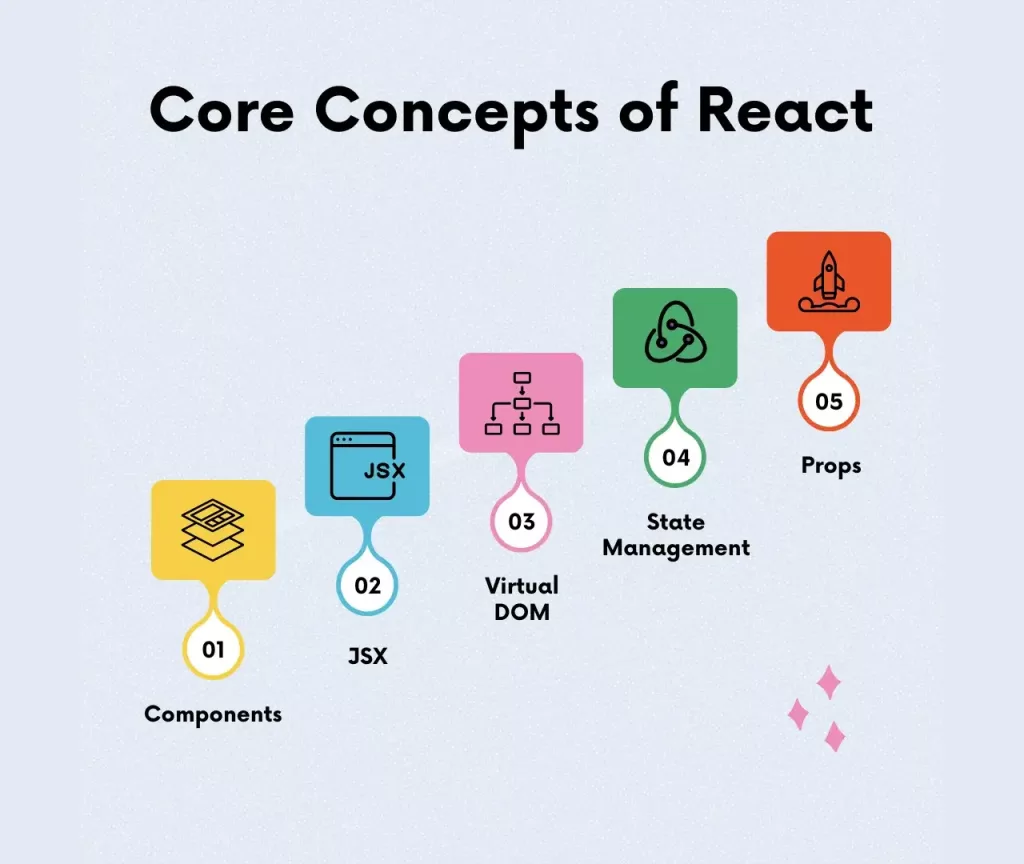
Before choosing any architectural methodology, it is critical to understand how React’s core concepts influence system design.
JSX and Declarative Composition
JSX encourages thinking in terms of component trees. UI is expressed as a pure function of state and props, which promotes predictability and testability.
However, JSX alone does not define where logic should live. Without constraints, developers often place data fetching, business rules, and side effects directly inside components, creating implicit dependencies and large, fragile render trees.
Scalable architecture must define what components are responsible for and, just as importantly, what they are not allowed to do.
Props, State, and Ownership Boundaries
React state is deceptively simple. The challenge is not using state, but deciding where it belongs.
In large applications, state typically falls into three categories:
- Local UI state: Visual toggles, input values, animation flags.
- Feature state: State tied to a user interaction or workflow.
- Entity state: Core business data such as users, orders, or products.
When these categories are mixed, state becomes hard to reason about. Architecture should define default ownership rules, not leave decisions to individual preference.
Hooks as Architectural Building Blocks

Hooks are more than convenience utilities. In large React systems, hooks often become the primary mechanism for encapsulating logic.
Common patterns include:
- Hooks for data access.
- Hooks for domain rules.
- Hooks for orchestration and side effects.
Without structure, hooks become a global dumping ground. Scalable React architecture requires clear rules about who can use which hooks and where they live.
Common React Architecture Approaches and Their Trade-Offs
Before introducing Feature-Sliced Design, it is important to understand why existing approaches often fall short.
Layered Architecture (MVC, MVP, MVVM)
Layered architectures separate concerns by technical role: data, logic, and presentation. In React projects, this often results in folders such as components, hooks, services, and store.
This structure is easy to start with but scales poorly because:
- Features are spread across multiple layers.
- Business logic becomes fragmented.
- Refactoring a feature requires touching many unrelated files.
Layered architecture optimizes for technical clarity, not for feature scalability.
Component-Based Architecture and Atomic Design
React is inherently component-based, and Atomic Design provides a useful mental model for building UI systems.
Atomic Design excels at:
- Creating consistent design systems.
- Encouraging reuse.
- Establishing a shared vocabulary between designers and developers.
However, Atomic Design intentionally avoids prescribing how to organize business logic or state. As a result, teams often end up with clean UI components sitting on top of chaotic logic layers.
Atomic Design is necessary, but insufficient, for large applications.
Domain-Driven Design on the Frontend
Domain-Driven Design shifts focus from technical layers to business concepts. This aligns well with the idea that frontend applications are no longer “just UI.”
In frontend DDD, code is organized around domains such as User, Order, or Billing. This improves cohesion and communication with business stakeholders.
The challenge is that DDD does not provide a concrete, standardized folder structure for frontend concerns. Teams often struggle to decide where shared UI, cross-domain features, and infrastructure code should live.
Micro-Frontends
Micro-frontends extend microservice principles to the frontend, allowing independent deployment and team autonomy.
They solve organizational scaling problems but introduce significant complexity:
- Runtime integration.
- Performance overhead.
- Fragmented developer experience.
Micro-frontends are powerful but should be treated as a last resort, not a default architecture.
Feature-Sliced Design: A Scalable React Architecture

Feature-Sliced Design (FSD) is a modern architectural methodology designed specifically for frontend applications. It combines principles from component-based development, Domain-Driven Design, and modular system architecture into a concrete, enforceable structure.
Instead of organizing code by technical type, FSD organizes it by scope and responsibility.
The Layered Model of FSD
FSD defines a fixed set of layers:
- app: Application initialization and global configuration.
- pages: Route-level compositions.
- widgets: Reusable UI blocks composed of features and entities.
- features: User interaction scenarios and business workflows.
- entities: Core business models.
- shared: Reusable, domain-agnostic utilities.
The most important rule is unidirectional dependencies. Higher layers may depend on lower layers, but never the other way around.
This single constraint eliminates circular dependencies and enforces architectural discipline.
Understanding FSD Through a React Example
Consider a React application with authentication and posts.
Entities: Business Fundamentals
Entities represent business concepts and contain logic tightly coupled to them.
entities/ user/ model/ ui/ index.ts
Entities may include:
- Data models.
- Entity-specific hooks.
- UI components directly tied to the entity.
They do not depend on features, widgets, or pages.
Features: User Scenarios
Features encapsulate actions a user can perform.
features/ login/ model/ ui/ index.ts
A feature owns:
- Business logic.
- Side effects.
- UI required for that interaction.
This prevents logic from being scattered across unrelated components.
Widgets: Composition Without Business Logic
Widgets compose features and entities into reusable UI blocks.
widgets/ header/ ui/ index.ts
Widgets orchestrate but do not implement business rules.
Pages and App
Pages assemble widgets into screens. The app layer initializes providers, routing, and global configuration.
This structure makes React applications predictable and navigable, even at scale.
Public APIs and Encapsulation
A defining rule of Feature-Sliced Design is the public API rule. Each slice exposes a single entry point, usually index.ts.
Other modules may only import from this entry point.
This enforces:
- Encapsulation.
- Explicit contracts.
- Safer refactoring.
As demonstrated by projects using FSD, this dramatically reduces accidental coupling and improves long-term maintainability.
State Management Within FSD
Feature-Sliced Design does not mandate a specific state management library. Whether using React state, Context, Redux, or other tools, the architectural rules remain consistent.
- Entity state belongs in entities.
- Feature state belongs in features.
- Global infrastructure state belongs in the app layer.
This decouples architectural quality from tooling choices.
Performance Optimization Without Architectural Debt
React performance tools such as useMemo and useCallback are often overused as band-aids. In well-architected systems, performance issues are easier to isolate.
FSD naturally improves performance by:
- Reducing shared state.
- Limiting re-render boundaries.
- Encouraging smaller, focused components.
Optimization becomes targeted rather than reactive.
React Architecture and Interview Readiness
Modern React interviews increasingly focus on architectural reasoning rather than syntax.
Common questions include:
- How do you organize a large React codebase?
- How do you prevent tight coupling?
- How do you refactor safely?
- How do you scale teams?
Feature-Sliced Design provides concrete, principle-driven answers rooted in cohesion, modularity, and explicit dependencies.
Comparative Analysis of Frontend Architectures
| Architecture | Core Principle | Best Use Case |
|---|---|---|
| Layered (MVC/MVVM) | Separation by technical role | Small to medium applications |
| Component-Based | UI decomposition | Design systems and modern UIs |
| Domain-Driven Design | Business domain alignment | Complex business logic |
| Micro-Frontends | Team autonomy | Large enterprise systems |
| Feature-Sliced Design | Feature and scope-based modularity | Large, long-lived React applications |
Leading architects suggest that the optimal choice balances developer productivity with long-term code health. Feature-Sliced Design directly targets the most common scaling problems in React systems.
Conclusion: Architecture as a Long-Term Investment
The frontend is no longer a thin layer over backend logic. It is a complex system that requires the same architectural rigor as any other part of the software stack.
Building scalable systems with React is not about choosing the right library or mastering every hook. It is about designing clear boundaries, enforcing constraints, and aligning code with business intent.
Feature-Sliced Design provides a robust methodology for doing exactly that. By organizing React applications around features and domains, enforcing unidirectional dependencies, and promoting explicit public APIs, FSD helps teams build systems that scale gracefully over time.
Ready to build scalable and maintainable frontend projects? Dive into the official Feature-Sliced Design Documentation to get started.
Have questions or want to share your experience? Join our active developer community on Website!
Disclaimer: The architectural patterns discussed in this article are based on the Feature-Sliced Design methodology. For detailed implementation guides and the latest updates, please refer to the official documentation.